
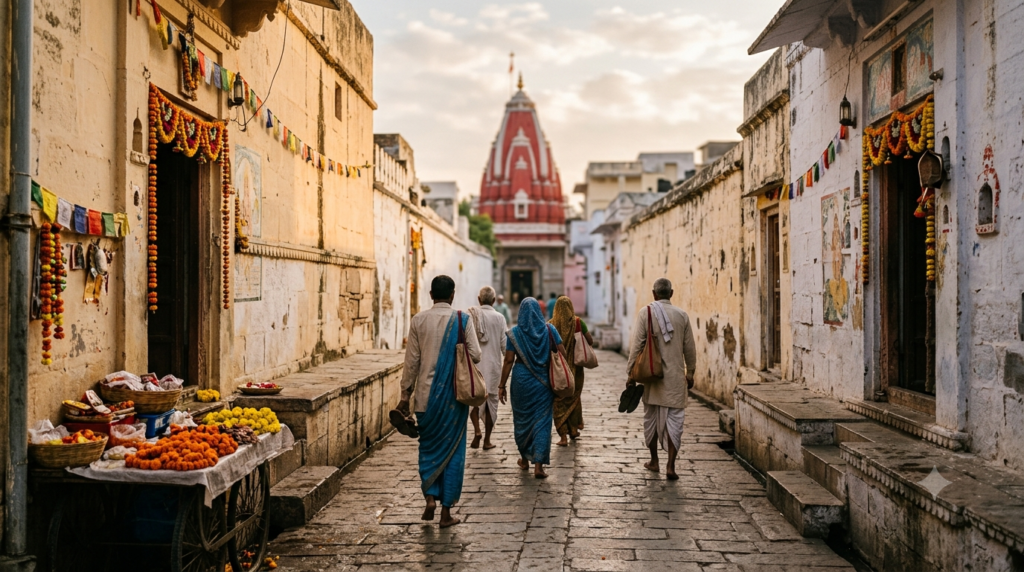
Brahma Temple Pushkar darshan is free, and no website can book it for you. That single fact clears up most of the confusion. Dozens of pages still promise ticket links that lead nowhere.
The Jagatpita Brahma Mandir stands a short walk from Pushkar Lake in Ajmer district, Rajasthan. So the real planning question is simply when to arrive. Below you will find verified Brahma Temple Pushkar darshan timings, the midday closure, and how the aarti clock works. We also cover what happens at the ghats before you reach the gate.
Go Kshetra is an independent pilgrimage guide, not the official temple website. We are not affiliated with the Brahma Temple, its priests, or the Rajasthan government. We accept no bookings, donations, or payments. For official information, use the Rajasthan Tourism page for Brahma Mandir.
Brahma Temple Pushkar Darshan at a Glance
If you only skim one section, make it this one. These are the Brahma Temple Pushkar darshan details that decide whether a visit works or falls flat.
- Entry is free, and there is no ticket counter for ordinary darshan.
- The temple shuts for roughly ninety minutes in the early afternoon.
- Aarti times shift daily because they follow sunrise and sunset, not the clock.
- Footwear comes off well before the steps, so carry a cloth bag.
- Ajmer Junction, about 11 to 14 km away, is the practical railhead.
| Detail | What to expect |
|---|---|
| Location | Brahma Temple Road, Pushkar, Ajmer district, Rajasthan |
| Winter hours | Roughly 6:30 AM to 8:30 PM, with a midday break |
| Summer hours | Roughly 6:00 AM to 9:00 PM, with a midday break |
| Midday closure | Usually about 1:30 PM to 3:00 PM |
| Entry fee | None for darshan; donations stay voluntary |
| Online booking | Does not exist for general darshan |
| Nearest railhead | Ajmer Junction, about 11 to 14 km by road |
| Nearest airport | Kishangarh (KQH), about 30 to 40 km, limited flights |
| Peak season | October to March, especially Kartik Purnima |
Brahma Temple Pushkar Darshan Timings and the Midday Closure
The temple opens around 6:30 AM in winter and around 6:00 AM in summer. Closing follows near 8:30 PM in winter and 9:00 PM in summer. Crucially, it also shuts in the early afternoon, usually between about 1:30 PM and 3:00 PM. Pilgrims arriving from Jaipur after a late start often reach Pushkar inside that window.
Published opening times vary across sources. Some pages still claim a 5:00 AM or 5:30 AM start. We could not confirm that earlier opening on any official Rajasthan Tourism page. Treat 6:00 AM to 6:30 AM as the realistic earliest, because priests set the exact minute seasonally.
Because timings shift with the season and with festival days, confirm locally on the morning you plan to visit. Guesthouse staff in Pushkar track this closely, so a quick question at reception saves a wasted walk.
Why the Aarti Timings Move Every Single Day
Aarti at this shrine does not run on clock time. Instead, the three daily aartis follow sunrise and sunset. That is why fixed times on travel blogs keep going stale. Mangala aarti happens roughly two hours before sunrise, Sandhya aarti about forty minutes after sunset, and the Shayan aarti several hours later at night.
In practice, the evening aarti lands near 6:10 PM in late December. By June it shifts closer to 7:40 PM. If you have travelled specifically for the aarti, check the day’s sunset and add forty minutes. That calculation beats any hard-coded schedule online.
Older guides on this site and elsewhere listed a flat 6:00 AM and 7:00 PM aarti. We have corrected that here, because the sunrise-linked rule is what the temple actually follows.
Entry Fee, Tickets and the Online Booking Myth
There is no entry fee for Brahma Temple Pushkar darshan, and there is no official online booking portal either. Since general entry costs nothing, there is nothing to book. Any site charging you for a Brahma Temple darshan pass is selling something the temple does not issue.
Special pujas and sankalp rituals are a different matter. You arrange those in person with the priests on the day. The dakshina stays a direct negotiation rather than a published rate. Ask the amount before the ritual begins, not afterwards.
Some tour operators do bundle a temple visit into a paid Pushkar walking tour. That fee buys the guide and the transport, though, never Brahma Temple Pushkar darshan itself. The distinction matters because it is exactly where visitors get overcharged.
What to Do If You Arrive and the Temple Is Shut
Brahma Temple Pushkar darshan is not guaranteed on demand, so plan for two failure points. The first is the afternoon closure. The second is Kartik Purnima week, when queues stretch down the lane and movement slows to a crawl.
If you hit the midday break, walk five minutes to the Varaha Temple or the Old Rangji Temple. Both stay accessible for longer stretches. Alternatively, climb toward Savitri Mata Mandir, since the ropeway and hill views fill an hour. Return just before 3:00 PM and you will be near the front when the doors reopen.
During festival crowds, arrive before 7:00 AM instead. Early morning is the only reliable window once the fair season begins, because footfall builds steadily from mid-morning onward.
How to Reach Brahma Temple Pushkar Darshan
By air
The nearest airport is not Jaipur, despite what many guides say. Kishangarh Airport (KQH), which serves Ajmer, sits about 30 to 40 km away and is far closer. However, its schedule is thin, with only a handful of domestic routes such as Ahmedabad, Pune and Nagpur.
Jaipur International Airport (JAI) remains the practical gateway at roughly 145 to 150 km, or three hours by road. Check Kishangarh flight availability first, then fall back to Jaipur if nothing fits your dates.
By train
Ajmer Junction is the main railhead, about 11 to 14 km away by road. The route crosses the Nag Pahar hill. Taxis and shared jeeps run it constantly, and the drive takes 25 to 35 minutes.
Pushkar also has its own small terminus. A branch line reaches it from Ajmer via Madar Junction and Budha Pushkar Halt. Services are sparse, so verify current trains on the IRCTC portal before you rely on one.
By road
State and private buses link Pushkar with Ajmer, Jaipur, Jodhpur and Udaipur. From the Pushkar bus stand it is a walk of roughly one kilometre to the temple through the bazaar lanes.
Drivers should note that the lanes near the shrine bar cars. Park in the designated lots on the approach road, where a small parking charge applies, then continue on foot.
Brahma Temple Pushkar Darshan Dress Code and Photography
Everyone should wear modest clothing covering shoulders and knees. Footwear comes off at a distance from the entrance, and small stalls nearby hold shoes for a few rupees. A cloth bag for your sandals works better, especially during busy hours.
Temple staff restrict photography inside the sanctum, and they enforce it firmly. Exterior shots of the red shikhara and the hamsa motif are generally fine. Leave leather items behind, as at most Rajasthani shrines.
One local rule surprises first-time visitors. Pushkar town itself prohibits meat, eggs and alcohol, so plan your meals accordingly before you arrive.
The Pushkar Passport: What Really Happens at the Ghats
This is the part almost no temple guide mentions, yet it affects nearly every visitor. At the lake ghats, men presenting themselves as priests offer you a flower. They lead you to the water and perform a short blessing. Then they tie a red thread on your wrist, which travellers call the Pushkar passport.
The ritual itself is genuine in origin. The problem is the demand that follows. It frequently runs into thousands of rupees, and groups often get separated so each member pays alone. Reported demands range from a few hundred rupees to well over five thousand.
Protect yourself with three habits. Decline the flower before anyone places it in your hand, since accepting it starts the sequence. Agree any dakshina amount out loud beforehand if you do want the puja. Remember also that nobody can oblige you to pay for a ritual you never requested.
None of this happens inside the Brahma Mandir itself. The shrine takes no fee at the door, so the ghat encounters are a separate matter entirely.
Best Time for Brahma Temple Pushkar Darshan, Plus Kartik Purnima 2026
Plan Brahma Temple Pushkar darshan between October and March for comfortable weather. Daytime temperatures then suit walking between shrines. Summer visits are genuinely punishing. May and June regularly cross 40°C, so the marble underfoot turns scorching by mid-morning.
Kartik Purnima falls on Tuesday, 24 November 2026, according to Drik Panchang. The Purnima tithi itself begins late on 23 November. Reports widely place the Pushkar Fair from about 17 to 24 November 2026, closing on that full moon.
The district administration sets those fair dates, and they can shift by a day or two. So confirm on the Rajasthan Tourism Pushkar page before booking. Visit just before Purnima if you want the atmosphere without the peak crush. Rooms sell out months ahead for that week, and tariffs multiply.
Health and Safety Notes for Pilgrims
The temple approach involves a modest flight of steps, which is manageable for most visitors. Savitri Mata Mandir is the demanding one, with several hundred steps up the hill. A ropeway now serves that climb.
Carry water and a hat between March and September, since heatstroke is a real risk on the exposed lanes. Elderly pilgrims, pregnant visitors and anyone with a heart or knee condition should climb the hill temples only in cool hours. Anyone planning a fast should speak to a doctor first. Ritual bathing and temple prayers are matters of faith and tradition, never substitutes for medical treatment.
Insider Tips for Brahma Temple Pushkar Darshan
- Reach the gate by 6:45 AM and you will often walk straight in without queuing.
- Keep small notes handy, because change is scarce and ATMs empty out during fair week.
- Walk the lake circuit anticlockwise from Gau Ghat, since that side stays quieter.
- Skip mid-afternoon entirely, as the closure plus the heat makes it the worst slot.
- Budget a full hour if you want to sit inside rather than pass through.
One more practical note. The lanes around the shrine flood with rose sellers and touts during Kartik. Yet the same lanes sit almost empty at dawn in February. Timing changes the experience more than anything else you can control.
Nearby Shrines Within Walking Distance
| Site | Distance | Why go |
|---|---|---|
| Pushkar Lake and ghats | Under 300 m | 52 ghats, evening lamp rituals |
| Varaha Temple | About 500 m | Ancient Vishnu shrine, quieter |
| Old Rangji Temple | About 600 m | South Indian style gopuram |
| Gurudwara Singh Sabha | About 500 m | Guru Nanak connection |
| Savitri Mata Mandir | About 2 km | Hilltop views, ropeway access |
Pushkar holds more than 500 shrines in total, though most visitors see only three or four. Because everything sits within a compact grid, a half day on foot covers the essentials. Rare Brahma shrines do exist elsewhere in India. Our guide to the Suchindram Thanumalayan Temple covers one with a dedicated Brahma sanctum.
Before You Go
Brahma Temple Pushkar darshan rewards early risers more than careful planners. There is no ticket, no queue system, and no booking to arrange. Arrive before 7:00 AM, respect the midday closure, and check the day’s sunset if the aarti matters. Decline the flower at the ghats unless you have agreed a price first.
Finally, verify current timings and fair dates on the official Rajasthan Tourism pages, because local authorities decide seasonal changes. Planning a wider North India circuit? Our Chandi Devi Temple guide and our Hindu festival guides cover the next stops many pilgrims add.
Frequently Asked Questions
Is there an entry fee for Brahma Temple Pushkar darshan?
No, entry is completely free, and the temple issues no ticket for general darshan. Donations to the temple hundi stay voluntary. Only special pujas arranged with the priests involve a payment. You agree that amount in person rather than reading it off a list.
Can I book Brahma Temple Pushkar darshan online?
No official online booking exists, because entry is free and unticketed. Websites offering paid darshan passes for this temple are not authorised by it. Any online payment you make is buying a tour service, never temple access.
What are the Brahma Temple Pushkar darshan timings today?
Expect roughly 6:30 AM to 8:30 PM in winter and 6:00 AM to 9:00 PM in summer. A midday closure runs about 1:30 PM to 3:00 PM. Exact minutes shift seasonally and on festival days, so confirm locally on the morning of your visit.
When is Kartik Purnima at Pushkar in 2026?
Kartik Purnima falls on Tuesday, 24 November 2026, with the tithi beginning late on 23 November. Reports place the Pushkar Fair from around 17 November, closing on Purnima. Confirm the final schedule on the Rajasthan Tourism site.
Is photography allowed inside the temple?
Temple staff restrict photography inside the sanctum. Exterior photographs of the red spire and courtyard are usually fine. Follow posted signs and any instruction at the entrance.
What is the Pushkar passport, and must I get one?
It is the red thread tied on your wrist after a ghat-side puja, which signals that you have already paid. It is entirely optional and carries no religious requirement for temple entry. Decline the offered flower if you would rather skip it.
How long does a visit take?
Thirty minutes covers Brahma Temple Pushkar darshan alone on a normal weekday morning. Add an hour if you plan to sit for the aarti. Allow half a day if you also walk the lake ghats and nearby shrines. Festival days can easily double any estimate.
Is there a dress code for Brahma Temple Pushkar darshan?
Wear modest clothing covering shoulders and knees, and remove footwear before the steps. Leave leather belts and bags behind. The temple mandates no specific colour or traditional garment.