
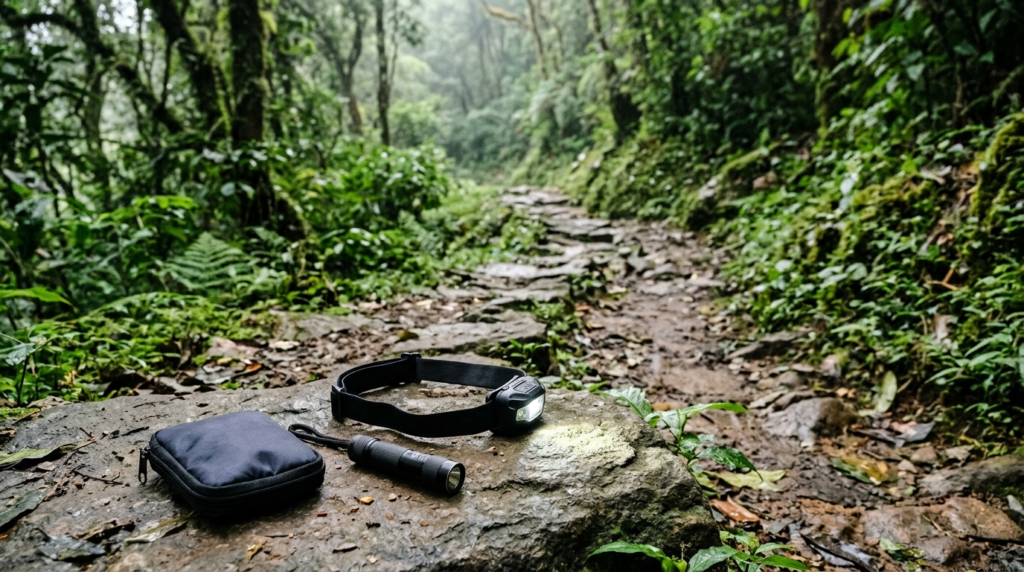
A Sabarimala headlamp should help you see the next safe step, not just throw a bright beam into the distance. For the uphill walk from Pamba, choose comfortable hands-free lighting with a useful close-range beam, reliable power and a separate backup. The best choice is the one you can operate calmly in rain and a moving crowd.
Independent-guide notice: Gokshetra is not the official Sabarimala Temple or Travancore Devaswom Board website. We are not affiliated with them and accept no bookings, rentals, payments or donations. Follow current instructions from authorised temple and police staff.
Sabarimala headlamp: the quick decision
- Choose a broad, even beam for the ground ahead; a mixed flood-and-spot beam adds distance when needed.
- Prioritise an easy switch, adjustable tilt and a secure strap over a headline brightness figure.
- Check real battery run time at the setting you plan to use, not only at the lowest setting.
- Carry an independent backup light and protect both lights from moisture.
- Never assume a headlamp is mandatory, permitted in every temple area or available for rent.
- Use only the approved walking route, and follow staff guidance if conditions change.
The key distinction is between useful trek lighting and official permission. A lamp can help with ordinary walking, yet its design and brightness do not grant entry through security checks. Likewise, a published pilgrim guide does not establish a compulsory torch specification.
Why a light matters on the Sabarimala climb
Kerala Tourism describes a roughly 5 km uphill walk from Pamba to Sannidhanam through forested hill terrain. That is a physical climb, not a short stroll across a flat courtyard. Lighting needs can change with the hour, cloud cover, rain and the conditions of the path.
A Sabarimala headlamp can free your hands while you pay attention to footing. However, it cannot make slippery steps safe or replace an authorised route. Other pilgrims, railings and queue movement also limit where you should point the beam.
Plan the full journey, including the return, before choosing a light. Gokshetra’s Sabarimala pilgrimage guide covers the broader route, traditions and darshan planning. This page stays focused on visibility, power and lighting failure.
Which Sabarimala headlamp beam works best?
For normal walking, start with a wide beam that lights the ground just ahead. A mixed beam can then add reach when the route opens up. A narrow spotlight alone may reveal distant objects while leaving your immediate footing hard to judge, so beam shape matters more than sheer brightness.
Petzl’s technical guide describes wide light for nearby vision and a mixed beam for trekking. It treats focused light as the distance option. This is equipment guidance, not a rule issued for Sabarimala.
| Beam type | Best use | Potential drawback |
|---|---|---|
| Wide or flood | Checking steps and nearby ground | Less reach into the distance |
| Narrow or spot | Looking farther ahead when safe | Can leave the edges too dark |
| Mixed or adjustable | Changing between close and far views | May need a little practice |
A broad patch of usable light often beats a dazzling centre point on an uneven path. Test that difference on safe steps at home. If the edges vanish whenever you look down, the light may not suit your pace.
Point the lamp down, not into other faces
A Sabarimala headlamp follows your head, so turning to speak can shine straight into someone’s eyes. Aim it at the surface ahead and select a lower setting in busy queues. When you need to look at another pilgrim, tilt the housing down or switch to a gentler mode.
Check side vision too. A strong central spot can make the surroundings seem darker by contrast. If you must scan a direction, pause at a safe place rather than swinging a powerful beam across moving people.
Sabarimala headlamp brightness and runtime
Sabarimala headlamp brightness figures describe light output, but they do not tell the whole story. Beam shape, usable distance, the selected setting and battery condition affect what you see. A high maximum output is less valuable if the lamp soon dims or drains its battery.
REI’s headlamp guide explains the difference between lumens, beam distance and run time. Check the manufacturer’s details for the exact model because runtime labels and testing methods may differ. Compare the setting you would actually walk with.
For a Sabarimala headlamp, a steady low or medium mode is often more practical than constant maximum output. Save a stronger setting for a brief check where staff directions and other walkers allow it. There is no verified official Sabarimala minimum-lumen requirement in the public guidance reviewed here.
Check battery life at your walking setting
A Sabarimala headlamp package may highlight its longest run time, yet that figure may refer to a dim setting. Look for a chart showing how the light behaves at each mode. Check whether output gradually fades or stays steady before a low-battery warning.
Then make a conservative plan for your own outing. You may face delays, a longer return or a sudden change in conditions. A reserve matters because even a lamp with a healthy battery can fail after a wet or accidental knock.
Sabarimala headlamp batteries: rechargeable or replaceable?
Both battery systems can work for a Sabarimala headlamp. Rechargeable models reduce repeated cell purchases, while replaceable-battery lamps can be simpler to refresh away from a socket. Neither option removes the need for a backup because charging access and spare-cell compatibility can become problems during travel.
| Power option | Practical advantage | Prepare for |
|---|---|---|
| Built-in rechargeable | Charge before departure | Low charge or cable failure |
| Replaceable cells | Swap a compatible spare set | Wrong size or drained cells |
| Hybrid design | May accept more than one power source | Model-specific compatibility rules |
If your Sabarimala headlamp is rechargeable, top up before leaving your accommodation and carry its working cable. A power bank can help on the journey, but do not assume a charging point exists on the trek. Never rely on charging while walking in rain.
If you use replaceable cells, bring a fresh compatible set in a protective case. Follow the lamp maker’s instructions about battery types and mixing cells. Do not put loose batteries beside keys or other metal objects.
Keep one light separate from the other
A Sabarimala headlamp and spare torch stored together in one wet pocket share the same risk. Put the backup in a separate, secure, water-resistant pouch. Keep it accessible enough to reach at a safe stop, not buried beneath clothes and offerings.
For groups, each person who depends on their own light should know where their reserve sits. One bright torch held by a companion may not illuminate everyone’s footing. Agree on how to stop together before a light fails.
Headlamp, hand torch or phone flashlight?
A Sabarimala headlamp is useful when you want both hands free. A handheld torch gives you direct control over where the beam points, but occupies one hand. A phone flashlight may help briefly, yet it competes with the charge needed for travel details and communication.
For a Sabarimala headlamp setup, pairing the main lamp with a small separate torch is a sensible fallback. This reduces the chance that one dead battery or faulty switch leaves you without light. The pair must still be light enough to carry safely.
The official Sabarimala do’s and don’ts restrict mobile-phone use inside temple premises. Therefore, do not plan on a phone torch as your only lighting method near the shrine. See Gokshetra’s mobile-phone rules guide for that separate issue.
Sabarimala headlamp fit and rain resistance
A Sabarimala headlamp may face rain, spray and sweat. Check the maker’s stated water resistance rather than assuming every outdoor-looking lamp is waterproof. A rating tells you about tested resistance, not permanent protection against every wet condition.
A Sabarimala headlamp needs a comfortable strap that stays in place when you look down. The lamp should tilt without sliding across your forehead. Try it with the clothing or head covering you plan to wear, while keeping your devotional practices and local instructions in mind.
A loose strap can let the beam bounce on steps. However, overtightening may cause discomfort during a long climb. Practise changing modes with the same hand position you will use while walking, and learn the button lock if your model has one.
Rainwear can block your beam
A hood may cast a shadow across your Sabarimala headlamp or slip in front of your eyes. Put on your full rain layer and test the lighting from several head angles. Adjust the hood so it never hides steps or narrows your side vision.
Our Sabarimala raincoat guide explains fit, ventilation and rain protection for belongings. Keep the lamp’s power connections dry, and wipe the lens with a clean cloth if water distorts its beam. Do not make repairs on a moving path.
Is a Sabarimala headlamp allowed near the shrine?
The official public instructions reviewed do not specify a blanket headlamp permission, prohibition or required model for every Sabarimala area. They do require pilgrims to follow security checks and staff directions. Therefore, equipment advice cannot promise that you may wear or carry a light through any particular checkpoint or queue.
Ask authorised Travancore Devaswom Board or police personnel about your Sabarimala headlamp if you are unsure. Explain that you have a headlamp and a backup torch, then follow the answer for that location. Do not equate normal trekking use with permission inside the temple precincts.
No current authorised headlamp-rental counter, deposit arrangement, required brightness rating or charging station was verified in those instructions. Do not make your plan depend on a supposed service at Pamba or Sannidhanam. Official notices and on-site directions take priority over vendor claims.
If your Sabarimala headlamp fails on the trail
If your Sabarimala headlamp goes dark, stop moving as soon as you can do so safely without blocking others. Tell your companions and use your backup light before trying to fix anything. If visibility remains poor, seek police or route staff guidance instead of walking into an unlit or restricted section.
- Stop and make space. Move only when you can see the path and officials permit it. Do not crouch on a busy step.
- Switch to the independent backup. Use the spare torch you already tested, not an unfamiliar gadget.
- Check the obvious fault. At a safe resting place, inspect the switch, battery indicator and compartment. Follow the manual.
- Protect the group. Tell companions what happened and avoid separating to search for a charger or shop.
- Ask for an authorised next step. If neither light works and visibility is inadequate, delay movement or seek help from police and staff.
There is no guaranteed rescue from poor preparation. A nearby bright patch or another pilgrim’s lamp cannot replace your own safe footing. Nor should you leave an approved route to find a shorter way.
Sabarimala headlamp checklist before departure
- Confirm your pilgrimage date, approved route and current instructions on the official Sabarimala website.
- Test the Sabarimala headlamp on safe steps with a broad beam and a lower brightness setting.
- Check the strap, tilt, switch, button lock, lens and battery compartment for damage.
- Fully charge the main lamp or fit batteries of the type approved by its maker.
- Pack a separate working backup torch and its compatible spare power supply.
- Wear your planned rain layer and confirm that the hood does not hide the beam.
- Agree with your group where to stop and seek help if someone loses light or feels unwell.
- Ask authorised staff about any item restrictions before approaching controlled temple areas.
Keep the lighting kit compact and easy to reach. The climb may already involve essential personal items and an irumudi, the sacred offering bundle. Ask your guru swami about respectful handling, and do not treat it as ordinary storage for electronics.
Small mistakes that make a torch less useful
The first Sabarimala headlamp mistake is shopping by maximum brightness alone. A wide usable beam, secure fit and predictable run time may offer more value on slow, uneven walking. Another is trying the lamp only indoors, where a white wall hides its weak edges.
Some pilgrims also leave a backup switched on inside a bag. Use the button lock or a safe storage method if your model supports one. Check both lights again before leaving Pamba, since packed equipment can shift during travel.
A final mistake is trusting that rain protection also protects visibility. Water on the lens, a hood shadow and glare from nearby surfaces can still make steps difficult to judge. Slow down, keep the beam low and respect the pace of the queue.
Health, crowd and route safety
A Sabarimala headlamp does not remove the strain of a hill climb. People with significant heart, lung, balance or mobility conditions should seek medical advice before a strenuous pilgrimage. Carry prescribed medicines and ask for official help if you develop chest pain, severe breathlessness, dizziness or injury.
The official general instructions advise rest during the ascent and cooperation with police and security staff. Follow designated paths, keep waste out of the forest and do not shine bright light into other pilgrims’ eyes. If weather or crowd controls stop movement, wait for authorised directions.
Before you begin the climb
Choose a Sabarimala headlamp for the steps you need to see, not the biggest claim on a product box. A comfortable mixed or wide beam, honest battery planning and a separate torch provide a more practical setup. Test it with your rainwear, then follow the route and checkpoint instructions that apply on the day.
Above all, treat safety and official permission as different questions. A light helps only when you use it with care, and it never overrides staff directions.
Frequently asked questions
Do I need a headlamp for Sabarimala?
A Sabarimala headlamp can help when the path is dark, but the reviewed official guidance does not establish a universal requirement to bring one. Decide based on your travel plan and expected visibility. Follow current instructions rather than claims that a particular torch is compulsory.
How bright should a Sabarimala headlamp be?
No verified official minimum-lumen specification was found in the public Sabarimala guidance reviewed here. Choose enough light to see nearby steps without dazzling others. Also check beam quality, run time and the lower modes, since a maximum figure tells only part of the story.
Is a flood or spot beam better for trekking?
A flood beam lights nearby ground, while a spot beam reaches farther ahead. A mixed or adjustable beam offers both options. For crowded steps and slower walking, start with broad light angled downward and use extra reach only where appropriate.
Can I take a rechargeable torch to Sabarimala?
A rechargeable Sabarimala headlamp may suit ordinary travel, but carrying it through each controlled temple area needs current staff confirmation. Charge it before departure and pack a separate backup. Do not assume that public charging points will be available along your route.
Are headlamps allowed inside Sabarimala Temple?
The reviewed public instructions do not state a blanket headlamp permission or ban covering every temple area. Security checks and on-site directions control what may proceed. Ask authorised personnel before the relevant checkpoint, and do not rely on a product advertisement as proof of entry.
Can I rent a headlamp or torch at Pamba?
No current authorised headlamp rental counter, fee or operating schedule was verified from the official sources reviewed. Bring your own tested lighting if your plan requires it. Any claim about a rental service should be checked with authorised staff before you depend on it.
Is my mobile phone flashlight enough?
A phone flashlight may help briefly, but it uses power you might need for communication. The official Sabarimala guidance also restricts mobile-phone use inside temple premises. A Sabarimala headlamp and separate backup are more dependable for low-light walking, subject to on-site rules.
What if my headlamp stops working in rain?
If your Sabarimala headlamp fails, stop safely and switch to a separately protected backup light. Check the damaged lamp only at a safe resting place. If visibility remains inadequate, ask police or route staff for help and do not continue along an unfamiliar or closed path.
Should I use my headlamp throughout the darshan queue?
Not automatically. A bright Sabarimala headlamp can disturb people nearby, and temple-area instructions may differ from ordinary trek conditions. Reduce or switch off the light when it is no longer needed and follow the directions at each checkpoint.