
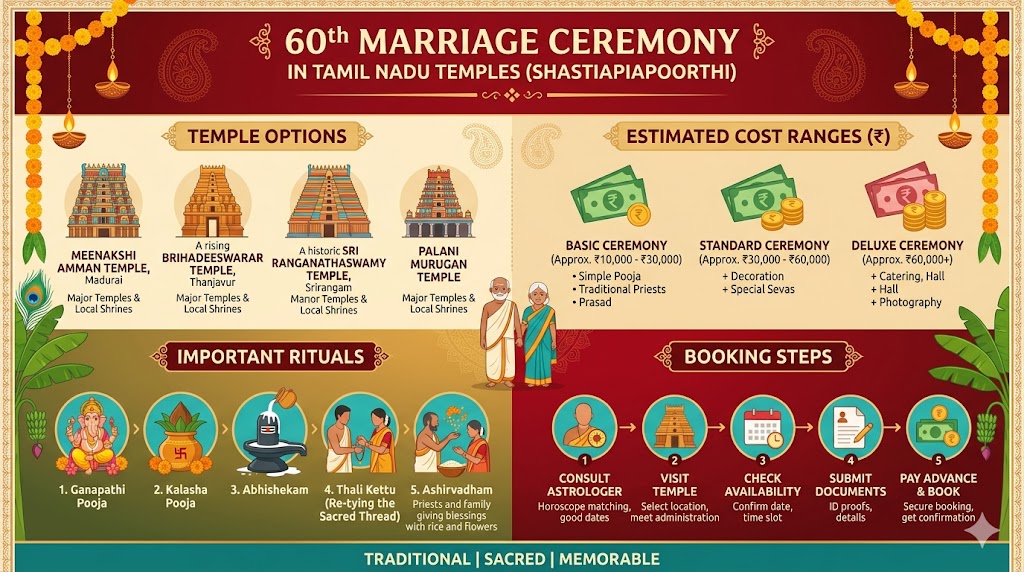
Getting married at the Meenakshi Amman Temple in Madurai is a dream for countless Hindu couples who seek divine blessings for their union. This ancient and magnificent temple, dedicated to Goddess Meenakshi and Lord Sundareswarar, is one of the most sacred marriage venues in South India. The temple’s connection to the divine wedding of Goddess Meenakshi and Lord Shiva makes it an especially auspicious place for couples to begin their married life. This comprehensive guide covers everything you need to know about the Meenakshi Amman Temple marriage procedure, costs, required documents, booking process, hall options, and rules for 2026.
Significance of Marriage at Meenakshi Amman Temple
The Meenakshi Amman Temple in Madurai holds profound spiritual significance for marriages. According to Hindu mythology, it was here that the divine wedding (Thirukalyanam) of Goddess Meenakshi (an incarnation of Goddess Parvati) and Lord Sundareswarar (Lord Shiva) took place. This celestial marriage is celebrated every year during the grand Chithirai Thiruvizha festival, which attracts millions of devotees from around the world.
Couples who choose to marry at this temple believe that performing their wedding at the very site of the divine marriage brings special blessings, prosperity, and a harmonious married life. The tradition of conducting weddings at the Meenakshi Amman Temple has been followed for centuries, and thousands of couples tie the knot here every year. The spiritual energy of the temple, the presence of the ancient deities, and the traditional Vedic rituals conducted by experienced temple priests create a sacred and unforgettable wedding experience.
Beyond the religious significance, the temple’s architectural grandeur with its towering gopurams, intricately carved pillars, and sacred mandapams provides a majestic backdrop for the wedding ceremony. Many families consider a Meenakshi Temple wedding to be a matter of great pride and devotion, making it one of the most sought-after temple wedding destinations in India.
Eligibility Criteria for Temple Marriage
Before applying for a marriage at Meenakshi Amman Temple, couples must ensure they meet the following eligibility requirements as per the temple administration and Indian law.
- Religion: Both the bride and groom must be Hindu. The temple marriage ceremony is conducted according to Hindu Vedic traditions.
- Legal Age: The groom must be at least 21 years of age and the bride must be at least 18 years of age at the time of marriage, as per the Indian legal marriage age requirements.
- Marital Status: Both parties must be legally eligible to marry. This means they must be unmarried, or if previously married, must provide legal documentation of divorce or death of the former spouse.
- Consent: The marriage must be with the free consent of both parties. Forced marriages are not permitted.
- No Prohibited Relationships: The couple must not fall within prohibited degrees of relationship as defined under the Hindu Marriage Act, 1955.
Required Documents for Meenakshi Temple Marriage
Gathering the correct documents in advance is crucial for a smooth marriage booking and ceremony. The following documents are typically required by the temple administration.
For Both Bride and Groom
- Government-issued photo ID proof (Aadhaar card, voter ID, passport, or driving licence)
- Age proof (birth certificate, school leaving certificate, or Aadhaar card showing date of birth)
- Passport-sized photographs (4 to 6 copies each)
- Address proof (Aadhaar card, ration card, or utility bill)
- Community certificate (if applicable, to confirm Hindu religion)
Additional Documents
- Horoscope of both bride and groom (for traditional matching, though not mandatory for the temple booking)
- Written consent from parents or guardians (particularly if either party is below 25 years of age)
- Divorce decree (if either party was previously married and divorced)
- Death certificate of former spouse (if either party is a widow or widower)
- Marriage invitation card (one copy for temple records)
- Affidavit on stamp paper declaring that the marriage is being performed with free consent and both parties are legally eligible
Important: All documents should be original with at least two sets of photocopies. The temple office may verify originals and retain copies for their records. It is advisable to carry extra copies to avoid any last-minute inconvenience.
Step-by-Step Marriage Booking Procedure at Meenakshi Amman Temple
The booking process for a marriage at Meenakshi Amman Temple involves several steps. Planning well in advance and following each step carefully will ensure a smooth experience.
Step 1: Choose Your Marriage Date
Select an auspicious date (muhurtham) for the marriage based on the horoscopes of the bride and groom. Consult with your family priest or an astrologer to determine the most favorable dates and times. Keep in mind that certain periods like Aadi month, Margazhi month, and Pitru Paksha are traditionally considered inauspicious for weddings. Popular months for temple weddings include Thai (January-February), Panguni (March-April), Vaikasi (May-June), and Aippasi (October-November).
Step 2: Visit the Temple Administration Office
Visit the Meenakshi Amman Temple administrative office in person to check the availability of your preferred date and wedding hall. The office is located within the temple complex, and the staff will guide you through the booking formalities. While some preliminary inquiries can be made by phone, the actual booking typically requires an in-person visit.
Step 3: Submit the Application Form
Obtain the marriage application form from the temple office. Fill it out completely with details of both the bride and groom, the desired date and time (muhurtham), preferred hall, number of expected guests, and any special requirements. Attach the required documents as listed above.
Step 4: Pay the Booking Fee and Deposits
Once your application is reviewed and the date is confirmed, you will need to pay the booking fee and any applicable deposits. Payment can be made in cash, demand draft, or through available digital payment methods. A receipt will be issued, which you must carry on the day of the wedding.
Step 5: Confirm Priest and Ritual Details
The temple will assign a priest (Vadhyar) for the marriage ceremony. You can discuss the specific rituals, duration of the ceremony, and any special poojas you wish to include. The standard marriage ceremony at the temple follows traditional Tamil Hindu Vedic rites, but families can request specific traditions based on their community practices.
Step 6: Final Confirmation
A few days before the wedding, visit or call the temple office to reconfirm all arrangements including the hall, priest, timing, and any additional services. This final confirmation helps avoid any misunderstandings or last-minute issues on the wedding day.
Marriage Cost Breakdown at Meenakshi Amman Temple
The cost of conducting a marriage at Meenakshi Amman Temple is quite reasonable compared to commercial wedding venues. The temple administration has structured the fees to make temple weddings accessible to families of all economic backgrounds. Below is a detailed cost breakdown.
| Item / Service | Approximate Cost (2026) | Remarks |
|---|---|---|
| Basic Marriage Booking Fee | Rs. 1,000 – Rs. 2,500 | Non-refundable, covers administrative processing |
| Mandapam / Hall Charges (Basic Hall) | Rs. 2,000 – Rs. 5,000 | For 2-3 hours usage during the ceremony |
| Mandapam / Hall Charges (Premium Hall) | Rs. 5,000 – Rs. 15,000 | Larger halls with better facilities, extended usage |
| Priest Fee (Temple Vadhyar) | Rs. 2,000 – Rs. 5,000 | Covers the entire marriage ceremony rituals |
| Special Pooja (Ganapathi Homam, etc.) | Rs. 500 – Rs. 2,000 per pooja | Optional, based on family preference |
| Navagraha Pooja | Rs. 500 – Rs. 1,500 | Optional but commonly performed |
| Decoration Charges (Basic) | Rs. 3,000 – Rs. 8,000 | Flower decoration for the mandapam |
| Decoration Charges (Premium) | Rs. 8,000 – Rs. 20,000 | Elaborate floral and traditional decorations |
| Electricity and Lighting Charges | Rs. 500 – Rs. 2,000 | Varies based on hall and equipment used |
| Prasadam for Guests | Rs. 1,000 – Rs. 5,000 | Depending on quantity and type of prasadam ordered |
| Security Deposit (Refundable) | Rs. 2,000 – Rs. 5,000 | Refunded after the event if no damages |
| Total Estimated Cost | Rs. 10,000 – Rs. 50,000+ | Varies based on hall choice and services selected |
Note: The costs mentioned above are approximate and may vary based on the specific hall chosen, the day of the week (weekends and auspicious dates may have higher charges), season, and any additional services requested. The temple administration may revise rates periodically. Always confirm the exact costs at the time of booking. Dakshina (honorarium) for the priest beyond the official fee is customary but at the discretion of the family.
Wedding Hall Options at Meenakshi Amman Temple
Meenakshi Amman Temple offers several mandapam (hall) options for conducting marriages, each with different capacities, features, and price points.
Meenakshi Nayakkar Mandapam
This is one of the historic and prestigious mandapams within the temple complex. Known for its architectural beauty and traditional ambiance, it is a preferred choice for families who want a truly authentic temple wedding experience. The hall can accommodate a moderate number of guests and is often booked well in advance for auspicious dates.
Thirukalyana Mandapam
Specifically designed for wedding ceremonies, this mandapam is named after the divine wedding (Thirukalyanam) of Goddess Meenakshi and Lord Sundareswarar. Conducting a wedding here carries special significance, as devotees believe the divine couple blesses marriages performed in this sacred space. The hall has adequate seating capacity and basic amenities for a traditional wedding ceremony.
Vasantha Mandapam
The Vasantha Mandapam is a larger hall option suitable for weddings with a higher guest count. It offers more space for seating arrangements, decoration, and movement of guests. This mandapam is popular among families planning bigger wedding celebrations while still maintaining the temple wedding atmosphere.
General Mandapam
For families looking for the most affordable option, the temple provides general mandapam facilities where basic wedding ceremonies can be conducted at minimal cost. While the space may be simpler, the religious sanctity and rituals remain the same, making it a great choice for families who prioritize devotion over grandeur.
The availability of specific mandapams depends on the date, time slot, and current temple schedules. It is advisable to express your hall preference during the initial booking inquiry and be flexible with alternatives in case your first choice is unavailable.
Priest Arrangements and Rituals
The marriage ceremony at Meenakshi Amman Temple is conducted by qualified Shaivite Vedic priests who are well-versed in traditional Tamil Hindu marriage rituals. Here is what you can expect regarding the priest and ritual arrangements.
Temple-Appointed Priest
The temple administration assigns an experienced priest for each wedding ceremony. The temple priests are traditionally trained in Shaiva Agama rituals and conduct the ceremony according to established protocols. They are proficient in Tamil and Sanskrit mantras and can explain the significance of each ritual to the couple and family members.
External Priest
In some cases, families may be permitted to bring their own family priest to conduct the ceremony, subject to the approval of the temple administration. If you wish to have your own Vadhyar conduct the marriage, this should be discussed and approved during the booking process. The temple may still require a temple priest to be present in a supervisory capacity.
Key Rituals in the Marriage Ceremony
- Ganapathi Pooja: The ceremony begins with prayers to Lord Ganesha, seeking the removal of obstacles.
- Nandi Pooja: Prayers to invite the divine energies and ancestral blessings.
- Kasi Yatra: A traditional ritual where the groom pretends to leave for Kasi (Varanasi), and the bride’s father persuades him to stay and marry his daughter.
- Kanyadaanam: The formal giving away of the bride by her parents to the groom.
- Mangalya Dharanam: The tying of the Mangalsutra (Thali) by the groom around the bride’s neck, the most important moment of the ceremony.
- Saptapadi: The seven sacred steps taken by the couple around the holy fire, each step representing a vow.
- Homam (Sacred Fire Ritual): Offerings made into the sacred fire while Vedic mantras are chanted.
- Blessings: The ceremony concludes with the couple seeking blessings from the deity, elders, and guests.
The complete marriage ceremony typically lasts 2 to 3 hours, depending on the specific rituals performed and any additional poojas requested by the family.
Timings for Temple Marriages
Marriages at Meenakshi Amman Temple are conducted during specific time slots that align with the temple’s daily schedule and do not interfere with regular poojas and darshan timings.
- Morning Slot: 5:00 AM to 10:00 AM – This is the most popular slot as most muhurthams fall during early morning hours. The early morning ambiance of the temple adds to the spiritual experience.
- Midday Slot: 10:00 AM to 12:00 noon – Available for muhurthams that fall during this period. This slot allows for a comfortable start for guests.
- Evening Slot: 4:00 PM to 7:00 PM – Less common for traditional weddings but available for families with evening muhurthams.
The exact timing of the ceremony must align with the muhurtham specified in the couple’s horoscopes. The temple office will confirm the availability of the hall for your specific time requirement during the booking process. Families are usually asked to arrive at least 30 to 60 minutes before the muhurtham time to complete setup and preparatory rituals.
Dress Code for Temple Marriage
Meenakshi Amman Temple has a traditional dress code that must be followed by all participants in the wedding ceremony.
For the Groom
- Traditional veshti (dhoti) and angavastram (upper cloth) is the standard attire
- Silk veshti (Kanjivaram or Dharmavaram) is preferred for the wedding ceremony
- Bare-chested or with a thin upper cloth during the ritual portion is traditional
- Western suits and trousers are not permitted during the actual ceremony within the temple
- Footwear must be removed inside the temple premises
For the Bride
- Traditional silk saree (Kanjivaram saree is the most popular choice) is the standard attire
- The saree should be draped in the traditional South Indian style
- Bridal jewelry including traditional pieces like jimiki, oddiyanam, and mattal add to the occasion
- Modest dressing that covers shoulders and legs is required within the temple premises
For Guests
- Men should wear traditional veshti or formal pants with a shirt. Shorts, bermudas, and sleeveless tops are not allowed inside the temple.
- Women should wear sarees, salwar kameez, or other traditional and modest clothing.
- All guests must remove footwear before entering the temple premises.
Photography and Videography Rules
Capturing the wedding moments at such a prestigious venue is important for every family. However, Meenakshi Amman Temple has specific rules regarding photography and videography that must be followed.
- Official Permission: Photography and videography inside the temple premises require prior permission from the temple administration. Obtain the necessary permits during the booking process.
- Photography Fee: A separate fee may be charged for professional photography and videography within the temple. This fee is in addition to the marriage booking charges.
- Restricted Areas: Certain sanctum areas may have restrictions on photography. The temple staff will guide your photographer on permitted zones.
- Equipment Restrictions: Drones, tripods, and elaborate lighting setups are generally not permitted inside the temple. Flash photography may also be restricted in certain areas.
- Photographer Access: Professional photographers must carry their identity cards and the permission letter issued by the temple office. The number of photographers allowed at any given time may be limited.
- Mobile Phones: Casual photography using mobile phones is generally permitted in the mandapam area but not inside the inner sanctum.
It is advisable to discuss photography arrangements in detail with the temple office during booking and brief your photographer about the temple rules well in advance.
Reception and Post-Ceremony Options
After the temple marriage ceremony, families often wish to host a reception for a larger number of guests. Here are the options available in and around the temple area.
Temple Mandapam Extension
If the mandapam is available for an extended duration, families can continue using the space for a small reception immediately after the ceremony. This works best for intimate gatherings with a limited guest list. Additional charges apply for extended usage.
Nearby Marriage Halls and Hotels
Madurai has numerous marriage halls and banquet facilities in close proximity to the Meenakshi Amman Temple. Many of these halls cater specifically to temple wedding families and offer packages that include catering, decoration, and music. Popular areas for marriage halls near the temple include the streets around the temple’s four tower gates, the Tallakulam area, and along the major roads leading to the temple.
Hotel Banquet Halls
Several hotels in Madurai ranging from budget to premium offer banquet halls for wedding receptions. Hotels near the temple like those on West Masi Street, Town Hall Road, and Bypass Road provide convenient options where guests can attend both the temple ceremony and the reception without much travel.
Catering at the Temple
For a simple post-ceremony meal, the temple area has several vegetarian caterers who specialize in traditional Tamil Nadu wedding meals served on banana leaves. These caterers are experienced in serving large groups and provide authentic South Indian wedding cuisine including sambar rice, variety rice, poriyal, kootu, payasam, and other traditional dishes.
Tips for Planning a Meenakshi Temple Marriage
- Book well in advance: Auspicious dates fill up quickly, especially during the wedding season months. Book at least 2 to 3 months in advance for your preferred date and hall.
- Visit the temple beforehand: If possible, visit the temple and the specific mandapam before confirming your booking. This helps you visualize the setup and plan logistics like guest seating, decoration placement, and photographer positions.
- Coordinate with the temple priest early: Meet or speak with the assigned priest before the wedding day to discuss rituals, your family traditions, and any specific requirements. This ensures the ceremony flows smoothly.
- Arrange accommodation for guests: Madurai has hotels and lodges at various price points near the temple. Book accommodation for outstation guests in advance, especially during peak wedding season.
- Plan for the weather: Madurai can be very hot during summer months (March to June). If your wedding is during this period, ensure guests have access to shade, water, and fans. Winter months (November to January) offer more pleasant weather.
- Keep the guest list manageable: Temple mandapams have limited capacity. Plan your guest list according to the hall’s capacity and keep a separate, larger guest list for the reception if needed.
- Carry extra copies of all documents: Have multiple copies of all required documents, booking receipts, and confirmations to avoid any administrative issues on the wedding day.
- Arrange transportation: Plan how guests will reach the temple, especially for early morning muhurthams. Pre-arranged buses or cars are helpful, particularly for elderly guests.
- Respect temple rules: Follow all temple regulations regarding dress code, noise levels, and conduct. Remember that the temple is a place of worship first, and your wedding is one of many activities happening simultaneously.
Marriage Registration
Conducting a wedding at Meenakshi Amman Temple gives the ceremony religious validity, but legal registration of the marriage is a separate process that must be completed for the marriage to be recognized under Indian law.
- The marriage should be registered at the local Sub-Registrar office under the Hindu Marriage Act, 1955.
- Registration can be done at the Sub-Registrar office in Madurai if both parties are present, or at the Sub-Registrar office of the bride’s or groom’s place of residence.
- Documents required for registration include the marriage invitation, photographs from the wedding ceremony, priest’s certificate, ID proofs, and witness signatures (typically two witnesses are required).
- Registration should ideally be completed within one month of the marriage ceremony.
- The temple may provide a marriage certificate or a priest’s certificate confirming the ceremony, which serves as supporting documentation for legal registration.
Frequently Asked Questions about Meenakshi Amman Temple Marriage
How far in advance should I book my marriage at Meenakshi Amman Temple, and what if my preferred date is not available?
It is recommended to book your marriage at Meenakshi Amman Temple at least 2 to 3 months in advance, and even earlier (4 to 6 months) if your preferred date falls during the peak wedding season (April-June and November-February) or on a particularly auspicious date. Popular muhurtham dates, especially those that are considered universally auspicious in the Tamil almanac, get booked very quickly. To book, visit the temple administration office in person with your required documents and preferred dates. If your first-choice date is unavailable, the office staff will suggest alternative available dates close to your preference. Having two or three backup dates ready when you visit for booking is a practical approach. In some cases, different mandapams may have different availability for the same date, so being flexible about the hall can also help secure your preferred date. Weekday weddings generally have better availability compared to weekends and public holidays.
Can a couple from outside Madurai or from another state get married at Meenakshi Amman Temple, and are there any special requirements?
Yes, couples from anywhere in India and even from abroad can get married at Meenakshi Amman Temple, as long as both the bride and groom are Hindu and meet the legal eligibility criteria. There are no residency requirements restricting the marriage to Madurai residents. The same booking procedure and document requirements apply to all couples regardless of their place of origin. However, couples from outside Madurai should plan additional logistics including travel and accommodation for themselves and their guests, local transportation arrangements, and coordination with the temple office which may require in-person visits. NRI (Non-Resident Indian) couples may need to provide additional documentation such as passport copies, visa details, and foreign address proof. It is advisable for outstation couples to designate a local contact person in Madurai who can handle in-person visits to the temple office and manage on-ground coordination in the weeks leading up to the wedding. Many travel agents and wedding planners in Madurai specialize in arranging temple weddings for outstation clients and can handle much of the logistics on your behalf.
What is the total cost of a simple marriage at Meenakshi Amman Temple, and can financially weaker families get any concessions?
A simple marriage at Meenakshi Amman Temple can be conducted for as little as Rs. 10,000 to Rs. 15,000 including the basic booking fee, basic mandapam charges, priest fee, and minimal decoration. This makes temple weddings significantly more affordable compared to commercial wedding venues and banquet halls. The temple administration is sensitive to the financial situations of different families and may offer concessions or reduced rates for economically weaker families on a case-by-case basis. During special occasions and temple anniversary celebrations, the temple trust sometimes organizes mass marriage ceremonies where multiple couples are married simultaneously at minimal or no cost. These mass marriages include basic arrangements like priest services, mangalsutra, and a simple meal. Families who qualify under below-poverty-line categories or can demonstrate financial need may apply for such concessional services through the temple office. Additionally, various charitable trusts and religious organizations associated with the temple periodically sponsor free marriages for underprivileged couples. To avail of such facilities, families should inquire at the temple administration office well in advance and provide relevant documentation proving their eligibility for financial concessions.
Final Words
A marriage at the Meenakshi Amman Temple in Madurai is more than just a wedding ceremony. It is a profound spiritual experience that connects the couple with centuries of divine tradition and the blessings of Goddess Meenakshi and Lord Sundareswarar. With proper planning, advance booking, and adherence to the temple’s procedures and rules, your temple wedding can be a beautiful, sacred, and memorable event that your family will cherish for generations. Whether you opt for a simple, intimate ceremony or a more elaborate celebration, the divine setting of this ancient temple ensures that your marriage begins with the most auspicious and blessed foundation possible.