
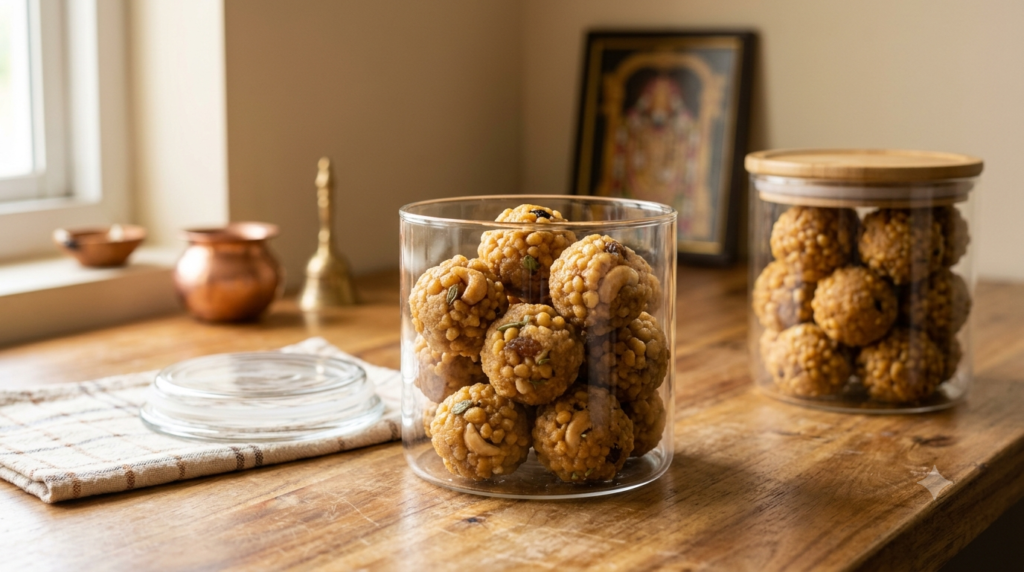
Tirumala laddu storage is safest when you avoid fixed expiry promises and focus on clean, dry handling, sensible temperature control, and early consumption. Tirumala Tirupati Devasthanams (TTD) does not currently publish a simple consumer rule saying every laddu stays safe for a guaranteed number of days. So this guide separates verified facts from popular storage advice that should not be treated as official.
Go Kshetra is an independent pilgrimage guide and is not affiliated with, endorsed by, or the official website of TTD. We do not accept bookings, payments, or donations; use official TTD channels for official information.
Tirumala Laddu Storage at a Glance
For Tirumala laddu storage, the safest answer is simple: there is no current, verified shelf-life figure that applies to every laddu in every home. Storage time can change with the laddu type, moisture, handling, travel conditions, room heat, humidity, and packaging. That is why this refresh removes earlier promises such as “10 to 15 days,” “two weeks in the fridge,” or “three to four weeks frozen.”
- Do not rely on a guaranteed number of days. Eat or share the prasadam reasonably soon after receiving it.
- Do not leave it uncovered for a mandatory 24 hours. No current TTD source reviewed for this update gives that instruction.
- Use a clean, dry, food-grade container. Keep the lid closed and protect the laddu from moisture, heat, pests, and repeated handling.
- Refrigeration can be a practical choice. However, it does not create a verified new expiry date.
- Warming changes texture, not safety. It cannot “reset freshness” or make spoiled prasadam safe again.
- Discard doubtful food. Visible mould, a clearly sour or rancid smell, pest contamination, or unusual wetness are reasons not to eat it.
What Does TTD Actually Say About Tirumala Laddu Shelf Life?
TTD’s current public material confirms strong production and quality controls, but it does not give a current universal home-storage expiry for consumers. In June 2026, TTD reported that it prepares more than four lakh laddus a day and tests raw materials before use. It also said the laddu operation holds an FSSAI licence and follows the traditional Dittam standards. TTD’s June 2026 laddu report lists the regular laddu’s major ingredients and quality-control process.
An older TTD Food Quality Analysis Lab article from 2016 did mention a shelf life of five to seven days for a big laddu made to the stated moisture and ingredient standards. That historical figure is useful context, but it should not be converted into a blanket 2026 guarantee for every laddu, package, journey, or household. Read the original TTD laboratory note.
This distinction matters. A laboratory statement about a particular product standard is not the same as a current consumer expiry label for all laddus. Therefore, this page no longer gives a single “safe for X days” answer where TTD has not published one.
Tirumala Laddu Storage: Safe Step-by-Step Method
Tirumala laddu storage should begin with clean hands, a dry container, and as little unnecessary exposure as possible. The goal is not to “dry” the prasadam for a fixed period. Instead, the goal is to keep it protected from added moisture, heat, dirt, insects, and repeated handling.
- Check the condition when you receive it. If the laddu looks normal and the packing is intact, avoid unnecessary opening during travel.
- Use clean, dry hands or a clean utensil. Moist fingers, wet spoons, and damp containers can add moisture to ready-to-eat food.
- If it is noticeably warm, do not trap steam. Let excess warmth dissipate briefly in a clean, protected place. Do not turn this into a fixed 24-hour uncovered drying rule.
- Move it to a clean, dry, food-grade container if needed. A well-fitting lid helps protect against humidity, dust, insects, and fridge odours.
- Choose a cool location. Keep the container away from direct sun, a hot vehicle, a stove, steam, or other heat sources.
- Refrigerate when conditions justify it. If your home is hot or humid, or you are not eating the laddu promptly, refrigeration is a reasonable precaution.
- Take out only what you plan to serve. Repeated opening, handling, warming, and chilling add avoidable exposure.
If you refrigerate the prasadam, keep it covered. Food Safety and Standards Authority of India (FSSAI) storage guidance says refrigerated food should be covered and cold food should be held at about 5°C or below. That is general food-safety guidance, not a Tirumala-laddu shelf-life guarantee. See the FSSAI food-handling guidance.
Room Temperature, Fridge or Freezer?
There is no verified current table that gives Tirumala laddu storage a fixed safe number of days under each method. So the useful comparison is not “how many guaranteed days do I gain?” It is “which method reduces exposure under my conditions?”
| Storage method | When it may make sense | What you should know |
|---|---|---|
| Cool, dry room | Short-term storage in mild conditions | Keep covered and away from heat, sunlight, steam, and pests. No guaranteed duration is stated here. |
| Refrigerator | Hot or humid weather, or when you will not eat it promptly | Use a clean covered container. Refrigeration may change texture, and it does not create a verified new expiry date. |
| Freezer | Not recommended here as a routine preservation claim | TTD guidance reviewed for this update does not provide a verified freezer duration for consumers. Texture may also change. |
For most devotees, the practical choice is to avoid keeping prasadam longer than necessary. Share it with family or fellow devotees while it is still in good condition. If you need to hold it beyond your normal short-term use, cold storage is more cautious than making an unsupported room-temperature promise.
Why the Old “Air-Dry for 24 Hours” Rule Was Removed
The previous Tirumala laddu storage advice told readers to leave the prasadam uncovered for a full day. It also called that step “not optional.” We could not verify that instruction in current TTD consumer guidance, so it should not be presented as a mandatory safety rule.
Extended uncovered storage can also expose ready-to-eat food to dust, insects, kitchen aerosols, and handling. If a laddu is still warm, the useful principle is simply to avoid trapping visible steam or condensation. Let it cool briefly in a clean, protected setting, then cover it.
There is also no evidence that a fixed drying period creates a predictable new shelf life. Moisture level is only one factor in food stability. Recipe, handling, packaging, temperature, contamination, and storage conditions matter too.
Tirumala Laddu Storage After a Long Journey
Tirumala laddu storage after a train, bus, car, or flight should start with inspection, not a “freshness reset.” A long journey may expose the prasadam to heat and repeated temperature changes. No home step can turn that elapsed travel time back to zero.
During travel, keep the laddu shaded and protected from crushing. Avoid leaving it in a sun-heated vehicle or beside hot luggage compartments when you can reasonably prevent that. A rigid outer container can protect the shape, while the food itself should remain clean and covered.
After reaching home, inspect the laddu and packaging. If everything looks normal, place the prasadam in a clean, dry container and choose room or refrigerated storage based on your conditions. Do not steam it, dry it for another day, or assume refrigeration restores the time already spent in transit.
If you are planning the wider pilgrimage, Go Kshetra’s Tirupati Tirumala guide collects darshan, travel, laddu, room, and seva references in one place.
Can Refrigeration Make Tirumala Laddu Last Longer?
For Tirumala laddu storage, refrigeration is a sensible option in hot or humid conditions because cold can slow many forms of food deterioration. However, this article does not attach a guaranteed number of extra days to that choice. TTD has not published a current consumer statement that lets us safely promise “two weeks” or any other fixed refrigerated life.
Use a clean, covered container because the refrigerator is not a sterile space. Covering also limits odour pickup and accidental contact with other foods. FSSAI guidance for refrigerated storage stresses clean conditions, proper covering, and cold temperatures.
When serving a chilled laddu, you may let the portion you plan to eat lose its chill for texture. That step may soften ghee-rich sweets, but it is not a food-safety treatment. Once again, warming does not reset age or reverse spoilage.
Do Not Use “Freshness Reset” Tricks
Old advice on this page suggested that air-drying after travel could “reset the freshness clock.” It also recommended steaming or brief microwaving to revive a hardened laddu. Those statements blurred two different things: texture and safety.
Gentle warming can change texture because fats soften as temperature rises. Yet a softer laddu is not automatically a safer laddu. Heating for a few seconds also does not remove every possible spoilage hazard, so do not use warmth as a rescue test for questionable prasadam.
- Do not steam an old laddu to “bring it back.” Added moisture can make storage less predictable.
- Do not microwave a doubtful laddu and assume it is safe afterward.
- Do not restart your day count after refrigeration, freezing, drying, or reheating.
- Do not rely on texture alone. A hard laddu may simply be cold or dry, while spoiled food may not always look dramatic.
How to Tell When You Should Discard the Laddu
There is no home test that can prove a stored laddu is safe. However, obvious spoilage or contamination signs are enough reason to discard it. Religious significance should never pressure you to eat food that appears unsafe.
- Visible mould or fuzzy growth: discard the laddu rather than cutting around the affected part.
- Clearly sour, fermented, stale-oil, or rancid odour: do not taste it to confirm.
- Unusual wet, slimy, leaking, or discoloured patches: treat unexplained changes cautiously.
- Pest exposure: discard food touched by ants, cockroaches, rodents, or other pests.
- Dirty or wet container: contamination risk rises when ready-to-eat food contacts unclean surfaces.
- Unknown age plus doubtful condition: when you cannot judge how long it has been held or how it travelled, caution is the better choice.
Do not taste questionable food just to test it. If a family member is elderly, pregnant, immunocompromised, or has a medical condition that increases foodborne-illness risk, use extra caution with any stored ready-to-eat food.
Serving and Sharing Prasadam Without Adding Moisture
Many Tirumala laddus are shared among several people, so serving habits affect storage. Use clean, dry hands when breaking a fresh piece, or use a clean dry utensil. Then close the main container instead of leaving it open through the entire gathering.
Do not return handled pieces to the storage box. Saliva, damp fingers, or food residue from another dish can contaminate what remains. If you plan to distribute portions over several visits, separate smaller portions before serving the first batch.
This approach also reduces repeated temperature cycling. You can take one portion from the refrigerator while leaving the rest covered and cold. That is more practical than warming and chilling the whole batch several times.
Common Tirumala Laddu Storage Myths
Tirumala laddu storage advice spreads quickly through family groups, travel forums, and old blog posts. Some tips sound precise because they include exact hours or day counts, but precision is not the same as verification.
Myth: Every Tirumala laddu lasts 10 to 15 days
No current TTD source reviewed for this refresh supports a universal 10-to-15-day consumer guarantee. A 2016 TTD laboratory note discussed five to seven days for a big laddu under stated production conditions. That historical figure should not be stretched into a blanket promise for all current laddus.
Myth: You must air-dry the laddu for exactly 24 hours
No current official instruction reviewed here requires a 24-hour uncovered drying period. If the laddu is warm, allow trapped heat to dissipate briefly in a clean protected place. Then store it covered rather than leaving ready-to-eat food exposed all day.
Myth: The fridge gives you a guaranteed two weeks
Refrigeration may slow deterioration, but the storage result depends on the starting condition, handling, temperature, and packaging. Therefore, this guide does not promise a fixed refrigerated life.
Myth: Reheating makes an old laddu fresh again
Warming can soften texture and release aroma, yet it cannot turn old food into newly made food. It also cannot be used as proof that questionable prasadam is safe.
What to Remember Before You Store Tirumala Laddu
The best Tirumala laddu storage advice is deliberately less dramatic than the old version. Keep the prasadam clean, dry, covered, and away from heat. Refrigerate when your conditions make that the more cautious choice, but do not attach an invented expiry date to the fridge.
Most importantly, do not use fixed 24-hour drying, steaming, microwaving, freezing, or refrigeration as a “freshness reset.” TTD’s current quality-control information is strong, but a current universal consumer shelf life remains unverified. When the laddu looks or smells wrong, discard it rather than trying to rescue it.
Frequently Asked Questions
How long does Tirumala laddu stay fresh?
There is no current verified TTD consumer shelf-life figure that this guide can safely apply to every laddu. TTD published a five-to-seven-day statement for a big laddu in a 2016 laboratory article, but that old product-specific context is not a universal modern guarantee. Storage conditions and handling also vary.
Does TTD publish an expiry date for Tirumala laddu?
The current TTD public sources reviewed for this refresh explain ingredients, production, licensing, testing, and distribution, but they do not give a simple universal home-storage expiry. If TTD later publishes packaging-specific instructions, follow those instructions over general blog advice.
Should Tirumala laddu be kept in the fridge?
You can refrigerate it when your home is hot or humid, or when you will not eat it promptly. Keep it in a clean covered container. FSSAI guidance uses about 5°C or below for cold food, but that general rule does not establish a Tirumala-laddu expiry period.
Should I air-dry Tirumala laddu for 24 hours?
No verified current TTD guidance reviewed here requires a mandatory 24-hour drying period. If the laddu is warm, let excess heat dissipate briefly in a clean protected setting. Then store it covered so it is not exposed to dust, pests, or kitchen contamination.
Can I freeze Tirumala laddu?
Freezing may change the texture of a ghee-rich sweet, and TTD guidance reviewed for this update does not provide a verified consumer freezer duration. Because the safe shelf life is unverified, this article does not recommend a “three to four week” freezing promise.
Can I warm a hard laddu to make it fresh again?
You may let a chilled portion warm naturally for better texture if the laddu is otherwise in good condition. However, warming only changes texture. It does not reset freshness, reverse spoilage, or prove that an old laddu is safe.
How should I store Tirumala laddu after a long trip?
Inspect it when you arrive, then keep it in a clean, dry, covered container. If your home is hot or humid, refrigeration is the more cautious option. Do not leave it uncovered for a day or assume any storage step restarts the time already spent in transit.
What are the clearest signs that I should throw it away?
Discard the laddu if you see mould, pest contamination, unexplained wet or slimy patches, or if it has a clearly sour or rancid smell. Do not taste doubtful food just to test it. When the age and storage history are uncertain, caution is sensible.