
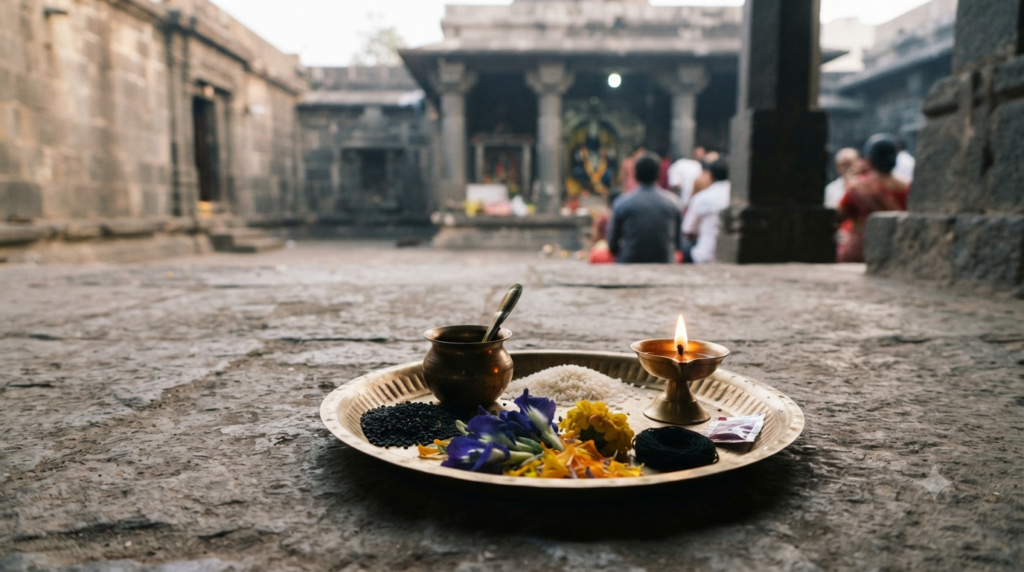
Shani Shingnapur Temple Pooja is best planned from the Devasthan’s own worship instructions, not from old booking pages or third-party puja sellers. The current official guidance gives a specific pooja-item list and a 14-step worship sequence. It also warns that Shri Shaneshwar Devasthan has not authorised online worship-service apps or websites, so devotees should perform pooja and oil abhishek at the temple premises.
Go Kshetra is an independent pilgrimage guide. We are not affiliated with Shri Shaneshwar Devasthan, and we do not take pooja bookings, donations, or payments. Therefore, confirm all worship arrangements directly with the Devasthan through shanidev.com or at the temple.
Shani Shingnapur Temple Pooja at a Glance
The most useful current point is simple: Shani Shingnapur Temple Pooja does not require an elaborate shopping list. The Devasthan’s pooja-item page says devotees may use any two or four items from its published list. That makes a small, simple offering fully consistent with the temple’s own guidance.
| Planning point | Current verified guidance | Source |
|---|---|---|
| Temple hours | 4:00 AM to 10:30 PM | Shri Shaneshwar Devasthan |
| Aarti | 4:30 AM, 12:00 PM, and sunset | Shri Shaneshwar Devasthan |
| Online worship booking | Devasthan warns it has not authorised online worship-service apps or websites | Official homepage alert |
| Pooja items | Official page lists the items and allows any two or four | Official Puja Item List |
| Pooja order | Devasthan publishes a 14-step sequence | Official Pooja Procedure |
| Current pooja fee | Official worship pages checked do not list a current fee table | Confirm at temple office |
Old travel pages often blur darshan, special pooja, oil abhishek and private online services into one booking process. The official material does not support that approach. Treat each ritual as an on-site temple matter unless the Devasthan itself publishes a new official facility.
Shani Shingnapur Temple Pooja Items List
The official pooja-item list is broader than the usual “oil and black sesame” advice. However, the same page allows devotees to use any two or four of the listed items. Therefore, devotees do not need to buy every item or an expensive bundled pooja kit.
- Rice
- Black til, or black sesame seeds
- Black string
- Flowers and leaves, with the official page specifically mentioning black flowers
- Incense sticks
- Lamp or diya
- Mustard oil
- Sweets for offering
- Seasonal or summer fruits
- Leaves of the rui plant
- Camphor
- Shani Dev photo or yantra
- Black urad
- Clove
- Cardamom
- Pan and supari
- Ganga water or other holy water
- Coconut
- Iron horseshoe
The official English page also contains one awkwardly translated item described as “packets made from oil.” Its meaning is not clear enough to turn into practical buying advice. Rather than guessing, confirm that item with temple staff if it becomes relevant.
Which pooja items are the simplest to carry?
For a light and practical offering, black til, mustard oil, flowers and a diya are easy to manage. You can reduce the list further because the Devasthan lets devotees choose just two or four items. Follow temple staff instructions before opening, pouring or placing any item near the worship area.
That distinction matters on crowded Saturdays because outside sellers may offer large trays or fixed packages. A large package is not shown as mandatory on the official item page. Buy only what you intend to offer and avoid assuming that a higher-priced kit gives special access.
Shani Shingnapur Temple Pooja Procedure
The Shani Shingnapur Temple Pooja sequence has 14 published steps. It begins with taking the worship posture and ends with namaskara. The sequence below preserves the official order while explaining the Sanskrit terms in plain English, so devotees can understand what each step represents.
- Aasanam Samarpayanami: take the worship posture or seat.
- Padya Samarpayanami: offer water to the feet of Lord Shani.
- Ardhya Samarpayanami: offer or pour water.
- Aachamaniya Samarpayanami: the official page describes this as drinking water for achamana.
- Snanam Samarpayanami: offer water for the ritual bath.
- Vasram Samarpayanami: offer black cloth.
- Gandham Samarpayanami: make the fragrant offering; the official English text mentions camphor and incense.
- Pushpamalam Samarpayanami: offer a flower garland.
- Dhupam Samarpayanami: light incense.
- Deepam Samarpayanami: light the lamp.
- Akshatam Samarpayanami: offer rice.
- Naivedyam Samarpayanami: offer black til according to the Devasthan page.
- Dakshinam Samarpayanami: offer dakshina where applicable.
- Namaskaram Karomi: conclude with namaskara.
This is the Devasthan’s published worship sequence, but it is not a promise that every visitor will physically perform every step in the same location. Crowd controls, ritual arrangements and staff directions can change. When you reach the temple, follow the instructions given by the Devasthan team at the worship area.
Do you have to perform all 14 steps yourself?
No official page checked says every visitor must personally perform all 14 steps. The published sequence explains the order of Shani pooja. In practice, the exact level of participation can depend on the worship arrangement available that day, so staff guidance should take priority over a blog checklist.
Oil Abhishek, Jap and Havan Options
Oil abhishek is one of the best-known forms of worship at Shani Shingnapur. The Devasthan’s abhishek page also refers to sankalp using the devotee’s name and gotra. It describes two mantra-jap options of 23,000 and 92,000 repetitions, with hawan linked to one-tenth of the jap count.
Those figures come from the official abhishek information page, but the page does not provide a current public price list for those arrangements. Therefore, this guide does not attach an old rupee amount to them. Confirm the available option, time, procedure and fee directly at the temple office before paying.
These practices belong to religious and astrological tradition. Devotees may perform them as acts of faith, but do not treat them as guaranteed cures for illness, debt, legal problems or other life outcomes. Medical conditions still require qualified medical care.
Shani Shingnapur Temple Pooja Booking Rules
The most important booking correction is that the Devasthan currently warns against fake online worship services. Its homepage states that it has not given permission to any online worship-service app or website. It tells devotees to come to Shani Shingnapur and perform pooja and oil abhishek at the temple premises.
This warning is stronger than simply saying “online booking may not be available.” Therefore, do not treat a third-party page as official merely because it uses the temple name, photos or devotional language.
Can Shani Shingnapur pooja be booked online?
Do not rely on a third-party online pooja booking claim. The Devasthan’s current alert says no online worship-service app or website has its permission. For pooja or oil abhishek, use the temple premises and confirm arrangements with the Devasthan itself.
The official website does have an online donation link, but donation and pooja booking are different services. A genuine donation facility does not make an unrelated puja seller an authorised temple agent.
What if a website says it will perform the pooja on your behalf?
Check whether that service clearly states that it is independent and not authorised by Shri Shaneshwar Devasthan. More importantly, do not describe it as a temple booking. The Devasthan’s own warning says it will not be responsible for fraud involving online puja apps or websites.
Current Temple Timings and Aarti
The Shri Shaneshwar Devasthan homepage currently lists temple opening hours from 4:00 AM to 10:30 PM. It lists the first aarti at 4:30 AM, the second at 12:00 PM, and the third at sunset. These current official hours replace the old 24-hour claim on this page.
Because the third aarti follows sunset, its clock time changes through the year. Arrive early enough to clear queues and follow the day’s on-site instructions. On Saturdays and major observance days, allow extra time rather than planning around a tight onward journey.
The official website also lists prasadam hours separately, so do not confuse dining or prasadam timings with temple opening hours. For a broader look at Shani Shingnapur content on this site, use the Shani Shingnapur guides category.
How Much Does Shani Shingnapur Temple Pooja Cost?
Shani Shingnapur Temple Pooja fees should come from a current Devasthan source. The official worship pages checked for this refresh do not verify a current universal pooja fee. Therefore, this refresh removes the old article’s approximate ₹500-and-above figure. Do not publish a changing fee as fact unless the Devasthan itself currently lists it.
When you arrive, ask the official temple office or designated Devasthan counter what arrangements are available and what they cost that day. If someone outside the official process quotes a package price, do not assume it is a temple fee. Never pay a private person merely because they promise faster darshan or special access.
What to Do If Your Preferred Pooja Is Unavailable
The Devasthan does not guarantee a special pooja outcome because availability can depend on the day’s temple arrangements, crowd level and ritual schedule. If the worship option you expected is unavailable, do not switch automatically to a private agent. First ask the Devasthan office what official alternatives exist.
- Choose normal darshan if special worship is not available at that time.
- Use a simple offering from the Devasthan’s published item list rather than buying an unverified package.
- Ask the temple office whether the desired abhishek, jap or other arrangement is available later that day or on another date.
- If temple staff offer no official alternative, plan a return visit instead of paying an unauthorised online or roadside service.
This fallback is less glamorous than many booking pages promise, but it is safer. It also keeps the distinction clear between temple-administered worship and private devotional services that may operate independently.
Old Claims This Refresh Removes
The previous version mixed useful ritual information with claims that no longer pass an official-source check. The biggest problem was the booking section, which suggested online token generation through official or authorised partners. That wording conflicts with the Devasthan’s present warning about unauthorised online worship-service sites.
- Old claim: temple open 24 hours. Current Devasthan homepage lists 4:00 AM to 10:30 PM.
- Old claim: special pooja or VIP arrangements are around ₹500 and above. Current official worship pages do not support that figure, so this refresh removes it.
- Old claim: use an authorised online partner for darshan or pooja tokens. The Devasthan warns that no online worship-service app or website has its permission.
- Old procedure: nine condensed steps. The official Devasthan page publishes a 14-step pooja sequence.
The older page also linked to a site describing itself as a temple visitor resource, but that site now carries its own disclaimer saying it is unofficial. For official worship information, this refresh uses shanidev.com and the Devasthan pages hosted there.
Practical Tips Before You Visit
Keep the worship plan simple. Since the official list allows two or four items, you can avoid carrying a large tray. A small set is easier to manage in a queue, especially when crowds fill the complex.
Check the official site shortly before travel because timings and operational rules can change. Once at the temple, follow current signs and staff instructions even if they differ from an older blog or video. Rules displayed on site are more useful than a screenshot saved months earlier.
Use only official Devasthan channels for temple-related payments. Do not share identity documents, birth details or payment information with a website simply because it claims to arrange Shani Shingnapur worship. If your purpose is only general darshan, do not let a seller persuade you that an expensive kit or private pooja package is compulsory.
Shani Shingnapur Temple Pooja: Before You Go
The clearest way to plan Shani Shingnapur Temple Pooja is to separate verified temple practice from commercial claims. Bring a few simple offerings, understand the 14-step order, and confirm the day’s actual pooja arrangements on site. Most importantly, do not mistake a third-party online puja seller for Shri Shaneshwar Devasthan.
The official source for this guide is Shri Shaneshwar Devasthan Shanishingnapur, including its Puja Item List, Pooja Procedure and Abhishek Procedure. Check those pages again before your journey because operational details can change.
Frequently Asked Questions
What items are needed for Shani Shingnapur Temple Pooja?
The official list includes black til, rice, black string, flowers, incense, lamp, mustard oil, sweets, fruit, rui leaves, camphor, black urad, clove, cardamom, pan-supari, holy water, coconut and an iron horseshoe. The Devasthan says devotees may use any two or four listed items.
Is online pooja booking available through the temple?
The Devasthan currently warns that it has not authorised any online worship-service app or website. It directs devotees to perform pooja and oil abhishek at the temple premises. Treat third-party online services as independent unless the Devasthan itself says otherwise.
What are the current Shani Shingnapur temple timings?
The official Devasthan homepage currently lists the temple as open from 4:00 AM to 10:30 PM. It lists aarti at 4:30 AM, 12:00 PM and sunset. These hours replace the 24/7 claim carried by the old version of this page.
Do I need to buy every pooja item on the list?
No. The official Puja Item List says devotees may use any two or four listed items. Therefore, a simple offering is enough to follow the published guidance, and you should not treat a large commercial pooja kit as compulsory.
What is the official Shani pooja procedure?
The Devasthan publishes 14 steps, beginning with aasanam and continuing through water offerings, bath, black cloth, fragrance, flowers, incense, lamp, rice, black til, dakshina and namaskara. Follow the temple’s on-site directions because practical participation may vary with current arrangements.
How much does a pooja or abhishek cost?
The official worship pages checked for this refresh do not verify a current universal pooja or abhishek fee. Confirm the available service and current amount directly at the temple office or official counter. This guide intentionally does not repeat old approximate prices.
What special jap options does the Devasthan mention?
The official abhishek page refers to jap performed with name, gotra and sankalp. It describes 23,000-mantra and 92,000-mantra options and links hawan to one-tenth of the jap count. Therefore, confirm current fees and availability on site.
Can Shani pooja cure health problems or guarantee relief from hardship?
Shani worship is a matter of religion, devotion and astrological belief, not a medical treatment or guaranteed remedy. Use the ritual for spiritual practice if it is meaningful to you, while continuing appropriate medical, legal or financial help for real-world problems.