
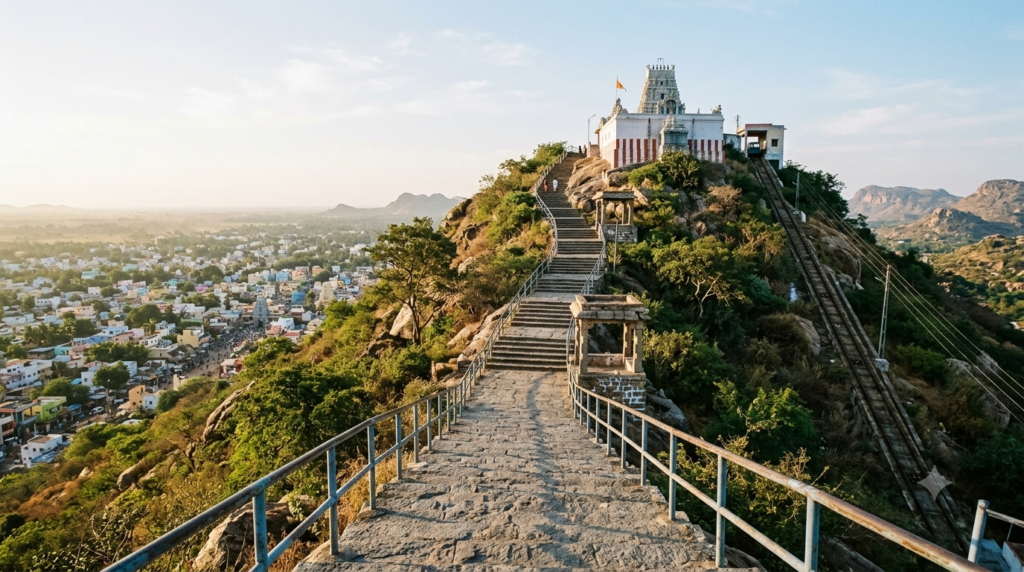
The Palani Temple steps count is something almost every pilgrim wants pinned down before the climb. The honest answer is that the most widely cited figure is 693 steps. Yet the real number depends on which route you take and how you count.
If one website says 650, another says 689, and a third insists on 700, you are not imagining things. This guide settles the confusion. It explains the climbing time, the distance, the height, the difficulty, and every easier alternative. So you can plan the ascent to Lord Murugan’s hill shrine with confidence.
Palani Temple Steps Count: The Real Answer
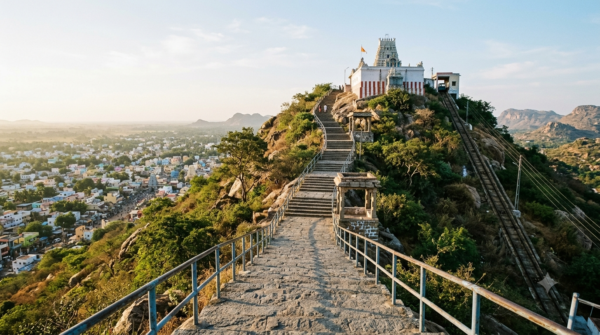
The Palani Temple steps count is most commonly given as 693 stone steps to the hilltop shrine. That figure appears across the majority of guides, and it is the number you will hear locally. Because the main staircase has been renovated over the years, and because devotees count slightly differently, you will also see 650, 670, 689 and 700 quoted.
So treat 693 as the practical working number, not a stamped official total. The temple administration does not publish one fixed count on its portal. What matters on the ground is simple. You are climbing roughly 690-odd steps up a hill that rises about 500 feet above the town.
Palani Temple Steps Count and Climb at a Glance
- Steps: about 693 (commonly quoted; routes vary)
- Height gained: roughly 500 feet (about 150 metres)
- Walking distance up: approximately 1 kilometre
- Climbing time: 20–45 minutes for most people
- Difficulty: moderate, with handrails and rest spots
- Easier options: winch, rope car and the Elephant Path
Why the Palani Temple Steps Count Varies Across Sources
The Palani Temple steps count changes because there is more than one stepped path up Sivagiri. Sivagiri is the hill on which the shrine sits. The hill has two main stepped approaches, and they do not have the same number of steps. This single fact explains most of the disagreement you see online.
On the right side, the main staircase is steeper and more direct. Fit pilgrims often take it to reach the top faster. The left side climbs more gently, almost like a ramp with shallow steps, which suits older devotees and families.
Since people count whichever route they used, the totals naturally differ. This is the main reason the Palani Temple steps count is reported as a range rather than one tidy figure.
Counting method adds a second layer. Some people tally only the principal flight, while others include the smaller upper section near the shrine. That section is sometimes described as a separate set of about 180 steps.
When you add it, the figure climbs toward 700. When you leave it out, it drops toward 670.
Why the Palani Temple Steps Count Isn’t 1,008
You may stumble on claims of 1,008 steps at Palani. That is a myth, or a mix-up with other hill temples. The Palani Murugan shrine sits on a comparatively low hill, so the true count stays well under 700.
Marudhamalai, by comparison, has around 900 steps. That is likely where some of the confusion creeps in.
Climbing Time and the Palani Temple Steps Count
Climbing time is the next thing most pilgrims ask about. Most devotees finish the climb in 30 to 45 minutes at a steady pace. If you are reasonably fit and do not stop much, you can reach the top in about 20 to 25 minutes.
Older pilgrims, or anyone resting often, should budget 50 to 60 minutes. That way the climb never feels rushed.
| Climber type | Approximate time |
|---|---|
| Fit / fast pace | 20–25 minutes |
| Average pace | 30–45 minutes |
| Leisurely / frequent rests | 50–60 minutes |
These timings assume a normal day. During Thai Poosam or Panguni Uthiram the steps fill with thousands of devotees. Movement then slows to a crawl, so the same climb can take far longer.
Plan extra time whenever you visit on a festival or a weekend. You can confirm daily schedules and break times on our Palani Murugan Temple timings guide before you set out.
Distance and Height of the Palani Climb
The stepped path covers roughly 1 kilometre on foot as it winds up the contour of the hill. Although that distance sounds short, you are gaining height the whole way. So the effort feels greater than a flat kilometre walk. The shrine stands about 500 feet, or close to 150 metres, above the surrounding town.
Because the path curves with the hillside, the climb is broken into stretches rather than one relentless flight. You pass small shrines, mandapams and resting platforms along the way. These give natural points to pause, catch your breath and take in the view of Palani town below.
Climb Difficulty Behind the Palani Temple Steps Count
For most pilgrims, the difficulty is best described as moderate. It is manageable for anyone with average fitness, yet genuinely tiring if you are unused to stairs. The steps are well maintained, and handrails run along the route, so support is always within reach. Still, climbing nearly 700 steps continuously will test your legs and lungs.
Heat is the bigger challenge for many. Since the climb can get hot from late morning onward, dehydration tires people faster than the steps themselves. Carry water, pace yourself, and start early while the air is still cool.
If you have a heart condition, severe knee trouble, dizziness or balance issues, talk to your doctor before attempting the climb. Seriously consider the winch or rope car instead. There is no loss of devotion in taking an easier route, because the blessing waits at the top either way. First-aid centres operate at both the base and the summit, which is reassuring if you start to feel unwell.
Easier Alternatives to the Palani Temple Steps Count
If the climb feels daunting, three alternatives carry you up without the long stair climb. The winch and the rope car are mechanical lifts up the hillside. The Elephant Path is a gentler sloping road. Each suits a different kind of pilgrim, so pick the one that fits your group.
| Option | Journey time | Best for |
|---|---|---|
| Steps | 20–45 min | Devotion, fit pilgrims |
| Winch | about 8 min | Elderly, families, budget |
| Rope car | about 4–5 min | Quick, scenic ascent |
| Elephant Path | varies | Vehicle or gentle walk access |
The Winch (Funicular Railway)
The winch is a cable-hauled carriage that runs on a track up the hillside. It covers about 290 metres in roughly 8 minutes. Three winches operate, and they have served pilgrims for decades, since the first was installed back in 1966. Because the fare is very low and the carriages are large, the winch is the budget-friendly favourite for elderly devotees and big families.
The Rope Car (Cable Car)
The rope car glides to the summit in about 4 to 5 minutes. So it is the quickest way up, and it rewards you with a fine view of the hills. Tickets are sold at the base station counter. For current fares, booking notes and operating hours, see our detailed Palani rope car timings and cost guide before you travel.
The Elephant Path (Yaanai Paadhai)
The Elephant Path is a winding, motorable road, originally built for the ceremonial temple elephants. Today it lets devotees reach the top by vehicle or on a gentler walk.
That makes it the most accessible route for wheelchair users, the very young and the very old. The slope is steady rather than stepped, so it avoids the strain of stairs entirely.
Best Time to Tackle the Palani Steps
Early morning is the ideal window, because the air is cool and the crowds are thin. The rising sun also lights up the town below. Aim to start your climb between roughly 5:45 and 7:00 AM if you can. Weekdays, especially Tuesdays and Thursdays linked to Lord Murugan, are far calmer than weekends.
Avoid the peak festival days unless the festival itself is your reason to come. During Thai Poosam and Panguni Uthiram the steps become a slow river of kavadi-bearing pilgrims. While the energy is unforgettable, the climb is crowded and slow. So judge whether you want the spectacle or the serenity.
What First-Time Climbers Often Get Wrong
The most common mistake is grabbing the steeper right-side staircase by default. If speed is not your goal, the gentler left route saves your knees and still reaches the same shrine. Choose your side deliberately rather than following the nearest crowd.
People also underestimate the descent. Coming down nearly 700 steps jars the knees more than going up. So if your legs are tired, consider riding the winch or rope car back down. Wear chappals or shoes with good grip, but never brand-new footwear, because fresh soles and stiff straps cause blisters fast.
Finally, do not skip the panchamirtham. This temple’s famous prasadam is a sweet blend of banana, jaggery, ghee, honey, dates and cardamom. It is prepared on the hill and sold at official counters. Buying it from a licensed stall, rather than a roadside vendor, ensures you get the genuine article.
Before You Climb: The Bottom Line
For practical planning, treat the Palani Temple steps count as about 693. Expect a 30 to 45 minute climb over roughly 1 kilometre, and rate the difficulty as moderate. If stairs are a worry, the winch, rope car or Elephant Path will carry you up comfortably.
Start early, carry water, and choose the gentler left route if your knees need it. Confirm current service timings on the official Arulmigu Dhandayuthapani Swamy Temple portal before you set out. You can also check the Dindigul district tourism page for background. The climb is part of the pilgrimage, so take it at your own pace and enjoy every step.
Frequently Asked Questions
How many steps are there in Palani Temple?
There are about 693 steps to the hilltop Palani Murugan shrine, which is the most widely quoted figure. You will also see 650, 670 and 689, because the hill has two stepped routes and people count them differently. For planning, 693 is the safe working number.
How long does it take to climb the Palani steps?
Most pilgrims climb the steps in 30 to 45 minutes at a steady pace. Fit climbers manage it in about 20 to 25 minutes, while those resting often may need up to an hour. Festival crowds can slow the climb considerably.
What is the distance and height of the Palani climb?
The stepped path runs about 1 kilometre as it winds up the hill. The shrine sits roughly 500 feet, or about 150 metres, above the town. Because you gain height throughout, the walk feels harder than a level kilometre.
Is the Palani steps climb difficult for elderly people?
The climb is moderately tiring and can be tough for elderly or unwell pilgrims. Handrails and rest spots help, but anyone with heart, knee or balance problems should consider the winch, rope car or Elephant Path. Consult a doctor first if you have health concerns.
Can I avoid the steps and still reach the temple?
Yes, you can skip the steps entirely. The winch reaches the top in about 8 minutes, the rope car in roughly 4 to 5 minutes, and the Elephant Path offers a gentle, motorable route. All three are popular with those who cannot climb.
Which side of the steps is easier to climb?
The left-side route is gentler, with shallower, ramp-like steps that are kinder on the knees. The right-side staircase is steeper but more direct, so fit pilgrims take it to save time. Pick the left side if comfort matters more than speed.
What should I carry for the Palani steps climb?
Carry water, wear well-worn shoes or chappals with good grip, and bring a small towel for the heat. Start early to beat the sun, and keep some cash for panchamirtham and small offerings. Avoid new footwear that can cause blisters.
Does the Palani Temple steps count reach 1,008?
No, the 1,008 figure is a myth, or a confusion with other temples. The Palani shrine stands on a relatively low hill, so the true count stays under 700. Around 693 is the realistic number.