
The Venkateswara Swamy Tirumala story is South India’s most retold temple legend. Most pages online carry only half of it. They stop at the sage’s kick, the wedding and the loan, because sites keep copying that short version from each other. The fuller account explains far more useful things.
It explains why pilgrims bow at a boar shrine before the main sanctum. Head-shaving at Tirumala also traces straight back to it. So does the cash that drops into the hundi every minute of the day. This guide sets out the Venkateswara Swamy Tirumala story in full, the recorded history behind it, the miracle claims, and the places where the legend is still visible on the ground.
Go Kshetra is an independent pilgrimage guide. We are not affiliated with Tirumala Tirupati Devasthanams, and we take no bookings, donations or payments. Please use the official TTD website for tickets, sevas and rooms.
Venkateswara Swamy Tirumala story at a glance
Here is the whole legend compressed, before we open each thread.
- Sage Bhrigu tests the Trimurti and kicks Vishnu on the chest, where Goddess Lakshmi resides.
- Lakshmi leaves Vaikuntha in anger, so Vishnu descends to earth to search for her.
- He lives on the Tirumala hills as Srinivasa, sheltering in an anthill, raised by Vakula Devi.
- Varaha Swamy, already on the hill, grants him land in exchange for first worship.
- Srinivasa meets Princess Padmavati, an incarnation of Lakshmi, and seeks her hand.
- He borrows heavily from Kubera to fund the wedding, and devotees still repay that debt symbolically.
Every element above has a matching ritual or shrine at Tirumala today. That link between narrative and practice is what makes the Venkateswara Swamy Tirumala story unusually durable.
Where the Venkateswara Swamy Tirumala story actually comes from
The Venkateswara Swamy Tirumala story comes from more than one book. It appears in the Varaha Purana and the Bhavishyottara Purana, and most fully in the Venkatachala Mahatmya, a section found within the Skanda Purana. Britannica also notes a large body of oral retellings across Telugu and Tamil traditions.
Because several texts carry the Venkateswara Swamy Tirumala story, details differ. Some versions send Lakshmi to Kolhapur, others to a city called Karavira. A few name Padmavati’s earlier birth as Vedavati, while others simply have King Akasa Raja discover her in a lotus.
None of these variants is a mistake. They are simply different manuscript traditions, so honest guides should say so rather than flatten them into one script.
Sage Bhrigu and the kick that starts the Venkateswara Swamy Tirumala story
Sages performing a sacrifice on the Ganga banks asked Narada which deity deserved their offering. Narada sent Sage Bhrigu to test Brahma, Shiva and Vishnu in turn. Brahma ignored him, and Shiva reacted with anger.
Bhrigu then reached Vaikuntha and kicked Vishnu squarely on the chest. Vishnu, instead of retaliating, held the sage’s foot and asked whether it hurt. In doing so he removed the extra eye in Bhrigu’s sole, which the texts treat as the seat of the sage’s pride.
Why Goddess Lakshmi left
Lakshmi resides on Vishnu’s chest, so the kick landed on her own abode. Worse, her husband apologised to the offender. She left Vaikuntha and came down to earth, and Vishnu followed her.
This is the emotional engine of the whole legend. The Lord of the seven hills is, in narrative terms, a husband searching for his wife. Every marriage-themed seva at Tirumala grows out of that single premise.
Srinivasa on the hill: the anthill, Vakula Devi and Varaha Swamy
On the Seshachalam range Vishnu took the name Srinivasa and sheltered inside an anthill. Vakula Devi cared for him as a mother while he lived there. Tradition holds that the sanctum at Tirumala stands over that same anthill, which is why devotees call the deity swayambhu, or self-manifested.
Before settling, though, Srinivasa needed permission. Tirumala was already Adi Varaha Kshetra, the domain of Vishnu’s boar incarnation.
The land deal that still runs the temple
Srinivasa had no money for the land. So he offered Varaha Swamy something else instead: the first bell, the first puja and the first naivedyam, every single day, before anything reached his own shrine. Varaha accepted and granted the ground.
That agreement is not a dead story. Priests at Tirumala still offer to Varaha Swamy first, and pilgrims follow the same order: a dip in Swami Pushkarini, then darshan at the Varahaswamy temple on the tank’s northern bank. Many first-time visitors skip it entirely because no aggregator page tells them. Locals will tell you a Tirumala trip is incomplete without it.
The marriage at the centre of the Venkateswara Swamy Tirumala story
Padmavati grew up as the daughter of King Akasa Raja. In the best-known version Srinivasa was hunting an elephant when he reached her garden and saved her from the charging animal. Vakula Devi then carried the marriage proposal to the palace, and Brihaspati advised the king to accept.
Regional tradition maps this courtship onto real towns around Tirupati. Local custom puts the meeting at Narayanavanam, the engagement nearby, and the wedding at Srinivasa Mangapuram. Tradition adds that the couple stayed six months there before climbing to Tirumala.
The Kubera loan and the hundi
Akasa Raja wanted proof of wealth, so Srinivasa borrowed a vast sum from Kubera, treasurer of the gods. The loan carried a repayment date at the end of Kali Yuga. Devotees therefore believe every offering helps clear the interest on that divine debt.
This belief is the reason Tirumala’s hundi collections are enormous. It is worth stating plainly what the belief is and is not. It is a matter of faith and tradition, not a transaction with a guaranteed return, and no temple publication promises outcomes in exchange for money.
Miracles in the Venkateswara Swamy Tirumala story, and what you can verify
Four claims dominate the “mysteries of Tirumala” content circulating online. Each one deserves a straight answer about what is tradition, what is observable, and what no pilgrim can personally check.
The self-manifested idol
Devotees hold that no sculptor ever carved the murti, and that it appeared on its own. Tradition places Tirumala among the swayambhu kshetras of Vishnu for this reason. Art historians study the icon’s Vaikhanasa iconography instead, and both readings coexist without conflict for most worshippers.
The hair, and the Neela Devi legend
Most retellings drop the story behind tonsure. Legend says Srinivasa lost hair from a wound to his scalp, and a Gandharva princess named Neela Devi cut her own hair to cover the loss. Pleased, the Lord promised his blessing to anyone offering hair at his feet. The Neeladri peak carries her name.
That is the origin of the shaving ritual at Kalyanakatta. Content sites also claim the idol’s hair visibly grows. That belongs to devotional lore, not to any documented finding, so treat it as faith rather than fact.
The sound of the ocean
You will read that placing an ear behind the idol reveals the sound of sea waves. Here is the correction almost nobody publishes: ordinary pilgrims cannot do this. Temple priests alone reach the sanctum’s inner space, and darshan itself lasts only seconds in a moving queue. The claim rests on priestly testimony, so no visitor can ever test it.
The eternal lamp and the camphor claim
Tradition says lamps in the sanctum have burned for centuries, with no record of who lit them. Another widely shared claim says raw green camphor, or pachai karpooram, cracks ordinary stone yet leaves this idol untouched. Both circulate without any published temple study behind them. Enjoy them as sacred lore, and do not repeat them as tested science.
Myths about the Venkateswara Swamy Tirumala story that keep spreading
Competing pages repeat several errors about the Venkateswara Swamy Tirumala story. Correcting them helps anyone planning a first visit.
- Tirupati and Tirumala are the same place. They are not. Tirupati is the town at the foot of the range, while Tirumala is the hill settlement roughly 3,200 feet above sea level where the temple stands.
- One king built the temple. No single ruler did. Over a thousand inscriptions record gifts from many dynasties across centuries.
- You must visit Padmavati before Tirumala. Sources genuinely disagree here. One tradition sends you to Tiruchanur first, another treats it as the closing visit, so follow your family custom.
- The legend has one fixed version. It does not, as the Puranic sources themselves differ on names and places.
The recorded history behind the Venkateswara Swamy Tirumala story
Faith supplies the narrative, while inscriptions supply the timeline. The temple walls at Tirumala and Tirupati carry more than a thousand of them, which is why historians can date patronage fairly precisely.
| Period | Patron or authority | Contribution |
|---|---|---|
| 9th century | Pallavas of Kanchipuram | Earliest surviving endowments and inscriptions |
| 10th century | Cholas of Thanjavur | Large gifts; the complex expands |
| 12th to 13th centuries | Yadavarayas and regional chiefs | Temple walls record their local grants |
| 1517 | Krishnadevaraya, Vijayanagara | Gold and jewels; gilding of the Ananda Nilayam |
| 1843 to 1933 | Hathiramji Mutt mahants | Day-to-day administration of the shrine |
| 1933 | Tirumala Tirupati Devasthanams | Statutory board takes over; later Acts in 1951, 1966 and 1979 |
Krishnadevaraya visited repeatedly, and in 1517 he funded the gilding of the inner shrine roof. Bronze statues of the emperor and his consorts still stand in the temple precinct. Most pilgrims walk straight past them in the crowd, so look left on the exit route.
Where to see the Venkateswara Swamy Tirumala story on the ground
This is the part official pages rarely assemble in one place. Each site below corresponds to a specific episode in the legend.
| Place | Episode it belongs to | Practical note |
|---|---|---|
| Sri Varahaswamy temple, Tirumala | The land granted to Srinivasa | On the north bank of Swami Pushkarini; visit before the main darshan |
| Swami Pushkarini | The Lord’s sacred tank | Adjoins the main temple; traditional dip before darshan |
| Narayanavanam | Where Srinivasa met Padmavati | A quiet temple town east of Tirupati, easily missed |
| Srinivasa Mangapuram | The wedding and the six-month stay | Kalyana Venkateswara shrine; the Srivari Mettu footpath starts here |
| Tiruchanur | Padmavati’s own abode | About 5 km from Tirupati; most families treat it as essential |
| Silathoranam | Natural rock arch on the hill | A short drive from the temple; geologically notable |
Sequencing these turns a rushed darshan trip into a coherent two-day circuit. Families with elderly members often split it, taking Tirumala one day and the plains temples the next.
Walking the seven hills, safely
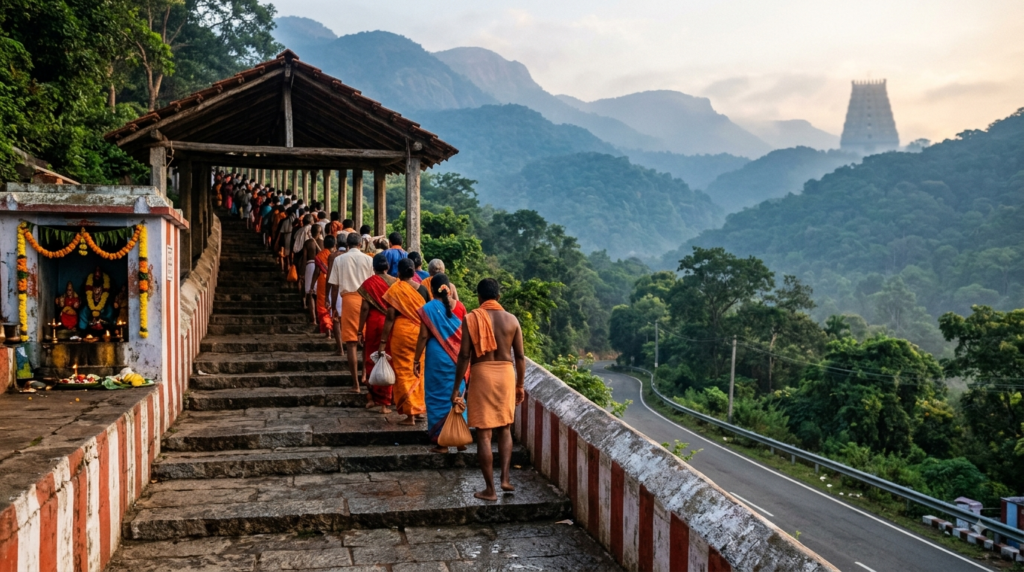
The seven peaks around Tirumala are Seshadri, Neeladri, Garudadri, Anjanadri, Vrishabhadri, Narayanadri and Venkatadri, and the temple sits on Venkatadri. Many devotees climb rather than drive, since the walk itself forms part of the vow.
Two footpaths exist. The Alipiri route runs roughly 9 km with about 3,550 steps, and a roof covers most of its length. Srivari Mettu is shorter at about 2,388 steps, but it climbs far more steeply.
Treat the climb as real physical exercise. Carry water, start early, and rest often, because the ascent takes several hours in humid heat. Anyone who is pregnant, elderly, or living with a heart, joint or breathing condition should speak to a doctor first. Faith is not a substitute for medical advice, and TTD road transport exists for good reason.
Planning the visit: what actually goes wrong
Darshan at Tirumala is never guaranteed on demand. Special Entry Darshan slots run on a quota, and they sell out fast after each release. Festival weeks squeeze availability further. Knowing the fallbacks matters more than knowing the booking steps.
- If online slots are gone, time-slotted Sarva Darshan tokens remain the free walk-in option.
- Footpath counters issue Divya Darshan tokens to pilgrims who climb on foot.
- If a festival date is unworkable, shift to a mid-week day outside Brahmotsavam season.
- Verify every current fee, quota and timing on the official TTD booking portal before you travel.
Book only through the government portal. Fake booking sites imitating TTD are a persistent problem, and they usually charge inflated “processing” fees for tickets that TTD issues at fixed rates. Our guide to Tirumala darshan types compares the free, paid and seva routes in detail.
The Venkateswara Swamy Tirumala story: before you go
The Venkateswara Swamy Tirumala story rewards a slower reading. Take the legend seriously as literature, take the inscriptions seriously as history, and keep the miracle claims in the category of belief where they belong. Then plan the visit around the shrines that carry the story, not just the main queue.
Start at Varaha Swamy, keep Tiruchanur and Srinivasa Mangapuram on the itinerary, and confirm all timings on the official portal. For the wider trip, see our complete Tirupati and Tirumala guide, and the Narayanavanam temple guide for the courtship sites. Andhra Pradesh Tourism also publishes regional travel information on its official site.
Frequently asked questions
Who is Lord Venkateswara?
Lord Venkateswara is a form of Vishnu worshipped at Tirumala, and the name means Lord of Venkata Hill. Devotees also call him Balaji, Srinivasa and Govinda. Tradition holds that he descended in Kali Yuga to protect devotees.
Which text contains the Venkateswara Swamy Tirumala story?
No single text holds the Venkateswara Swamy Tirumala story in full. The legend appears in the Varaha Purana and Bhavishyottara Purana, and most completely in the Venkatachala Mahatmya within the Skanda Purana. Oral traditions add further detail, which is why versions differ.
Why do devotees visit Varaha Swamy before Lord Venkateswara?
Because the legend says Varaha Swamy granted the land for the temple. In return he received the first bell, first puja and first offering each day. That custom continues, so pilgrims traditionally take a dip in Swami Pushkarini and see Varaha Swamy first.
Why do people shave their heads at Tirumala?
Tonsure goes back to Neela Devi, who gave her own hair to cover a wound on the Lord’s scalp. He blessed everyone who offers hair at his feet. Today devotees do this at Kalyanakatta as an act of surrender and gratitude.
Is the Tirumala idol really self-manifested?
Devotees believe so, and tradition ranks Tirumala among the swayambhu shrines of Vishnu. This is a matter of faith and temple tradition. Historians instead study the icon’s Vaikhanasa iconography and the temple’s inscriptions.
Can pilgrims actually hear ocean sounds near the idol?
Not in practice. The claim comes from priests who access the sanctum’s inner area, which ordinary pilgrims never enter. Darshan lasts only a few seconds in a moving queue, so no visitor can verify it personally.
Who built the Tirumala temple?
No single ruler built it. Pallava, Chola, Yadavaraya and Vijayanagara patrons endowed and expanded it over centuries. Krishnadevaraya funded the gilding of the inner shrine roof in 1517, and TTD has administered the temple since 1933.
Should you visit Tiruchanur before or after Tirumala?
Both customs exist and neither is wrong. Some traditions ask devotees to greet Goddess Padmavati at Tiruchanur first, while others treat it as the closing darshan. Follow your family practice, and allow half a day either way.
What is the Kubera loan story?
Srinivasa borrowed wealth from Kubera to fund his marriage to Padmavati, repayable at the end of Kali Yuga. Devotees believe offerings at the Tirumala hundi help repay that debt. It is a devotional belief, not a promise of returns.
How many steps lead up to Tirumala?
The Alipiri footpath has about 3,550 steps over roughly 9 km. The steeper Srivari Mettu route from Srinivasa Mangapuram has about 2,388 steps. Both take several hours, so plan water, rest and medical precautions accordingly.