
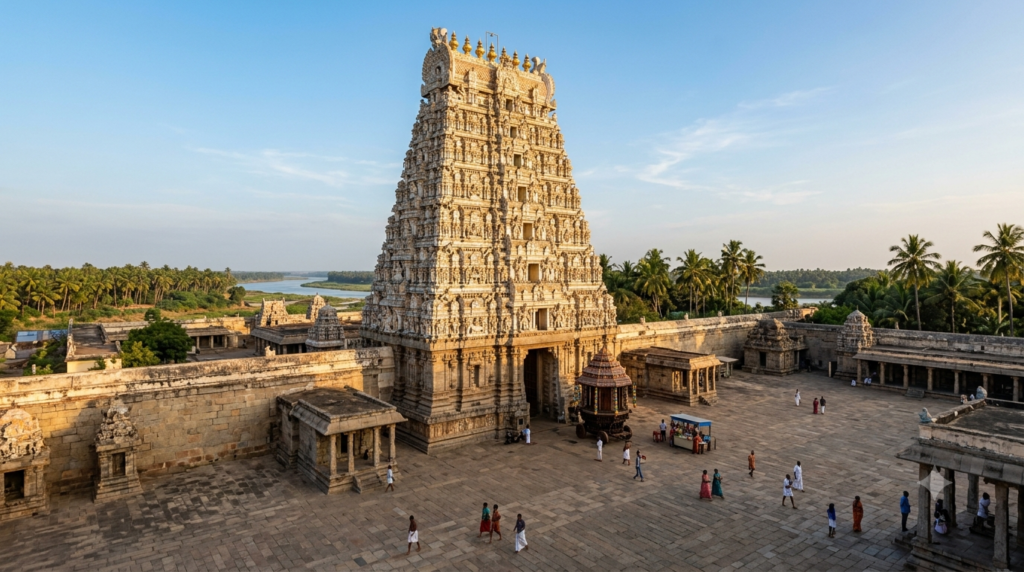
Your Jambukeswarar Temple darshan at Thiruvanaikaval starts with one correction that most travel pages get wrong. The temple opens at 6 AM and closes at 9 PM. Yet many aggregator sites still repeat an outdated “5:30 AM to 8:30 PM” schedule.
This ancient Shiva shrine near Trichy is the water element among the five Pancha Bhoota Sthalams. Its sanctum holds a self-formed lingam that rests in a natural spring all year.
So if you fix the timings, the famous noon ritual, and the travel route first, the rest of the visit falls into place. This guide covers everything a Jambukeswarar Temple darshan needs, from the accurate schedule to the noon pooja and the road route. Here is the honest, on-the-ground version.
Gokshetra is an independent pilgrim guide. We are not affiliated with, endorsed by, or the official website of the Arulmigu Jambukeswarar Akilandeswari Temple or the Tamil Nadu HR&CE Department. We take no bookings, donations, or payments. Please use the official temple portal for any reservation, seva, or official update.
Jambukeswarar Temple darshan at a glance
Before the details, here is a quick snapshot so you can plan your Jambukeswarar Temple darshan fast.
- Location: Thiruvanaikaval, on Srirangam island, north Trichy, Tamil Nadu 620005.
- Timings: 6 AM to 1 PM and 3 PM to 9 PM on Monday to Thursday; continuous 6 AM to 9 PM on Friday to Sunday.
- Entry fee: Free for general darshan; small charges apply for quick-darshan queues and sevas.
- Famous for: the water lingam (Appu Lingam) and the daily noon pooja by a priest dressed as the Goddess.
- Best time: October to March, and early morning for a calm queue.
- Nearest station: Srirangam, about 2 km away.
Jambukeswarar Temple darshan timings
The official HR&CE portal lists the temple as open from 6 AM to 1 PM and again from 3 PM to 9 PM. This applies from Monday to Thursday, when a midday break falls between 1 PM and 3 PM. Because Friday, Saturday, and Sunday draw bigger crowds, the temple stays open continuously from 6 AM to 9 PM on those days.
Many third-party pages still show “5:30 AM to 8:30 PM”, so treat that as outdated. The official closing time is 9 PM, and the opening bell is 6 AM. For a smooth Jambukeswarar Temple darshan, plan around that verified window. Timings can also shift on festival days, so confirm on the official portal before you travel.
The midday pooja pause you should plan around
There is one more timing detail that catches visitors off guard. On most days, devotee access to the inner sanctum slows or pauses roughly between 10:30 AM and 12 noon. That happens because the priests prepare for the famous noon ritual.
If you want an unhurried early view of the lingam, reach before 9:30 AM. Alternatively, come after 12:30 PM once the noon pooja finishes and the queue reopens fully.
Jambukeswarar Temple darshan: entry fee and special queues
A standard Jambukeswarar Temple darshan is free, so you can join the common queue without any ticket. When the shrine gets crowded, the temple runs faster paid queues at a small charge. Meanwhile, sevas and abhishekam carry their own nominal fees. A recent visitor reported queue tiers around ₹25 and ₹10 alongside the free line, though these amounts change over time.
Since these figures are not officially fixed here, treat them as indicative only. Confirm the current quick-darshan and seva rates at the temple counter or on the official portal on the day you visit. The temple accepts payment at the counter, so you do not need to book anything in advance for a normal darshan.
Sevas, abhishekam, and the famous noon ritual
The temple performs five poojas a day at the sanctum, and each carries its own devotional mood. Abhishekam to the lingam is a daily highlight, and Annabhishekam, where cooked rice covers the lingam, is another cherished offering. Because the sanctum is small, priests admit devotees for close sevas in groups of about six. Together, these offerings turn a simple Jambukeswarar Temple darshan into a fuller ritual experience.
The most celebrated ritual, however, is the daily noon pooja, known locally as the uchikala pooja. At 12 noon, the head priest wears a saree and the headgear of the Goddess. Then he worships Lord Jambukeswarar on behalf of Akilandeswari, and also offers a cow pooja to a black cow called Karam Pasu. This re-enacts the legend of Parvati worshipping Shiva here as his student, so it carries a rare guru-shishya meaning that devotees find deeply moving.
Why the water lingam makes this darshan unique
Jambukeswarar is one of the five Pancha Bhoota Sthalams, and it represents water, called neer in Tamil and appu in Sanskrit. The self-formed lingam, therefore, sits lower than the surrounding floor, with an underground spring keeping its base perpetually wet. During the monsoon, the water rises visibly around the lingam, which is why devotees call it the Appu Lingam or Jala Lingam.
The other four elemental temples complete a famous Shaivite circuit across South India. Chidambaram represents space, Kanchipuram Ekambareswarar represents earth, Tiruvannamalai Arunachaleswarar represents fire, and Srikalahasti represents air.
Because Thiruvanaikaval holds the water element, many pilgrims add it to the wider circuit. They often pair it with the fire temple at Tiruvannamalai’s Arunachala and the air temple at Srikalahasti. Both belong to the same five-element yatra.
The Sangam-era Chola king Kochengannan built the earliest structure roughly 1,800 years ago. Later Chola and Nayak rulers expanded it, and the complex now spreads across five concentric courtyards, or prakarams. You view the main deity through a stone window with nine apertures, which stand for the Navagraha.
Akilandeswari and the Sri Chakra earrings
The Goddess here is Akilandeswari, whose name means the ruler of the entire universe. Unusually, she is worshipped not as Shiva’s wife but as his disciple, so this shrine is an Upadesa Sthalam where no Thirukalyanam marriage ritual takes place. The idols of Shiva and the Goddess face each other, reflecting the teacher-and-student bond.
Tradition holds that the Goddess once carried a fierce temper. To calm her, the saint Adi Shankara installed a Prasanna Ganapati idol opposite her shrine. He also adorned her with Sri Chakra earrings, called thatanka.
The Shankaracharyas of the Kanchi Kamakoti Peetham still perform the cleaning and reconsecration of these sacred earrings. Devotees revere Akilandeswari alongside Meenakshi of Madurai and Kamakshi of Kanchipuram as the powerful Trishakti triad.
Best time for Jambukeswarar Temple darshan
The most comfortable window for a Jambukeswarar Temple darshan runs from October to March, when Trichy’s weather stays mild and pleasant. Summer months from May to July can be harsh, since daytime temperatures often climb toward 40°C. So if you must visit in summer, favour the early morning or the evening slot to avoid the heat.
For a calm queue, arrive soon after the 6 AM opening on any weekday. Weekends and Tamil-month Fridays get busy, especially during the month of Aadi, when Friday worship of the Goddess peaks. If a festival draws you, expect a livelier but far more crowded experience.
Festivals worth timing your visit around
Several festivals light up the temple calendar through the year. The Panguni Brahmotsavam is the grandest, while Vasantha Utsavam, Aadi Pooram, Navaratri, Karthigai Deepam, and Thai Theppam each bring their own colour. During Aadi Fridays, the temple often extends its hours for special worship of Akilandeswari, so check the schedule before you set out.
How to reach Thiruvanaikaval
Thiruvanaikaval sits on Srirangam island, between the Cauvery and the Kollidam rivers, just north of central Trichy. The temple is easy to reach for your Jambukeswarar Temple darshan by air, rail, or road. Trichy is a well-connected transit hub in central Tamil Nadu.
By air
Tiruchirappalli International Airport (TRZ) lies about 12 to 15 km from the temple. After you land, prepaid taxis, app cabs, and buses run to Thiruvanaikaval through the city. The airport connects to Chennai and several other Indian and Gulf cities.
By train
Srirangam Railway Station is the closest railhead, only about 2 km away. Tiruchirappalli Junction, a major junction with trains from across India, sits around 8 km from the shrine. From either station, autos and local buses reach the temple quickly.
By road
State transport and private buses serve Thiruvanaikaval from all major Tamil Nadu towns. Trichy’s central bus stand lies about 8 km away, and local town buses, autos, and taxis cover the last stretch. If you self-drive, parking is available near the complex but fills up fast on festival days.
Dress code and etiquette for Jambukeswarar Temple darshan
Traditional attire is the respectful choice, even though the temple does not enforce a rigid dress code. Men usually wear a dhoti or trousers with a shirt, while women wear a saree, half-saree, or salwar kameez. Clothing that covers the shoulders and knees is appreciated as a mark of respect.
Remove your footwear before entering, and keep it at the designated stands. Photography is generally restricted inside the inner shrine, so check the notices or ask an official first. Since queues can jostle near the cramped sanctum, stay patient and follow the staff who regulate the line.
Health and safety note for pilgrims
The temple grounds are largely flat, so the walk itself is gentle for most visitors. However, the inner sanctum sits below floor level, and its doorway is only about four feet high. So you must bow low and take a few steps down to enter. Elderly pilgrims and anyone with knee or back trouble should move carefully here and accept help if needed.
Trichy’s summer heat can be intense, so carry water, wear a cap, and keep any regular medication with you. The water lingam and the Goddess draw many devotees seeking healing or fertility blessings, and those beliefs are a matter of faith and tradition. They are not a substitute for medical care, so please consult a qualified doctor for any health concern.
Nearby temples and places to see
Thiruvanaikaval pairs naturally with several sacred and scenic stops around Trichy. The most famous neighbour is the vast Sri Ranganathaswamy Temple at Srirangam, roughly 2 km away. It ranks among the largest functioning Hindu temples in the world. Together, the two shrines let you honour both Shiva and Vishnu on the same island in one trip.
The Rockfort Ucchi Pillayar Temple, about 7 to 8 km away, rewards a short climb with sweeping views over the city. For a change of pace, the Kallanai and Mukkombu barrages on the Cauvery, around 20 km out, offer riverside calm and a historic dam. Because all these sit close together, a single day in Trichy can cover a rich mix of faith and sightseeing.
Insider tips for your Jambukeswarar Temple darshan
A few practical pointers can lift your Jambukeswarar Temple darshan from good to memorable. These come from how the temple actually works on the ground, not just the brochure version.
- Time the noon pooja: reach by 11:30 AM if you want to witness the uchikala ritual, but expect a crowd.
- Beat the pause: an early view before 9:30 AM avoids the mid-morning slowdown near the sanctum.
- Bow safely: the low sanctum door is easy to knock your head on, so mind the lintel as you enter.
- Carry small change: quick-darshan and seva counters move faster when you have exact cash ready.
- Combine the island: pair this darshan with Srirangam early, then keep the afternoon for Rockfort.
Before you go
A well-planned Jambukeswarar Temple darshan rewards you with a rare, water-fed sanctum and a noon ritual you will not see elsewhere. Fix the timings first, since the accurate 6 AM to 9 PM window is the single detail most sources get wrong. Arrive early, dress simply, and leave room in your day for Srirangam next door. For any seva, rate, or festival date, always confirm on the official temple portal before you set out.
Frequently asked questions
What are the current Jambukeswarar Temple darshan timings?
The temple opens at 6 AM and closes at 9 PM. On Monday to Thursday, it breaks between 1 PM and 3 PM, while Friday to Sunday stays open continuously. Festival days can vary, so confirm on the official portal.
Is there an entry fee for Jambukeswarar Temple darshan?
General darshan is free of charge. The temple runs faster paid queues at a small fee when it is crowded, and sevas or abhishekam carry their own nominal charges. Confirm current rates at the counter.
What is special about the noon pooja?
At 12 noon, the head priest dresses as the Goddess and worships Lord Jambukeswarar, along with a cow pooja to a black cow. This uchikala pooja re-enacts Parvati worshipping Shiva as his student, so devotees treasure it.
Why is the lingam always in water?
Jambukeswarar represents the water element among the Pancha Bhoota Sthalams. An underground spring keeps the self-formed lingam perpetually wet, and the water rises visibly during the monsoon. Devotees therefore call it the Appu Lingam.
How far is the temple from Srirangam Ranganathaswamy Temple?
The two temples sit on the same island, only about 2 km apart. Most pilgrims visit both in one trip, honouring Shiva at Thiruvanaikaval and Vishnu at Srirangam. Autos and buses connect them quickly.
What is the best time for Jambukeswarar Temple darshan?
October to March offers the most pleasant weather for a comfortable visit. Early morning on a weekday gives the calmest queue. Summer months can be very hot, so plan for the cooler morning or evening slots.
What is the dress code at the temple?
Traditional attire is recommended, though it is not strictly enforced. Men wear a dhoti or trousers with a shirt, and women wear a saree or salwar kameez. Cover shoulders and knees, and remove footwear before entering.
Do I need to bow to enter the sanctum?
Yes. The inner sanctum door is only about four feet high, so every devotee bows low to enter. A few steps also lead down into the shrine, so elderly visitors should take extra care.