
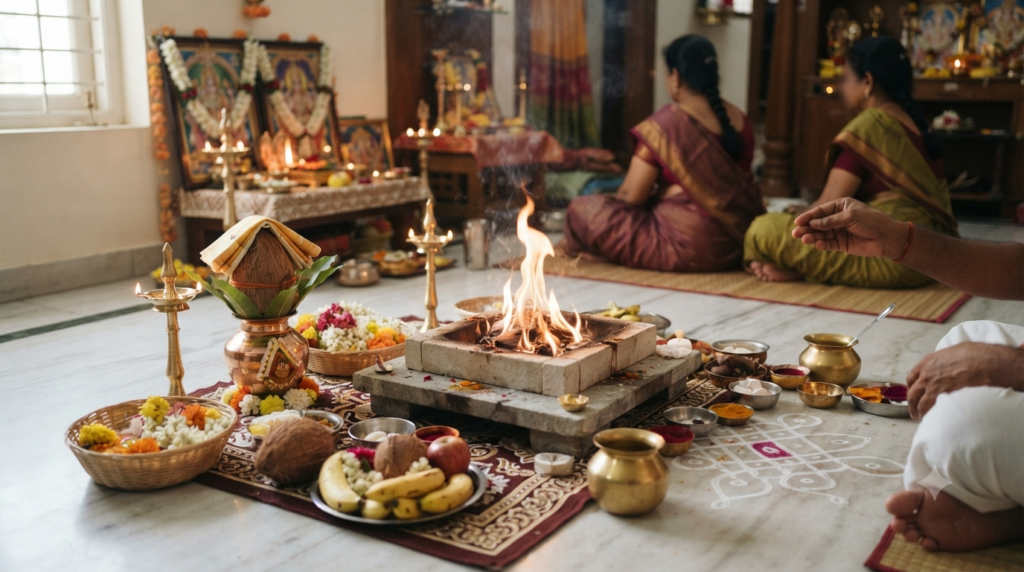
Sudarshana Homam Home Procedure is best understood as a priest-led Vaishnava fire ritual, not a fixed do-it-yourself recipe. Families may host it at home. However, mantras, offerings, counts, and sequence can vary by sampradaya and priestly tradition. This guide explains the common framework, practical planning, cost, items, and safety points without pretending that one checklist fits every household.
Go Kshetra is an independent information guide. We do not arrange priests, accept homam bookings, collect donations, or take payments for rituals. Use a trusted local temple, mutt, religious institution, or qualified priest for ritual arrangements.
Sudarshana Homam Home Procedure: Quick Overview
Sudarshana Homam honours Sri Sudarshana, the divine discus associated with Lord Vishnu. Devotees traditionally seek protection, removal of obstacles, spiritual steadiness, and well-being through this worship. However, these are matters of faith and tradition, not guaranteed outcomes or medical treatments.
- Where: A home, temple, mutt, or suitable ritual venue with a safe fire area.
- Who leads it: A priest familiar with the family’s Vaishnava tradition is the safest choice for a formal homam.
- Typical duration: Many home formats take about 2–3 hours, while larger japa or multi-priest formats can take longer.
- Main stages: Preparation, sankalpa, Ganapati worship, Sudarshana invocation and japa, homa offerings, purnahuti, arati, and prasadam.
- Cost: There is no all-India official tariff, so the final amount depends on city, priest count, materials, travel, and ritual scale.
- Key safety point: Do not improvise a formal indoor fire ritual if your building rules, ventilation, or fire-safety conditions are unsuitable.
The Sudarshana Homam Home Procedure should therefore begin with one decision: are you arranging a formal homam or a simple devotional worship at home? If you want the full fire ritual, confirm the procedure and samagri with the priest before buying materials. If a priest is not available, a simple prayer or stotra-based worship is safer than copying an advanced homam sequence from the internet.
What Is Sudarshana Homam?
Sudarshana Homam is a Vaishnava fire ritual centred on Sri Sudarshana, who represents Lord Vishnu’s protective discus. Temples and Vaishnava institutions conduct the homam for devotional and ceremonial purposes. Tirumala Tirupati Devasthanams has documented a Maha Sudarshana Homam during Sri Venkateswara Vaibhavotsavams, while Chinna Jeeyar’s JIVA campus has also documented a priest-led Sudarshana Homam.
Those institutional examples show the ritual’s living practice, but they do not create one universal home manual. You can read the TTD account of Maha Sudarshana Homam and the JIVA account of Sudarshana Homam for context. The household sequence may still differ because priests follow their lineage, regional customs, and the intended sankalpa.
Can Sudarshana Homam Be Done at Home?
Yes, families may host Sudarshana worship and homam at home when a suitable priest and safe ritual space are available. The Ramanuja Mission notes that Sri Sudarshana homam has taken place at devotees’ homes, which supports home hosting as an established practice. However, home hosting does not mean every family should independently perform the full fire ritual.
A formal homam uses specific mantra recitation, fire offerings, and ritual sequencing, so guidance matters. For most families, the Sudarshana Homam Home Procedure works best when the priest confirms responsibilities in advance. The Ramanuja Mission host-preparation page also illustrates this division between household preparation and priestly guidance.
Sudarshana Homam Home Procedure: Step-by-Step Framework
The Sudarshana Homam Home Procedure below is a planning framework, not a substitute for a priest’s paddhati, or ritual manual. The safest approach is to confirm the sequence before the day because some traditions add purification rites, kalasha worship, Narasimha worship, Vishnu Sukta, Purusha Sukta, or other recitations.
- Confirm the priest, tradition, and purpose. Tell the priest whether the homam is for a family prayer, a new beginning, an anniversary, or another devotional sankalpa. This helps the priest decide the scale, japa count, and required materials.
- Choose the date and time. Some Vaishnava families favour Ekadashi, Dwadashi, Swati nakshatra, or another day recommended by their priest. There is no need to treat one weekday as universally compulsory because customs differ.
- Prepare the worship area. Clean the space and keep the altar separate from the fire area. Also remove curtains, paper decorations, loose clothing, and other combustible items from the homa-kunda zone.
- Set up the altar and kalasha if required. Place the Vishnu or Sudarshana image, lamps, flowers, water vessels, and offerings as directed. The priest may also ask for a kalasha, cloth, mango leaves, coconut, or other tradition-specific items.
- Begin with purification and sankalpa. The family states the prayerful intention and participates as the priest directs. Ganapati worship commonly comes early in the sequence because many Hindu ritual traditions begin by invoking Ganesha.
- Proceed to Sudarshana worship and mantra japa. The priest selects the mantras and repetition counts. Do not assume that 108 or 1,008 repetitions are mandatory in every home ceremony because the scale varies.
Fire Offering and Closing Stages
- Offer homa dravya into the sacred fire. The priest controls the fire and calls each ahuti, or offering. Family members should add offerings only when instructed, since excess ghee or unsuitable materials can create a sudden flare or heavy smoke.
- Complete purnahuti and closing worship. The final offering marks the formal close of the fire portion. Arati, prayers, blessings, and prasadam may follow according to the family’s practice.
- Let the fire cool fully. Do not move hot ash or the homa-kunda immediately. After the ceremony, follow the priest’s advice for respectful disposal of ash and ritual remnants while also following local waste and fire rules.
Why the Exact Mantra Sequence Is Not Listed Here
A full homam is not simply a list of Sanskrit lines copied into a webpage. Pronunciation, nyasa, invocation, japa, ahuti wording, and the order of subsidiary rites can differ by tradition. Therefore, this guide gives a usable planning sequence while leaving formal mantra instruction to a qualified practitioner.
If you want a simpler related fire-ritual overview, Go Kshetra also has a Gayatri Mantra Homam guide. Use it as general context rather than mixing two ritual systems into one ceremony.
Sudarshana Homam Items List for Home
A reliable items list separates universal household supplies from priest-specific homa materials. The old habit of publishing fixed quantities such as several kilograms of rice or litres of ghee can mislead readers because a two-hour family homam and a large multi-priest homam use very different amounts.
| Item group | Common examples | What to confirm |
|---|---|---|
| Altar | Vishnu or Sudarshana image, clean cloth, flowers | Whether a yantra or specific vigraha is required |
| Basic puja | Turmeric, kumkum, sandal paste, incense, lamp, wicks | Any lineage-specific powders or offerings |
| Naivedya | Fruits, coconut, cooked offering, drinking water | Preferred prasadam and dietary rules |
| Kalasha | Pot, water, leaves, coconut, cloth | Whether kalasha worship forms part of the chosen procedure |
| Homa setup | Homa-kunda, heatproof base, sand, safe firewood or samidh | Size of kunda and type of fuel |
| Homa offerings | Ghee and priest-approved homa dravya | Exact ingredients, quantity, and ahuti count |
| Closing items | Purnahuti materials, arati plate, prasadam vessels | What the priest brings versus what the family supplies |
Before shopping, ask for a written samagri list from the priest. In the Sudarshana Homam Home Procedure, the priest’s list should override a generic online quantity chart because the ritual scale varies. This also avoids last-minute substitutions that may not suit the family’s tradition.
Fire and Health Safety at Home
Any Sudarshana Homam Home Procedure that uses open flame must include ordinary fire safety because homa fire creates heat, sparks, and smoke. Use a stable non-combustible base, maintain clear space around the kunda, and keep water or an appropriate extinguisher nearby. Children and pets should remain away from the fire area throughout the ceremony.
Ventilation matters because smoke can irritate the eyes and lungs. If anyone has asthma, respiratory disease, smoke sensitivity, or another health concern, reduce exposure and seek medical advice when appropriate. A homam is a devotional practice; it should never replace medical diagnosis, treatment, or emergency care.
Apartment rules can also matter. If the building prohibits open flames or smoke, choose a temple, approved hall, or another lawful venue instead. Never disable smoke alarms or block exits in order to conduct the ritual indoors.
Sudarshana Homam Home Procedure: Cost and Planning
The Sudarshana Homam Home Procedure has no standard national price because independent priests and service providers set their own fees. Public listings checked in September 2026 range from roughly ₹3,500 for an entry-level priest service to ₹25,000 or more for bundled home packages. Large multi-priest or high-japa packages can cost substantially more.
| Cost factor | Why it changes the quote | Planning tip |
|---|---|---|
| Priest count | More priests increase dakshina and coordination costs | Ask how many priests the selected format actually needs |
| Japa and ahuti count | Larger counts require more time and homa material | Confirm the count before accepting a package price |
| Samagri | Some quotes include all materials, while others cover priest service only | Get an inclusion list in writing |
| Travel | Outstation travel can add transport and accommodation | Prefer a qualified local priest when suitable |
| Venue and scale | Large family events need extra seating, vessels, and fire arrangements | Separate ritual costs from event-decoration costs |
Treat online package prices as market references, not as an official tariff. Before paying anyone, confirm the priest’s identity, the full ritual scope, material inclusions, travel charges, and cancellation terms. Go Kshetra does not collect payments or recommend a private booking channel.
How Long Does Sudarshana Homam Take?
Many standard home services advertise about two to three hours for Sudarshana Homam, but the actual duration depends on the selected japa count and added rites. A larger ceremony can run longer, especially when several priests chant or when the family combines the homam with other worship.
Ask for both the start time and expected purnahuti time before inviting guests. Also allow extra time for setup and cooling the fire afterward, so the schedule does not pressure the priest or compromise safety.
What Are the Traditional Benefits?
Devotees traditionally undertake Sudarshana worship while praying for protection, removal of obstacles, courage, clarity, family welfare, and spiritual discipline. Religious institutions also describe the ritual in protective and auspicious terms. These descriptions reflect faith, scripture, and living tradition rather than measurable guarantees.
Claims about curing disease, preventing accidents, defeating enemies, or guaranteeing business success should not be treated as factual promises. If a family is facing illness, legal trouble, financial stress, or a safety problem, use appropriate professional help alongside any devotional practice.
What Day Is Best for Sudarshana Homam?
There is no single universal day that every Vaishnava tradition requires. Some priests choose Ekadashi, Dwadashi, Swati nakshatra, a family-specific muhurta, or a day connected with the intended sankalpa. Therefore, ask the officiating priest to select the date from the local panchang and the family’s tradition.
This approach is better than copying a fixed “best day” list from a generic website. Panchang details also change by location, so a muhurta that applies in one city may not match another city’s sunrise and tithi boundaries.
What If a Priest Is Not Available?
If a qualified priest is unavailable, do not feel pressured to improvise the formal fire ritual. You can keep the day devotional with a clean altar, a lamp, simple Vishnu or Sudarshana prayer, and familiar stotras from your own tradition. Then arrange the full homam later when proper guidance becomes available.
For temple participation instead, see Go Kshetra’s Yadagirigutta Temple Sudarshana Homam guide. Temple procedures, ticketing, and participation rules differ from a private home homam, so do not transfer one venue’s instructions to another.
Common Mistakes to Avoid
- Buying materials before speaking to the priest: this often creates excess supplies or misses lineage-specific items.
- Treating one online list as universal: mantras, counts, and subsidiary rites vary, so copied instructions can conflict.
- Using too much ghee: excess fuel can produce sudden flames and smoke, so follow the priest’s direction.
- Chasing a “powerful” date: a suitable local muhurta and proper preparation matter more than a generic weekday claim.
- Presenting faith claims as medical facts: spiritual benefits belong to belief and practice, not clinical treatment.
- Ignoring building rules: if open fire is restricted, move the ceremony to an approved venue instead of taking a safety risk.
Before You Arrange the Homam
A good Sudarshana Homam Home Procedure plan starts with the priest, not the shopping cart. Confirm the tradition, date, expected duration, samagri responsibilities, fire setup, total quote, and who will clean up after the ceremony. That preparation keeps the ritual focused and avoids preventable confusion.
Most importantly, keep expectations grounded. Families may find deep spiritual meaning in Sudarshana worship, but no ritual can guarantee health, money, legal victory, or protection from every hardship. Devotion and practical responsibility can sit together without conflict.
Frequently Asked Questions
Can I follow the Sudarshana Homam Home Procedure by myself?
You can perform simple devotional worship by yourself if it matches your family tradition. However, a formal Sudarshana Homam Home Procedure with fire, specialised mantras, and prescribed offerings is better led by a qualified priest. This also reduces mistakes and improves fire safety.
How much does Sudarshana Homam cost at home?
There is no official all-India fee. Public service listings checked in September 2026 start around a few thousand rupees and rise above ₹25,000 for bundled formats, while elaborate multi-priest ceremonies can cost much more. Always compare the actual inclusions before deciding.
How long does a home Sudarshana Homam take?
Many standard formats take around two to three hours. However, the time increases when the priest uses larger mantra counts, adds related rites, or involves several priests. Ask for the expected purnahuti time when planning meals or guests.
What are the essential items for Sudarshana Homam?
Most setups need altar supplies, flowers, fruits, lamps, basic puja materials, a safe homa-kunda, ghee, approved homa dravya, and closing offerings. Exact quantities vary, so use the officiating priest’s written samagri list rather than a generic fixed-quantity checklist.
Is fasting compulsory before Sudarshana Homam?
Fasting rules differ by family and tradition, so there is no universal requirement for every participant. Follow the priest’s guidance and do not fast if it conflicts with medical needs. People with diabetes, pregnancy, medication schedules, or other health conditions should prioritise medical advice.
Which mantra should I chant during Sudarshana Homam?
Priests may use Sudarshana mantras along with Vishnu- or Narasimha-related recitations according to their tradition. Because formal mantra use can involve pronunciation and ritual rules, ask the priest for the exact text and count. For personal prayer, use hymns already familiar in your household tradition.
Can Sudarshana Homam cure health problems?
No medical cure should be promised from a ritual. Devotees may pray for health and peace as part of their faith, but illness needs appropriate medical evaluation and treatment. Treat the homam as spiritual practice, not a substitute for healthcare.
Can I perform Sudarshana Homam in an apartment?
Only if the building permits open flame and the space has safe ventilation and fire clearance. If smoke alarms, lease rules, or fire codes make the setup unsuitable, use a temple or approved venue. Never disable safety systems to accommodate a homam.
What should I do if one required item is unavailable?
Ask the priest before substituting anything because some items have ritual significance while others are flexible. A qualified priest can tell you what is essential and what can change. Do not add unknown powders, oils, herbs, or combustible materials to the fire.