
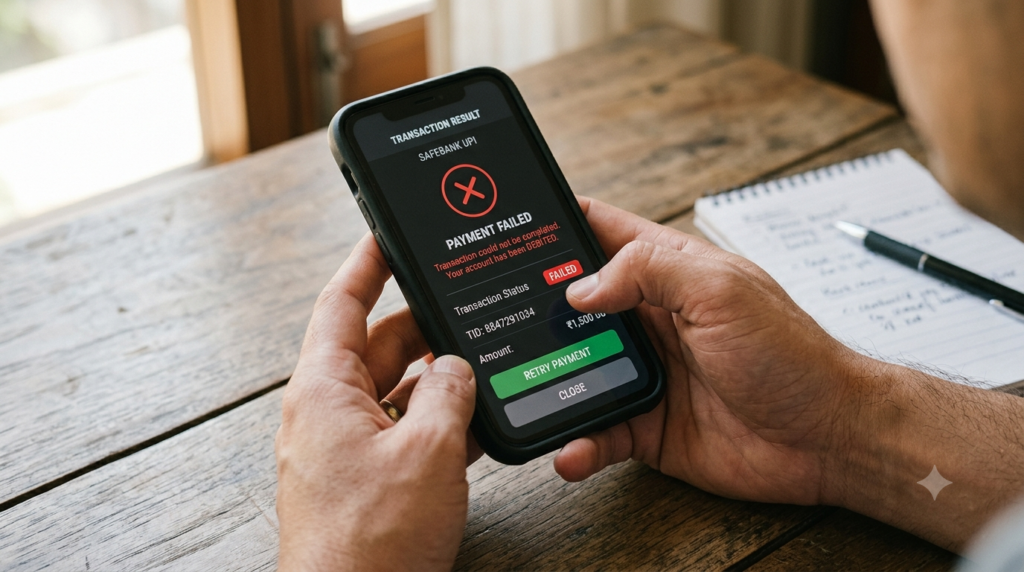
A TTD failed payment refund usually reaches your account within seven working days, so a deducted amount with no Tirumala darshan ticket is rarely lost money. Thousands of devotees hit this exact wall every booking window. The bank shows money gone, yet the Tirumala Tirupati Devasthanams (TTD) portal shows nothing confirmed. Because the rules here are clearer than most blogs admit, this guide walks you through what really happens, the official timeline, and the one mistake that turns one debit into two.
TTD failed payment refund at a glance
Here is the short version before the detail, since most readers just want the verdict fast.
- Official rule: if money is debited but no ticket is issued, TTD refunds it to your account within 7 working days from the transaction date.
- It is automatic: you usually do not need to file anything for a genuine failed transaction.
- Do not rebook instantly: wait, because a quick retry often creates a duplicate charge.
- Check first: log in and confirm whether the ticket actually got booked before you assume it failed.
- RBI backstop: if your bank delays the reversal, it owes you ₹100 per day as compensation.
Why your TTD payment failed but money was deducted
This gap happens because two systems must talk to each other in seconds, and one of them blinks. Your bank debits the amount instantly. The confirmation signal back to TTD, however, does not always arrive in time.
During peak release mornings the TTD servers carry enormous load. So the payment leaves your account, while the booking request times out before a ticket is generated. The money sits in transit, neither truly with TTD nor back with you yet.
Net banking carries the highest failure rate of all the options, since it depends on a second bank login mid-transaction. UPI and cards tend to behave better under load. When the session expires during payment, the same split result appears: a debit on your side, no receipt on theirs.
When a transaction shows as failed after a debit, TTD displays a line saying the receipt will be generated soon if the amount was deducted. That message is your first clue that the system already knows. In most cases a TTD failed payment refund is already in motion before you even call anyone.
First, check if the ticket actually booked
Before treating this as a failure, confirm it is one, because sometimes the ticket booked and only the confirmation page crashed. A quick check saves you from a needless second payment.
Log in to the official portal at tirupatibalaji.ap.gov.in using the same mobile number you booked with. Open your booking history or transaction history. If a confirmed ticket sits there, you are done, so simply download it.
If the transaction reads “failed” or “pending,” then no ticket exists yet. Now take a screenshot of your bank debit and note the transaction reference number. This evidence matters later if the refund stalls. Keep the booking reference too, even for a failed attempt, since support staff ask for it.
How the TTD failed payment refund actually works
A TTD failed payment refund is processed automatically to your original payment source when money is debited but no ticket is issued. TTD’s own booking guidelines state the amount returns within seven working days from the transaction date. You generally raise nothing; the system reverses it.
This matters because a popular myth says TTD never refunds online failures. That claim is wrong. The official TTD FAQ clearly commits to refunding failed transactions to the customer account. Refund initiation stays at TTD’s discretion, yet the policy itself is explicit and on record.
Every refund goes back through electronic transfer to the source you paid from. TTD does not hand out cash refunds under any circumstance. So a card payment returns to that card, while a UPI payment returns to that UPI-linked account.
One caution worth repeating: enter your details correctly during booking. If the payment profile and the booking profile mismatch, the reversal can be delayed or rejected. Accuracy at the start protects your money at the end.
TTD failed payment refund timeline by payment method
The headline figure is seven working days, but your payment method shifts the real-world speed. UPI reversals tend to land fastest. Credit card refunds often take the longest, because card networks add their own settlement step.
The table below sets realistic expectations for a TTD failed payment refund across the common methods. Treat these as typical ranges, since your bank adds its own processing window of two to three days on top.
| Payment method | Typical refund window | Notes |
|---|---|---|
| UPI (PhonePe, GPay, Paytm) | 2–5 working days | Usually the quickest; check the wallet first |
| Debit card | 5–7 working days | Returns to the same card account |
| Credit card | 7–10 working days | Slowest, due to card-network settlement |
| Net banking | 5–7 working days | Highest failure rate at booking |
If you paid by a card that has since expired, do not panic. Your bank normally maps the credit to the replacement card on the same account. Only a fully closed account needs a manual follow-up with your bank.
What the RBI rule means for your TTD failed payment refund
Here is the part most Tirumala guides skip entirely, and it is the strongest card in your hand. The Reserve Bank of India (RBI) protects you when a bank sits on a failed transaction. This is not a TTD policy; it is national banking law.
Under the RBI circular on Harmonisation of Turn Around Time (TAT) and Customer Compensation for Failed Transactions, banks must auto-reverse a failed digital payment within a set window. For card and online merchant payments that window is generally T+5 days, where T is the transaction date. If the bank misses it, the consequences fall on the bank, not you.
The compensation is concrete: ₹100 per day for every day of delay beyond the deadline. Crucially, this credit is meant to be automatic, so you should not have to beg for it. The penalty applies only when the failure was not your own mistake.
So you have two protections stacked together. TTD commits to a seven-day refund, while RBI rules force your bank to reverse stuck money and pay you for delays. Quote this RBI guideline by name if a bank representative stalls; it changes the conversation quickly.
TTD failed payment refund: what to do right now
Follow this sequence the moment you see a debit with no ticket, because order matters here. Acting calmly now prevents a second loss later.
- Stop. Do not click “Pay” again and do not rebook for at least 15–20 minutes.
- Screenshot the debit in your bank or UPI app, and note the transaction ID.
- Log in to the TTD portal and open your booking history to confirm the ticket did not book.
- Wait the window set by your payment method before expecting the reversal.
- Check daily across your bank SMS, your wallet, and the portal’s transaction history.
- Escalate only after the timeline lapses, with your screenshots ready.
If you genuinely need the ticket and can afford it, you may book again separately while the first amount returns on its own. Just keep both transaction records, so you can prove the duplicate if needed.
Mistakes that cost pilgrims money
The errors below turn a simple delay into a real loss, and they are entirely avoidable. Read them once before your next booking.
Rebooking in panic
Clicking pay again within seconds is the most common trap. The first payment may still be processing, so a second click can create a genuine duplicate charge. Then you wait on two refunds instead of zero.
Trusting fake “customer care” numbers
This one is dangerous, not merely annoying. Fraudsters plant fake TTD helpline numbers online and ask for your card details or OTP.
TTD itself warns devotees never to send money or share details with anyone claiming to assist with a booking. No real TTD officer ever asks for an OTP. Use only the official numbers listed further below.
Believing the “no refund” myth
Plenty of forum comments insist TTD will not return failed-payment money. That is outdated noise. The official policy refunds failed transactions, and RBI rules cover the bank side. Knowing this keeps you from giving up on money that is rightfully coming back.
How to escalate a TTD failed payment refund
If the TTD failed payment refund has not arrived after the expected window, escalate in a clear order. Start with the source closest to the money, then climb.
First, contact your own bank with the transaction ID and date, since the stuck amount usually sits on the bank’s side. Ask them to trace the reversal and quote the RBI TAT rule if they delay. Request the ARN or UTR reference number for follow-up.
Next, reach TTD support if the portal still shows the amount as taken with no refund flagged. The official toll-free helpline is 1800 425 4141 for general queries, and the WhatsApp line is 9399399399. You can also email helpdesk@tirumala.org with your screenshots attached.
Finally, if your bank ignores the rules after 30 days, file a complaint on the RBI complaint portal at cms.rbi.org.in under the Integrated Ombudsman Scheme. This is your strongest formal route, and banks respond to it.
Before you rebook
A debited amount with a failed Tirumala booking feels alarming, yet the money is almost always safe and on its way back. A TTD failed payment refund reaches your account within seven working days, and RBI rules force your bank to reverse stuck payments or compensate you.
Your job is simple: do not rebook in a panic, confirm the failure in your booking history, save your proof, and let the system work. Escalate with evidence only if the window lapses. For the booking itself, always use the official TTD portal or app and never a number you found in a random search result.
To plan the rest of your visit smoothly, see our guides on TTD free darshan online booking, the L1, L2 and L3 darshan levels, and how to download your darshan ticket.
Frequently asked questions
How long does a TTD failed payment refund take?
A TTD failed payment refund reaches your original payment source within seven working days from the transaction date, as per TTD’s official booking rules. Your bank may add two to three days on top. UPI is fastest, while credit cards take the longest.
My TTD payment was deducted but no ticket came. Will I get it back?
Yes, in almost every case. TTD automatically refunds transactions where money was debited but no ticket was issued. First confirm the failure in your booking history, then wait the refund window before escalating.
Should I book again immediately if the payment fails?
No, wait at least 15–20 minutes and check your booking history first. A quick retry often creates a duplicate charge because the first payment may still be processing. Rebook only after confirming nothing booked, and keep both records.
Does TTD give cash refunds?
No, TTD never refunds in cash. Every refund goes electronically to the original source of payment. A card payment returns to that card, and a UPI payment returns to the linked account.
What if my bank delays the refund?
RBI rules require banks to auto-reverse failed digital payments within a set window, generally T+5 days for card and merchant payments. If your bank misses it, you are owed ₹100 per day as compensation. Quote the RBI TAT circular and, if needed, complain at cms.rbi.org.in.
Which TTD number should I call about a failed payment?
Use only official TTD numbers, such as the toll-free line 1800 425 4141 or WhatsApp 9399399399. Never trust a helpline number from a random website or pay anyone claiming to assist. TTD warns that fraudsters use fake customer-care numbers.
Why does net banking fail more often on the TTD portal?
Net banking adds a second bank login during payment, which can time out under heavy server load on release mornings. UPI and cards usually handle peak traffic better. If net banking keeps failing, switch to a UPI app for a steadier attempt.
Do I need to submit documents for a failed-transaction refund?
Usually no, since a genuine TTD failed payment refund is processed automatically. For accommodation refunds or escalations, keep your booking reference, the transaction ID, and bank account details handy. Incorrect details can delay or reject the reversal.