
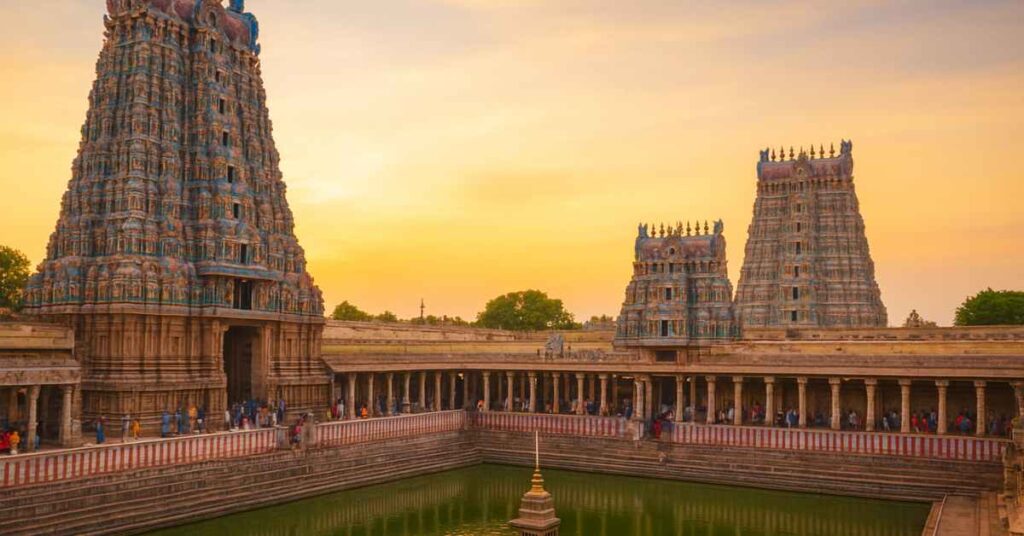
Explore the Meenakshi Amman Temple in Madurai: history, architecture, festivals, rituals & travel tips for an immersive pilgrimage experience.
Key Information at a Glance
- Timings: to Visit
Avoid major festival days if you prefer less crowding; however for ful - Entry/Ticket: Booking Pooja
The legend of the temple centres on the goddess Meenakshi, born
- Location: Madurai, Tamil Nadu, India
Deities
Goddess Meenakshi & Lord Sundareswa
Nestled in the heart of the sacred city of Madurai in Tamil Nadu, the Meenakshi Amman Temple stands as a vibrant testament to centuries of devotion, architectural mastery and cultural continuity. Dedicated to the goddess Meenakshi (a form of Parvati) and her consort Sundareswarar (a form of Shiva), this temple complex is much more than a place of worship — it is the spiritual and cultural axis of the region. In this blog we will delve into its history, mythology, architectural splendour, key rituals and festivals, pilgrimage advice and more — giving you a comprehensive guide for your visit or research.
Quick Facts
| Detail | Information |
|---|---|
| Location | Madurai, Tamil Nadu, India |
| Deities | Goddess Meenakshi & Lord Sundareswarar |
| Founded / Current Form | Ancient roots; present major structure from 16th-17th centuries |
| Architecture Style | Dravidian, with 14 towering gopurams and richly carved halls |
| Timings | Generally open ~5 :00 AM–12 :30 PM & 4 :00 PM–9 :30 PM |
| Special Features | Hall of Thousand Pillars, Golden Lotus Tank, Massive gopurams |
1. Spiritual Legend & Significance
The legend of the temple centres on the goddess Meenakshi, born to King Malayadwaja Pandya and Queen Kanchanamala, who according to myth had three breasts — the prophecy being that the third would vanish when she meets her destined husband. Lord Shiva appeared as Sundareswarar, they married in Madurai, thus melding divine love and rulership into a living temple tradition.
The temple thus symbolises the marriage of Shiva and Shakti, and by extension the harmony of masculine-feminine divine forces, making it profoundly significant in Shaivism and Shaktism. The complex also incorporates Vaishnava elements, reflecting inclusive spirituality.
For pilgrims, visiting the Meenakshi Amman Temple is not just darshan (viewing) of deities, but an immersion into Tamil religious culture, heritage and the living continuity of myth and community.
2. Historical Evolution
Early History
References to the shrine date back many centuries and it features in Tamil Sangam literature. The site has been an active temple centre for more than a millennium.
Medieval & Nayak Period
The present grand structure took shape during the Nayak rule (especially under Thirumalai Nayak, 1623-55 CE) who expanded the complex, built the pillared halls, and beautified the gopurams.
Modern Era
Today the temple remains a living, active religious site with ongoing rituals and festivals, administered under Tamil Nadu’s Hindu Religious & Charitable Endowments department.
The blend of ancient roots and evolving tradition makes it a compelling pilgrimage destination.
3. Architecture & Temple Layout
This temple complex is a masterpiece of Dravidian architecture.
- Gopurams (Gateway Towers): The complex has 14 gopurams, the southern tower rising to about 52 m (170 ft). They are covered in brightly coloured sculptures of deities, mythic creatures, guardians.
- Hall of Thousand Pillars (Ayiram-Kaal Mandapam): Although technically about 985 pillars, this hall features beautifully carved stone columns showing gods, musicians, attendants — a marvel of craftsmanship.
- Golden Lotus Tank (Potramarai Kulam): A sacred pond in the complex where ritual baths are taken and festivals held.
- Sanctum Sanctum & Shrines: Two main shrines for Meenakshi and Sundareswarar, with gilded vimanas above them.
- Sculptures & Inscriptions: Ancient inscriptions on the walls give insights into social and religious life of old Madurai.
Visiting the temple is akin to walking into a vibrant open-air museum of faith − every pillar, roof, wall has meaning.
4. Major Rituals & Festivals
Daily Rituals
The temple follows traditional timings: morning (Suprabhatam), mid-day, evening arati, night rituals. Devotees gather for darshan, offerings, and participate in the temple’s spiritual rhythm.
Key Festivals
- Chithirai Thiruvizha (April–May): One of the biggest festivals in Madurai. It enacts the divine wedding of Meenakshi and Sundareswarar, includes processions, cultural events, chariot festivals.
- Float Festival (Theppotsavam): Held on the lotus tank where deities are taken on floats in the evening of the Tamil month Thai (Jan-Feb).
These events draw massive crowds and enrich the pilgrimage experience with pageantry, tradition and devotional fervour.
5. Planning Your Visit
How to Reach
The temple is located in the city of Madurai, well connected by rail (Madurai Junction), road and air (Madurai Airport ~12 km away).
Best Time to Visit
Avoid major festival days if you prefer less crowding; however for full spiritual immersion the Chithirai festival time is spectacular.
Darshan & Timings
Typically open 5 AM–12 :30 PM and 4 PM–9 :30 PM. Allocate at least 2–3 hours for a relaxed visit; during festivals it may take 4–5 hours.
Dress Code & Etiquette
Wear modest attire; remove footwear before entering sanctum; mobile phones may be restricted in certain areas—many visitors store them at security due to temple rules.
What to See
Don’t miss the giant gopurams, the Hall of Thousand Pillars, the Golden Lotus Tank, and the intricate carvings throughout. Consider taking a guided temple tour to appreciate depth.
Nearby Attractions
Since the temple sits centrally in Madurai, you can pair your visit with the local bazaar, heritage walk around the city, nearby temples.
6. Why Meenakshi Amman Temple Stands Out
- It is not just a temple, but a vibrant religious-cultural complex shaping the life of the city of Madurai.
- Architecturally, its scale, colour, carvings and space are unmatched in South India.
- Spiritually, the temple’s devotion to the goddess as primary deity places it uniquely in the landscape of Hindu temples.
- For pilgrims and travellers both, the experience is immersive ― you don’t just visit the temple, you live its rhythm.
FAQs
Q1: Is photography allowed inside the temple sanctum?
A1: Photography is generally restricted in certain inner sanctum areas and many phone/camera devices may need to be deposited at security.
Q2: Are non-Hindus allowed inside?
A2: Yes, the complex is open to all visitors; however access to some inner sanctum sections may vary.
Q3: Can I attend the festival? When is the best time?
A3: Yes — attending the Chithirai festival gives a powerful experience of the temple’s living tradition. Visit during April–May.
Q4: How much time should I allocate for the visit?
A4: Minimum 2–3 hours for darshan and architecture; 4–5 hours during busy times or festival.Meenakshi Amman Temple
Q5: Are there special sevas or offerings?
A5: Yes — the temple offers various rituals, sevas and you can check with the temple board for current offerings.
The Meenakshi Amman Temple is a shimmering jewel of Tamil-Nadu’s spiritual heritage, an architectural wonder and a vibrant centre of faith. Whether you arrive as a pilgrim seeking divine darshan or as a visitor drawn to history and art, this temple offers a profound encounter with devotion, culture and living tradition. Make your visit with respect, openness and curiosity and you will carry away memories both visual and spiritual.
Usefull Links
- Tirumala Venkateswara Temple Guide
- Sabarimala Temple Yatra Details
- Rameswaram Ramanathaswamy Temple History
- Official Meenakshi Amman Temple Website
- Tamil Nadu Tourism – Meenakshi Temple Page
Author Box
Author: Gokshetra Blog Writer (Alpha v4)
About Me: Specialist in Hindu temple heritage and pilgrimage coverage for Gokshetra.com
Important Tips for Visitors
- Remove footwear before entering the temple premises. Shoe storage is usually available near the entrance.
- Carry a valid ID proof — some temples require it for special darshan or accommodation booking.
- Visit during weekdays for shorter queues. Weekends and festival days see significantly higher footfall.
- Wear modest, traditional clothing — most temples require covered shoulders and knees.