
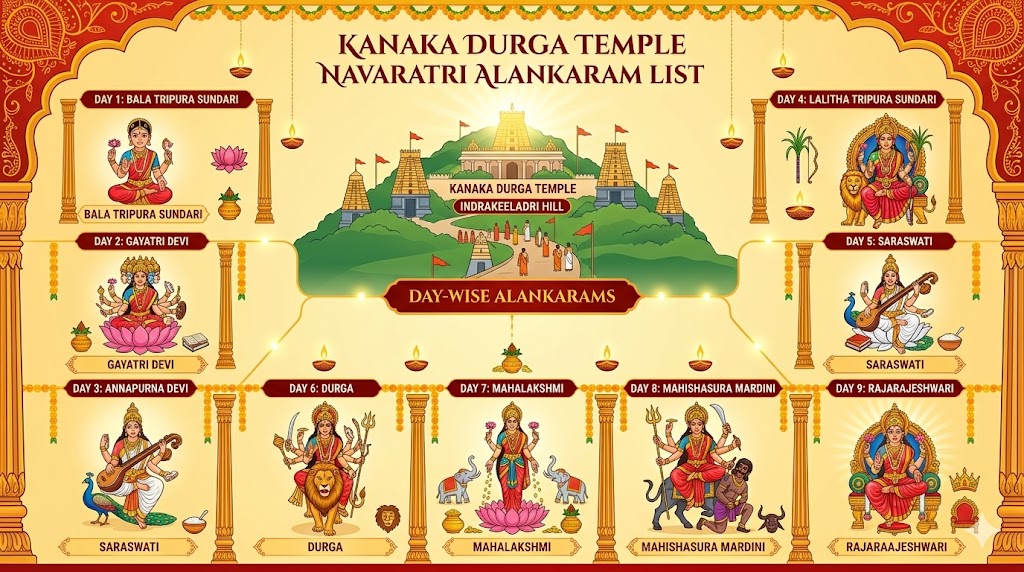
The Kanaka Durga Temple Navaratri Alankaram List is one of the most sacred traditions celebrated during the grand Dasara festival at the famous Kanaka Durga Temple in Vijayawada, Andhra Pradesh. During Navaratri, Goddess Kanaka Durga is adorned in different divine forms for nine days, each representing a unique aspect of the Goddess and symbolising spiritual power, protection, prosperity, and wisdom. Thousands of devotees visit the temple every day during this festival to witness the special alankarams and seek the blessings of the Goddess.
Key Information at a Glance
- Timings: during the festival
- Location: on Indrakeeladri Hill near the Krishna River in Vijayawada, Andhra Pradesh
The Navaratri celebrations at the Kanaka Durga Temple are known as Sri Durga Malleswara Swamy Varla Devasthanam Dasara Festival, which attracts pilgrims from across India. Each day, the Goddess appears in a different avatar such as Sri Bala Tripura Sundari, Sri Gayatri Devi, Sri Annapurna Devi, and Sri Mahishasura Mardini, among others. These divine alankarams represent the victory of good over evil and the divine feminine energy that protects devotees.
This guide explains the complete Kanaka Durga Temple Navaratri Alankaram List, including day-wise goddess forms, spiritual significance, festival timings, and important details for devotees planning to visit the temple during Navaratri.
Kanaka Durga Temple Navaratri Alankaram List – Complete Guide
The Kanaka Durga Temple Navaratri Alankaram List represents the different divine forms of Goddess Durga worshipped during the nine-day Navaratri festival.
Each day of Navaratri features a unique alankaram that symbolises a powerful aspect of the Goddess.
About Kanaka Durga Temple Vijayawada
- Kanaka Durga Temple is one of the most famous Shakti temples in South India.
- The temple is located on Indrakeeladri Hill near the Krishna River in Vijayawada, Andhra Pradesh.
- Devotees believe that Goddess Kanaka Durga appeared here to destroy the demon Mahishasura and protect the world.
- Therefore, the temple is considered extremely powerful during Navaratri.
Kanaka Durga Temple Navaratri Alankaram List (Day Wise)
During Navaratri, the Goddess is decorated in different divine forms each day.
Day 1 – Sri Bala Tripura Sundari Devi
The first day of Navaratri features Bala Tripura Sundari, the youthful form of the Goddess.
Spiritual meaning:
- Symbol of innocence and purity
- Represents divine feminine energy at its earliest stage
Day 2 – Sri Gayatri Devi
On the second day, the Goddess appears as Gayatri Devi, the embodiment of the Gayatri Mantra.
Spiritual significance:
- Represents knowledge and wisdom
- Symbol of spiritual enlightenment
Day 3 – Sri Annapurna Devi
On the third day, the Goddess appears as Annapurna Devi, the provider of food and nourishment.
Meaning:
- Symbol of abundance
- Represents compassion and nourishment
Day 4 – Sri Lalitha Tripura Sundari
The fourth day features the form of Lalitha Tripura Sundari.
Significance:
- Represents beauty, grace, and divine power
- One of the important forms in Shakta tradition
Day 5 – Sri Saraswati Devi
The Goddess is worshipped as Saraswati, the goddess of learning and arts.
Meaning:
- Symbol of wisdom
- Patron of education and knowledge
Day 6 – Sri Durga Devi
On the sixth day, the Goddess appears in her powerful Durga form.
Significance:
- Represents courage and protection
- Destroyer of evil forces
Day 7 – Sri Mahalakshmi Devi
The seventh day is dedicated to Mahalakshmi, the goddess of wealth and prosperity.
Meaning:
- Symbol of financial prosperity
- Blessings for success and abundance
Day 8 – Sri Mahishasura Mardini
On the eighth day, the Goddess appears as Mahishasura Mardini, the slayer of the demon Mahishasura.
Significance:
- Symbol of victory of good over evil
- Represents divine strength
Day 9 – Sri Rajarajeshwari Devi
The ninth day features Rajarajeshwari Devi, the supreme form of the Divine Mother.
Meaning:
- Represents universal mother energy
- Symbol of ultimate power and compassion
Day 10 – Sri Vijayadashami Alankaram
- The tenth day marks Vijayadashami, celebrating the victory of good over evil.
- The Goddess is worshipped with grand celebrations and special rituals.
Importance of Navaratri at Kanaka Durga Temple
Navaratri is the most important festival celebrated at the temple.
During this period:
- Lakhs of devotees visit the temple
- Special alankarams are performed daily
- Cultural and religious events take place
Therefore, Vijayawada becomes a major pilgrimage destination during the festival.
Darshan Timings During Navaratri
The temple operates extended darshan hours during the festival.
Typical timings:
| Activity | Time |
|---|---|
| Temple Opening | 4:00 AM |
| Morning Darshan | 4:00 AM – 12:00 PM |
| Afternoon Break | 12:00 PM – 3:00 PM |
| Evening Darshan | 3:00 PM – 10:00 PM |
Timings may change depending on festival arrangements.
Tips for Devotees Visiting During Navaratri
If you plan to see the Kanaka Durga Temple Navaratri Alankaram, consider the following tips.
- Arrive early to avoid heavy crowds
- Use online darshan booking if available
- Follow temple dress code
- Carry drinking water and essentials
These steps help ensure a smooth pilgrimage.
FAQ – Kanaka Durga Temple Navaratri Alankaram List
What is the Navaratri alankaram at Kanaka Durga Temple?
During Navaratri, the Goddess is decorated in different divine forms each day.
How many alankarams are performed?
There are nine main alankarams during Navaratri.
Which day is most important during Navaratri?
Mahishasura Mardini Alankaram (Day 8) is considered very powerful.
Where is Kanaka Durga Temple located?
The temple is located in Vijayawada, Andhra Pradesh.
When does the Navaratri festival start?
Navaratri begins on Ashwayuja Shuddha Padyami according to the Hindu calendar.
External Official Links
Kanaka Durga Temple Official Website
Andhra Pradesh Tourism
Important Tips for Visitors
- Wear modest, traditional clothing — most temples require covered shoulders and knees.
- Arrive early morning for a peaceful darshan experience — most temples are less crowded before 8 AM.
- Photography may be restricted inside the main sanctum. Check with temple authorities before clicking pictures.
- Remove footwear before entering the temple premises. Shoe storage is usually available near the entrance.
Official Resources

V S Anantha Sharma is a Senior Content Researcher at Go Kshetra with over 20 years of experience in Indian archaeology, temple architecture, and Hindu pilgrimage traditions. A lifelong devotee and...
Go Kshetra covers 1,600+ Hindu temples across 28 states. Content sourced from official temple websites and first-hand visits. About our editorial process