
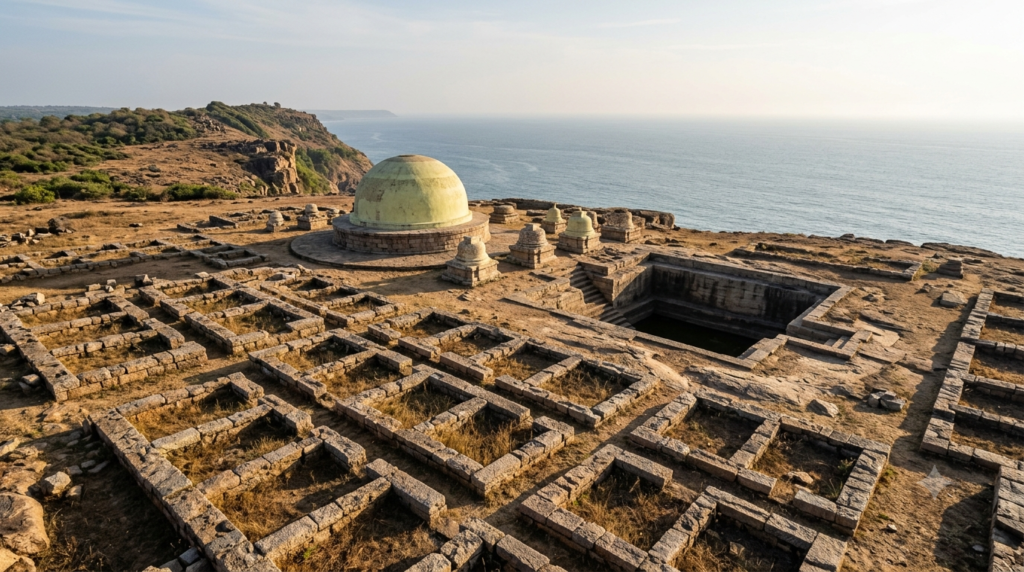
The Thotlakonda Buddhist Complex sits on a windswept hill roughly 15 km from Visakhapatnam. Most visitors reach the top without knowing what they are actually looking at. Ruins of a 2,000-year-old monastery spread across the plateau, while the Bay of Bengal fills the horizon below.
A full walk takes barely ninety minutes, yet the site rewards anyone who arrives with some context. This guide covers timings, entry, access, history and one detail almost every other page gets wrong.
Go Kshetra is an independent travel and heritage guide. We are not affiliated with the Andhra Pradesh Department of Archaeology and Museums, and we accept no bookings, tickets or payments. Because gate rules change without notice, confirm current timings and charges through the official channels linked below.
Thotlakonda Buddhist Complex at a Glance
- Location: Hill near Chepaluppada on Bheemili Beach Road, about 15 km north of Visakhapatnam city
- Elevation: Roughly 128 metres above sea level
- Period: Active from about the 2nd century BCE to the 2nd century CE
- Timings: Daytime only; published sources give either 9:00 AM to 6:00 PM or 10:00 AM to 5:00 PM
- Entry: Reported as free by many sources, though a small gate charge appears in some visitor accounts
- Time needed: 60 to 120 minutes
- Protected by: Andhra Pradesh state government, not the Archaeological Survey of India
What Is the Thotlakonda Buddhist Complex?
The Thotlakonda Buddhist Complex is a hilltop monastery site near Bheemunipatnam in Andhra Pradesh. Monks lived, studied and meditated here for roughly four centuries. Today the plateau holds a rebuilt Maha Stupa, votive stupas, viharas, a congregation hall, a refectory and rock-cut water cisterns. Those cisterns give the hill its Telugu name, which translates loosely as hill of troughs.
Excavations recovered Satavahana lead coins and Roman silver coins. That mix tells you something specific about the place. This was not an inland retreat but a coastal stop on a busy maritime trade route.
Archaeologists also found terracotta tiles, stucco panels, miniature stone stupa models and carved Buddha footprints. Twelve inscriptions turned up as well. Linguists reading them suggest the hill may once have been called Senagiri, from the Pali word for elder or superior.
Thotlakonda Buddhist Complex Timings and Entry Fee
The site opens during daylight hours only, and published timings genuinely conflict. Some listings give 9:00 AM to 6:00 PM, while others state 10:00 AM to 5:00 PM. Treat 10:00 AM to 5:00 PM as the safe planning window, since it falls inside both.
Entry is a similar story. Most tourism pages report free access for pedestrians, although several visitor accounts mention a nominal charge collected at the gate. Vehicle or parking charges may also apply on some days.
Because no single portal publishes a definitive schedule, confirm before you travel. The Visakhapatnam district administration and Andhra Pradesh Tourism are the right places to ask.
| Detail | What to expect |
|---|---|
| Opening window | Safest assumption: 10:00 AM to 5:00 PM, daily |
| Entry charge | Free in most reports; small gate fee possible |
| Parking | Available near the base; charge possible |
| Guides | Informal, arranged on site; no fixed tariff |
| Photography | Permitted; no drone without permission |
| Facilities | Limited; no on-site museum |
How to Reach the Thotlakonda Buddhist Complex
By road from Visakhapatnam
The drive along Bheemili Beach Road is the easiest option. Expect roughly 40 to 50 minutes from the city centre in normal traffic. A taxi typically costs a few hundred rupees each way, though app-based fares swing with demand.
The turn-off climbs a short surfaced road to the site. Drivers can go most of the way up, so this route suits families and older travellers.
By bus or auto
APSRTC buses towards Bheemunipatnam run along the beach road throughout the day. Ask the conductor to stop near the Thotlakonda turning. After that you face a walk of one to two kilometres uphill, which is hard work in afternoon heat.
Shared autos cover parts of the same route. Still, many drivers will not climb the hill road, so agree the drop point before you start.
By train and air
Visakhapatnam Junction is the nearest major railhead, around 18 to 20 km away. Visakhapatnam International Airport lies roughly 20 to 22 km from the site. Both connect easily by taxi, and neither requires an overnight stop.
The Maha Stupa Story Most Guides Leave Out
Here is the detail that changes how you look at the summit. In October 2019, part of the Maha Stupa collapsed after prolonged monsoon rain. The structure had been reconstructed only three years earlier, in 2016, so the failure caused a public row about restoration standards.
The Hindu reported in September 2021 that the Maha Stupa had been restored again, at a cost of around ₹42 lakh. What you photograph today is therefore substantially rebuilt masonry rather than untouched ancient stonework.
This matters for two reasons. First, it explains why some walls look crisp while others look genuinely weathered. Second, it is why conservationists keep pressing for stricter oversight of work at the site.
History of the Thotlakonda Buddhist Complex
The Thotlakonda Buddhist Complex came to light almost by accident. An Indian Navy aerial survey spotted the ruins in the 1970s while scouting land for a base. The Andhra Pradesh State Archaeology Department then excavated the hill between 1988 and 1993. Those digs confirmed a Nikaya Buddhist establishment that flourished around two thousand years ago.
Thotlakonda lay within the reach of ancient Kalinga, a region that carried Buddhism to Sri Lanka and Southeast Asia. Pilgrims sailing the coast used it as a resting point before travelling north. The tall stupas, plastered in pale lime and lit by rows of wick lamps at night, likely worked as navigation markers.
There is no evidence of royal patronage here. Traders and local lay followers appear to have funded the sangha instead. At its peak the monastery may have housed more than a hundred bhikkhus.
Worship followed aniconic conventions, meaning the Buddha was honoured through symbols rather than human figures. Padukas, or sacred footprints, and the ashtamangala symbols served that purpose. Activity faded by the end of the 3rd century CE as trade patterns shifted.
What You Actually See at the Thotlakonda Buddhist Complex
The layout reads clearly once you know the vocabulary. Walk the perimeter path first, then work inward towards the stupa.
- Maha Stupa: The central dome, rebuilt after the 2019 collapse
- Votive stupas: Small offering structures clustered nearby
- Viharas: Cell blocks where monks slept and studied
- Chaitya grihas: Prayer halls, some on an apsidal plan
- Congregation hall and refectory: Communal spaces with stone platforms
- Rock-cut cisterns: Deep troughs that stored monsoon rainwater
Interpretive boards stand beside the main structures. They are brief, so read them before you wander, because the layout makes far more sense afterwards.
Best Time to Visit
October to February is the clear winner for visiting the Thotlakonda Buddhist Complex. Coastal humidity drops, and the hilltop breeze turns pleasant rather than punishing. March through May gets genuinely harsh, since almost nothing on the plateau offers shade.
Within the day, aim for opening time or the last two hours before closing. Low sun brings out the texture of the stonework, and the sea light is better for photographs. Weekdays are also noticeably quieter than weekends.
Monsoon visits work if you accept the risk. Access can be slippery after heavy rain, though the greenery is at its best.
Pair Thotlakonda With the Rest of the Vizag Buddhist Trail
This is where most itineraries fall short. Thotlakonda is one of four excavated Buddhist sites within reach of Visakhapatnam, and seeing two or three together makes the history land properly.
| Site | Distance from Vizag | Why go |
|---|---|---|
| Thotlakonda | About 15 km | Sea views, rebuilt Maha Stupa, cisterns |
| Bavikonda | About 16 km | Well-signposted layout, apsidal chaitya |
| Pavurallakonda | About 25 km | Quiet hilltop, rock-cut cisterns, few visitors |
| Bojjannakonda | About 40 km | Rock-cut caves and carvings at Sankaram |
Thotlakonda and Bavikonda pair naturally in a single morning, since they sit close together on the same side of the city. Add Bojjannakonda near Anakapalli only if you have a full day.
Andhra Pradesh has announced plans for an integrated Buddhist heritage circuit linking these coastal sites with Amaravati and Nagarjunakonda. Facilities may improve as that work progresses, although timelines have slipped before.
Facilities, Access and a Practical Safety Note
Amenities at the Thotlakonda Buddhist Complex are thin. There is no museum, no cafe inside the complex and limited shade. Some refreshment and parking options exist near the base, but do not count on them.
The walking surface is uneven stone and packed earth, with short flights of steps between levels. Wheelchair access is not practical across most of the site. Visitors with knee or balance problems should take the vehicle route to the top and explore only the level central area.
Heat is the real hazard here. Carry water, wear a hat and avoid the midday hours between March and June. Anyone elderly, pregnant, or managing a heart or respiratory condition should plan a short early-morning visit and consult a doctor beforehand if unsure.
Insider Tips for the Thotlakonda Buddhist Complex
- Go up, then walk down: Drive to the top and explore on the level, rather than climbing from the base
- Talk to the site staff: Guards here often know the layout well and explain it generously
- Carry small cash: Parking or informal guide charges are rarely digital
- Combine with the coast: Rushikonda and Bheemili beaches sit on the same road
- Watch the wind: The plateau is exposed, so secure hats and loose papers
- Skip drones: This is a protected monument, and permissions are required
Common Mistakes First-Time Visitors Make
Arriving at noon in summer tops the list. The plateau bakes, and there is nowhere comfortable to wait it out. Assuming full facilities comes second, because visitors regularly turn up without water expecting a canteen.
A third mistake is booking transport that stops short of the hill. Confirm the drop point with your driver, or you will walk the final stretch uphill. Finally, many people ignore the signage entirely and leave without understanding what they walked through.
Before You Go
Treat Thotlakonda as a ninety-minute heritage stop rather than a half-day destination. Go early, carry water, and confirm timings before you set out, since published hours disagree. Pair it with Bavikonda if you want the history to make sense, and read the boards on site instead of skimming past them. Above all, remember that much of what stands today was rebuilt after the 2019 collapse, which makes the surviving original fabric more interesting, not less.
For official information, refer to the Visakhapatnam district tourism department, Andhra Pradesh Tourism Development Corporation and the Ministry of Tourism listing for Thotlakonda. The 2021 restoration was reported by The Hindu.
Planning a wider Andhra trip? Our guides to Simhachalam Temple darshan timings and the Amaravati temple at Guntur cover the other major stops nearby. Readers drawn to monastic history may also enjoy our Hemis Monastery guide.
Frequently Asked Questions
Is there an entry fee at the Thotlakonda Buddhist Complex?
Most tourism sources report free pedestrian entry, although some visitor accounts describe a small charge collected at the gate. Parking or vehicle charges may also apply. Because reports conflict, carry a little cash and confirm at the entrance on arrival.
What are the Thotlakonda Buddhist Complex timings?
Published sources give either 9:00 AM to 6:00 PM or 10:00 AM to 5:00 PM, daily. Planning around 10:00 AM to 5:00 PM keeps you safely inside both windows. Confirm locally before travelling, since the site has no dedicated booking portal.
How far is Thotlakonda from Visakhapatnam?
The site lies about 15 km from the city along Bheemili Beach Road. Driving usually takes 40 to 50 minutes. Buses towards Bheemunipatnam run the same route, but they stop one to two kilometres short of the complex.
How long should I spend at the site?
Allow 60 to 90 minutes for a relaxed walk, and up to two hours if you read every interpretive board. Photographers often stay longer for the sea views. Adding Bavikonda afterwards makes a comfortable half-day.
Is Thotlakonda an Archaeological Survey of India monument?
No, and this is a common error online. Thotlakonda is protected by the Andhra Pradesh state government under the state monuments and archaeological sites legislation of 1960, and was notified as protected in 1978. State archaeology, not ASI, has led excavation and restoration here.
Is the Maha Stupa original?
Largely no. The stupa was reconstructed in 2016, partially collapsed during heavy rain in October 2019, and was restored again by September 2021. The base and surrounding structures retain far more original fabric than the dome itself.
Can I visit Thotlakonda and Bavikonda on the same day?
Yes, comfortably. The two hills sit roughly 15 and 16 km from Visakhapatnam on the northern side of the city. Most travellers cover both in a single morning with a taxi, then return for lunch.
Is the site suitable for children and elderly visitors?
Children generally enjoy the open space, though the paths are uneven and unfenced in places. Older visitors should use the vehicle route to the top and stay on level ground. Avoid midday heat, carry water, and take breaks in whatever shade you find.