
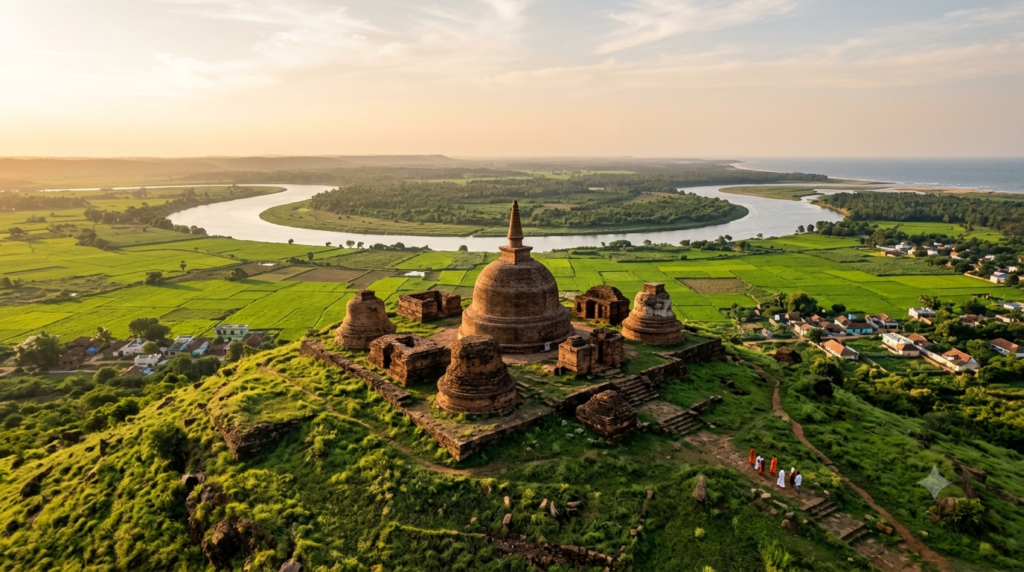
This Salihundam visiting guide gives you verified timings, entry details, and a practical plan for one of Andhra Pradesh’s most rewarding Buddhist heritage sites. Salihundam sits on a hilltop above the Vamsadhara River in Srikakulam district, and its ruined stupas span the 2nd century BCE to the 12th century CE. Most pages online repeat vague or wrong timings and mix it up with active-temple rituals. Here you get the real picture: free entry, honest travel distances, what the museum actually holds, and how to fold the visit into a full day of Srikakulam heritage.
Go Kshetra is an independent travel and heritage guide. We are not affiliated with the Archaeological Survey of India, the Andhra Pradesh Tourism Department, or any government body, and we do not sell tickets or take bookings. Always confirm current timings and fees at the site or on the official portals linked below.
Salihundam Visiting Guide: Key Facts at a Glance
Here are the essentials before you set out, so you can plan the drive and the hours you’ll need on site.
- Location: Hilltop on the south bank of the Vamsadhara River, Gara Mandal, Srikakulam district, Andhra Pradesh (PIN 532405).
- Distance: About 18 km from Srikakulam town and roughly 5 km west of Kalingapatnam.
- Entry fee: Free — there is no ticket charge for Indian or foreign visitors.
- Timings: Open through daylight hours, generally around 9 AM to 5 PM; confirm locally as hours are not always posted.
- Time needed: Plan 2 to 3 hours for the stupas, the museum, and the views.
- Best season: October to February, when the hilltop is cool enough to walk comfortably.
Why Salihundam Is Worth the Detour
Salihundam draws history lovers, photographers, and travellers who want something quieter than a crowded temple town. Notably, the ruins show Buddhism evolving through three traditions on one hill. Because so few tourists come here, you often get the whole ridge almost to yourself.
The setting does half the work. Paddy fields stretch below, the river bends past the base, and the brick stupas catch a warm glow at sunrise and sunset. This is offbeat Andhra travel at its best, a quiet contrast to the busier Andhra Pradesh temple trails most pilgrims follow. This Salihundam visiting guide focuses on the practical details that make the trip smooth.
Salihundam Visiting Guide: History and Significance
Salihundam’s story runs back more than two thousand years. The site was brought to light in 1919 by Gidugu Venkata Rama Murthy, the Telugu scholar and language reformer. Later excavations by state authorities uncovered four stupas, relic caskets, a chaityagriha, structural shrines, and many sculptures.
Historically the place was called Salivatika, meaning “rice emporium,” a nod to its role in ancient Kalinga trade. Some records also call it Salyapetika, or “box of relics,” after the caskets found here. Whichever name you follow, the hill was a busy centre of Buddhist learning for over a thousand years.
Inscriptions in the Brahmi script, written in Prakrit and Sanskrit, were found across the complex. From this coast, Buddhism spread onward to Sumatra and other parts of Southeast Asia. That trade-and-faith link is what gives the site its wider importance. Today the ruins are cared for as a protected monument, with the Archaeological Survey of India and the state involved in conservation.
The Three Phases of Buddhism Here
What makes Salihundam special is that one hill records three stages of the religion. The remains reflect Theravada, then Mahayana, and finally Vajrayana practice. Sculptures of the goddesses Tara and Marichi, both Vajrayana figures, were recovered here.
So a single walk takes you across roughly 1,400 years of change. Few sites in South India layer the traditions this clearly. Since the museum labels are sparse, a little background before you go makes the stones far more readable.
Salihundam Visiting Guide: Entry Fee and Timings
Entry to Salihundam is free, and the site is open through daylight hours across the year. Because it is a protected heritage monument with limited staffing, exact opening and closing times are not always displayed, so treat the hours below as indicative and confirm on arrival.
| Detail | Information |
|---|---|
| Entry fee | Free for all visitors (no ticket) |
| Opening hours | Daylight hours, commonly ~9 AM–5 PM; confirm locally |
| Open days | Throughout the year |
| Ideal duration | 2–3 hours for site and museum |
You may see older listings quoting a small ten-rupee charge or fixed evening hours. These are outdated or inaccurate, so do not plan around them. If a caretaker is present, a small tip for guidance is welcome but never required.
Salihundam Visiting Guide: How to Reach the Site
Salihundam is easiest to reach by road, though train and air work with a final road leg. Below is each option with honest distances so you can judge the day.
By road: Road is the practical choice for most visitors. The site lies about 18 km from Srikakulam town on the route toward Kalingapatnam, with good surfaced roads. Local buses run from Srikakulam toward Gara and Kalingapatnam, but they may not stop right at the monument. Because the last stretch can be a walk, a taxi or private vehicle is the most convenient way in.
By train: The nearest major railhead is Srikakulam Road Railway Station, also called Amadalavalasa, roughly 20 to 28 km away. It sits on the busy Chennai–Howrah line, so trains from Visakhapatnam, Vijayawada, and beyond stop here. From the station you can hire a taxi or catch a local bus toward the site.
By air: The closest airport is Visakhapatnam International Airport, around 110 to 120 km south. After landing, hire a cab or take a bus to Srikakulam, then continue by road to Salihundam. Since the drive from Vizag takes roughly three hours, an early start helps if you want a relaxed visit.
Salihundam Visiting Guide: Best Time to Visit
The cooler months from October to February are ideal, because daytime temperatures stay pleasant for the uphill walk. Summer on the exposed hilltop turns hot and humid, which makes exploring tiring. If you must come in the warmer season, go early or late in the day.
Early morning and late afternoon also give the best light. The low sun warms the brick and lengthens the shadows across the ruins. Many visitors make the mistake of arriving at midday, when the heat is harsh and photographs fall flat. For that reason, this Salihundam visiting guide always points first-timers toward the cool season and the softer hours.
Salihundam Visiting Guide: What to See on the Hill
The hill packs a lot into a compact area. Between the stupas, the little museum, and the river views, there is more to absorb than first appears. This part of the Salihundam visiting guide walks through the highlights in the order you will meet them.
Stupas and the Mahastupa: Dozens of stupas of different sizes dot the ridge, since they were built in earthy brick and stone over many centuries. A large Mahastupa anchors the group, while smaller votive and monolithic stupas ring it. Several also show wheel motifs and geometric patterns from different Buddhist periods, so each one repays a slow look.
The site museum: A small museum near the base displays finds from the excavations. Inside you will see sculptures of Tara and Marichi, relief panels, and rock-cut statues dated between roughly the third and seventh centuries. Walking the museum after the ruins ties the loose stones back to real people and rituals. Labels are minimal, so read up first or ask the attendant.
Hilltop views and photography: From the summit you look out over paddy fields, the Vamsadhara River, and scattered villages. For many, this panorama is the highlight of the whole trip. The sunset is especially memorable, since golden light spills over ancient brick and green fields. Carry a wide lens if you have one, because the sweep is hard to capture otherwise.
Salihundam Visiting Guide: Insider Tips
A few practical habits make the visit smoother, and this Salihundam visiting guide leans on what regular heritage travellers learn the hard way.
- Wear sturdy shoes: The paths climb over uneven, rocky ground.
- Carry water and a snack: There are almost no shops or stalls at the ruins.
- Sun-proof yourself: A hat, sunscreen, and light cotton clothing matter on the open hill.
- Read before you arrive: With few signboards, prior context makes the site come alive.
- Respect the monument: Do not climb on or touch the fragile stupas and carvings.
A quick safety note: the climb is short but uneven, so pilgrims who are elderly, pregnant, or have knee or heart trouble should take it slowly and rest in the shade. Bring any regular medication, since help is not close by. This is a heritage walk, not a strenuous trek, yet the heat is the real hazard.
A Suggested One-Day Srikakulam Heritage Trip
Salihundam pairs beautifully with the temples and coast nearby, and no single official page maps this out. This Salihundam visiting guide combines archaeology with the local Indian temple pilgrimage route into one day. Here is a plan that works well from Srikakulam or Vizag.
- Morning: Start at the Arasavalli Sun Temple for early darshan, one of India’s rare surviving sun shrines.
- Late morning: Drive to Srikurmam, the unusual temple to Vishnu in his tortoise form.
- Midday: Head to Salihundam for the stupas, museum, and hilltop views.
- Evening: Finish at Kalingapatnam Beach, where the Vamsadhara meets the Bay of Bengal.
This loop mixes faith, archaeology, and coastline in one relaxed day. Because the sites sit within a short radius, you avoid long backtracking. Keep water and snacks in the car, since roadside options thin out between stops.
Salihundam Visiting Guide: Nearby Places to Visit
The wider Srikakulam district holds several worthwhile stops close to Salihundam. If you have more than a day, these round out the region nicely.
- Arasavalli Sun Temple: A rare temple to Surya, famous for sunrise rays reaching the deity on certain days.
- Srikurmam Temple: A Kurma (tortoise) form of Vishnu, wrapped in Kalinga carvings and old inscriptions.
- Srimukhalingam Temple: A striking Shiva temple and a fine example of Kalinga architecture.
- Kalingapatnam Beach: A quiet river-mouth beach, good for an evening wind-down.
Salihundam also belongs to Andhra’s wider Buddhist circuit. Farther south near Vizag lie Thotlakonda, Bavikonda, and Bojjannakonda, all hilltop Buddhist ruins. Together they trace the religion’s long presence along this coast.
Salihundam Visiting Guide: Common Mistakes to Avoid
A little planning prevents the usual regrets, so this Salihundam visiting guide flags the slips travellers hit most. Because the site is quiet and lightly signed, these mistakes are easy to make:
- Rushing in 30 minutes: The site is larger than it looks, so give it a couple of hours.
- Expecting a grand monument: Salihundam is modest in scale but rich in layered history.
- Arriving at midday in summer: The open hill gets punishing, and shade is scarce.
- Skipping the museum: Many walk the ruins and leave, missing the best-preserved sculptures.
- Assuming buses drop you at the gate: Confirm transport, or the last stretch becomes a hot walk.
Final Thoughts
Salihundam is a quiet doorway into India’s Buddhist past, set on a hill that rewards the curious. This Salihundam visiting guide has covered the verified timings, honest travel distances, the museum, and a full day around the ruins. Come in the cool season, start early, and give yourself time for both the stupas and the museum. Pair it with a nearby temple or the coast, and you join one of India’s great heritage journeys in a corner few travellers reach.
Frequently Asked Questions
Is there an entry fee for Salihundam?
No, entry to the Salihundam Buddhist monuments is free for both Indian and foreign visitors. There is no ticket counter. If a caretaker guides you, a small voluntary tip is appreciated but not required.
What are the Salihundam timings?
The site is open through daylight hours all year, commonly cited as around 9 AM to 5 PM. Hours are not always posted, so confirm at the site. Morning and late afternoon are the best windows for cool weather and good light.
How long does a Salihundam visit take?
Plan for 2 to 3 hours. That covers the stupas on the hill, the site museum, and time to enjoy the river views. History buffs and photographers often stay longer.
How do I reach Salihundam from Visakhapatnam?
Salihundam is about 110 to 120 km from Visakhapatnam, roughly a three-hour drive. Take a cab or bus to Srikakulam, then continue by road toward Kalingapatnam. There is no rail station within about 10 km of the site.
Can I photograph the site?
Yes, photography is allowed across the open ruins and is one of the joys of the visit. Early morning and late afternoon light suit the brick stupas best. Avoid climbing on the structures to get a shot.
Are guides available at Salihundam?
A monument attendant or informal local guide is sometimes present near the entrance, though advance booking is uncommon. Signboards are limited, so a guide or some prior reading adds a lot. This Salihundam visiting guide covers the key context you will want.
Is Salihundam suitable for children and elderly visitors?
Yes, with care. The climb is short but the ground is uneven, so supervise children and let older visitors pace themselves. Carry water, sun protection, and any needed medication, since facilities on the hill are minimal.