
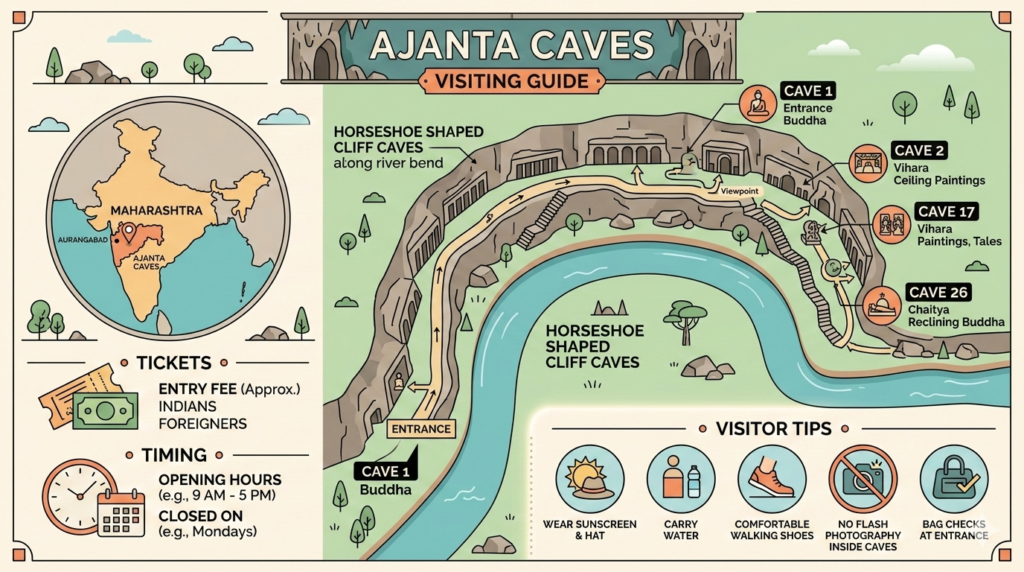
This Ajanta Caves visiting guide answers the most important question travellers ask: How do you properly explore Ajanta Caves without missing the highlights? The short answer — arrive early, prioritise key caves like 1, 2, 16, 17, and 26, and plan at least 3–4 hours to experience the site properly.
Key Information at a Glance
- Timings: to experience the site properly
- Entry/Ticket: ₹40 for Indian visitors and ₹600 for foreign tourists
- Location: in Maharashtra about 105 km from Aurangabad, the Ajanta Caves form one of the mo
Located in Maharashtra about 105 km from Aurangabad, the Ajanta Caves form one of the most significant archaeological landmarks in Asia. These 30 rock-cut Buddhist caves were carved into a horseshoe-shaped basalt cliff between the 2nd century BCE and the 6th century CE. Inside, visitors find ancient monasteries, prayer halls, sculptures of the Buddha, and some of the oldest surviving murals in India.
Yet many travellers arrive without a plan and end up rushing through the caves. The complex stretches across nearly 600 metres of cliffside pathways, and lighting inside several caves is intentionally dim to protect the paintings. That means knowing which caves matter most and how to move through the site efficiently makes a huge difference.
This Ajanta Caves visiting guide explains tickets, timings, best season to visit, travel routes, and expert insights that help you explore one of India’s greatest cultural treasures with confidence.
Ajanta Caves Visiting Guide
Key Takeaways
- Ajanta Caves contain 30 Buddhist rock-cut caves carved between 2nd century BCE and 6th century CE.
- The site sits 105 km from Aurangabad in Maharashtra above the Waghora River gorge.
- Entry tickets cost ₹40 for Indian visitors and ₹600 for foreign tourists.
- Ajanta Caves remain closed every Monday.
- Most travellers need 3–4 hours to see the important caves.
- The best preserved artwork appears in Caves 1, 2, 16, 17, and 26.
- UNESCO listed Ajanta as a World Heritage Site in 1983.
What Makes Ajanta Caves So Important?
Ajanta represents one of the earliest surviving centres of Buddhist art, architecture, and monastic culture.
The complex includes:
- Chaitya halls – prayer halls used for worship
- Viharas – residential monasteries for monks
- Detailed carvings of Buddha and Bodhisattvas
- Narrative murals illustrating Jataka Tales
Archaeologists divide the construction of Ajanta into two major phases:
| Period | Dynasty | Contribution |
|---|---|---|
| 2nd century BCE | Satavahana | Early prayer halls and monasteries |
| 5th century CE | Vakataka | Elaborate murals and sculptures |
Many art historians consider the Ajanta murals among the greatest achievements of classical Indian painting.
Where Are Ajanta Caves Located?
Ajanta Caves lie in the Sahyadri mountain range in Maharashtra, overlooking a steep valley carved by the Waghora River.
Distances from major travel hubs:
| City | Distance |
|---|---|
| Aurangabad | ~105 km |
| Jalgaon | ~60 km |
| Pune | ~235 km |
| Mumbai | ~430 km |
Aurangabad serves as the main tourism base because it also provides access to Ellora Caves, Daulatabad Fort, and Bibi Ka Maqbara.
Ajanta Caves Ticket Price
The Archaeological Survey of India (ASI) manages entry to the caves.
| Visitor Type | Ticket Cost |
|---|---|
| Indian citizens | ₹40 |
| Foreign tourists | ₹600 |
| Children under 15 | Free |
Visitors purchase tickets at the Ajanta Visitor Centre, located a few kilometres from the caves.
Electric shuttle buses carry visitors from the visitor centre to the cave entrance. This system reduces pollution around the heritage site.
Ajanta Caves Timings
| Day | Opening Hours |
|---|---|
| Tuesday – Sunday | 9:00 AM – 5:00 PM |
| Monday | Closed |
Arriving before 10 AM usually means fewer crowds and cooler temperatures.
Best Time to Visit Ajanta Caves
Weather strongly affects the visiting experience because the pathways between caves remain exposed to the sun.
| Season | Travel Experience |
|---|---|
| October – March | Pleasant temperatures and best photography conditions |
| April – June | Extremely hot, temperatures often above 40°C |
| July – September | Green landscape but slippery paths |
Most travellers prefer winter mornings, when the gorge fills with soft light.
Must-See Caves Inside Ajanta
Although the site contains thirty caves, a handful contain the most impressive artwork.
Cave 1 – Iconic Murals
This cave houses the famous Bodhisattva Padmapani painting, widely recognised as a masterpiece of ancient Indian art.
Cave 2 – Decorative Ceilings
Known for elaborate painted ceilings featuring celestial beings and geometric patterns.
Cave 16 – Historical Narratives
Contains detailed paintings describing events from the life of Buddha.
Cave 17 – The “Painting Gallery”
Art historians often refer to this cave as Ajanta’s finest mural gallery.
Cave 26 – Grand Prayer Hall
A massive chaitya hall with a dramatic sculpture of Buddha in Mahaparinirvana.
How to Reach Ajanta Caves
By Air
Nearest airport: Aurangabad Airport
Flights connect Aurangabad with major Indian cities.
By Train
Nearest railway stations:
- Jalgaon
- Aurangabad
Both stations offer taxis and buses to Ajanta.
By Road
Regular buses operate from:
- Aurangabad
- Jalgaon
- Mumbai
- Pune
Private taxis and guided tours are common among visitors.
Expert Visitor Strategy (Avoid These Mistakes)
Most visitors underestimate how large Ajanta is.
Smart travellers follow a simple plan:
- Start exploring from Cave 1
- Continue sequentially along the cliff path
- Focus on caves 1–10 and 16–26
- Allocate at least 4 hours
- Carry water and comfortable footwear
Lighting inside many caves remains dim to preserve ancient pigments, so give your eyes a few moments to adjust.
Ajanta vs Ellora Caves: Which Should You Visit?
Travellers often compare these two famous cave complexes.
| Feature | Ajanta | Ellora |
|---|---|---|
| Religious focus | Buddhist | Hindu, Jain, Buddhist |
| Age | 2nd century BCE | 6th–10th century CE |
| Famous attraction | Murals and paintings | Kailasa Temple |
| Distance from Aurangabad | 105 km | 30 km |
Many travellers explore Ellora one day and Ajanta the next.
Why Ajanta Still Fascinates Historians
Ajanta provides rare insight into early Buddhist life in India.
The caves reveal:
- Monastic education systems
- Trade networks along ancient routes
- Royal patronage of Buddhist institutions
- Artistic techniques used more than 1,500 years ago
Several pigments used in the murals — including natural minerals and plant dyes — have survived for centuries despite the region’s humid climate.
FAQ – Ajanta Caves Visiting Guide
How many caves are there in Ajanta?
Ajanta contains 30 rock-cut caves, including monasteries and prayer halls.
How long should I spend at Ajanta Caves?
Most visitors need 3–4 hours to explore the key caves comfortably.
Are Ajanta Caves worth visiting?
Yes. The site preserves some of the oldest surviving Buddhist paintings and sculptures in the world.
Can Ajanta and Ellora be visited in one day?
Technically yes, but most travellers prefer two separate days to properly experience both sites.
Is photography allowed inside Ajanta Caves?
Photography is allowed in many areas, but flash photography is not permitted because it damages ancient murals.
External Official Links
https://asi.nic.in
https://whc.unesco.org/en/list/242
Important Tips for Visitors
- Remove footwear before entering the temple premises. Shoe storage is usually available near the entrance.
- Visit during weekdays for shorter queues. Weekends and festival days see significantly higher footfall.
- Wear modest, traditional clothing — most temples require covered shoulders and knees.
- Photography may be restricted inside the main sanctum. Check with temple authorities before clicking pictures.
Official Resources

V S Anantha Sharma is a Senior Content Researcher at Go Kshetra with over 20 years of experience in Indian archaeology, temple architecture, and Hindu pilgrimage traditions. A lifelong devotee and...
Go Kshetra covers 1,600+ Hindu temples across 28 states. Content sourced from official temple websites and first-hand visits. About our editorial process