
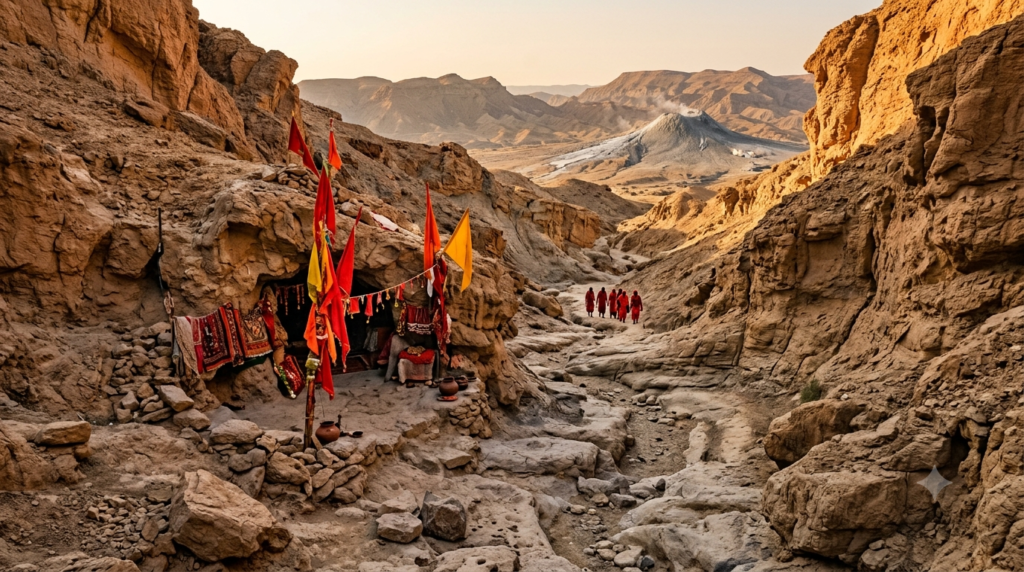
The Hinglaj Mata Temple is one of the holiest Shakti Peethas any Hindu can dream of reaching. This ancient cave shrine sits deep inside Balochistan, Pakistan, within Hingol National Park on the banks of the Hingol River.
Before you plan a single step, one thing every Indian reader must know up front. Since April 2025, India has suspended visa services for travel involving Pakistan. The government now advises its citizens against travelling there. So this guide gives you the sacred story, the route, the yatra, and the honest reality of who can actually go.
Go Kshetra is an independent pilgrimage guide. We are not affiliated with the Hinglaj Mata Temple, its temple committee, or any government body, and this is not their official website. We do not arrange visas, tours, bookings, or payments. Always confirm travel rules and dates through the official sources linked below.
Hinglaj Mata Temple: Quick Facts at a Glance
Here is the essential information in one place before we go deeper. Use it as a snapshot, then read the sections below for the detail that competing pages skip.
| Detail | Information |
|---|---|
| Location | Hinglaj, Lasbela district, Balochistan, Pakistan (inside Hingol National Park) |
| Deity | Hinglaj Mata, a form of Goddess Durga (also called Nani Mandir, Bibi Nani) |
| Significance | One of the 51 Shakti Peethas; Sati’s head is believed to have fallen here |
| Shrine type | Natural cave with a low mud altar and a stone smeared with sindoor — no man-made idol |
| Main festival | Hinglaj Yatra, a four-day event each April around Chaitra Navaratri |
| Entry fee | No temple entry fee; travel, visa, and tour costs apply |
| Distance from Karachi | Around 250 km via the Makran Coastal Highway (roughly 4–8 hours by road) |
| Indian access (2026) | Restricted — India–Pakistan visa services suspended; travel officially advised against |
Where Is the Hinglaj Mata Temple Located?
The Hinglaj Mata Temple stands in a narrow gorge in the Lasbela district of Balochistan, about 250 km west of Karachi. It sits inside Hingol National Park, Pakistan’s largest national park, which spreads across more than 6,000 square kilometres of desert, coast, and mud volcanoes. The shrine rests on the west bank of the Hingol River, roughly 20 km inland from the Arabian Sea.
Because the site is so remote, there is no town infrastructure around it. The Makran Coastal Highway, which links Karachi with Gwadar, changed everything after it opened. What was once a brutal desert trek of more than 150 km on foot is now a road journey most pilgrims complete in a day.
One detail surprises almost every first-time visitor. The Hinglaj Mata Temple is not a grand marble structure with towering gopurams. It is a small natural cave with a low clay altar.
Inside, there is no carved statue of the goddess. Instead, a stone smeared with vermilion is worshipped as her living form. Many find this simplicity far more moving than any ornate hall.
The Legend: Why Hinglaj Mata Temple Is a Shakti Peetha
Every Shakti Peetha traces back to the story of Sati, and the Hinglaj Mata Temple holds a place of unusual importance among them. When Sati immolated herself after her father Daksha insulted Lord Shiva, a grief-stricken Shiva carried her body across the universe. To calm his devastating cosmic dance, Lord Vishnu used his Sudarshana Chakra to divide Sati’s body, and the pieces fell to earth at sacred spots.
At Hinglaj, tradition holds that Sati’s head — her Brahmarandhra, the seat of consciousness — came to rest. Because the head is the most vital part, many devotees rank this among the most powerful of the 51 Shakti Peethas. As at every Peetha, Shiva is present too, here as the Bhairava named Bhimalochana.
There is also a beloved Ramayana legend tied to the shrine. It is said that Lord Rama travelled to Hinglaj to seek release from the sin of killing Ravana. The goddess required him to arrive not as a king with an army, but as a humble pilgrim on foot. That story still shapes the yatra’s spirit today, since the journey itself is treated as part of the worship.
Can Indian Citizens Visit the Hinglaj Mata Temple Right Now?
For Indian citizens in 2026, a visit to the Hinglaj Mata Temple is currently not practical. India has suspended visa services connected to Pakistan, and it officially advises against travelling there. This is the single most important update for Indian pilgrims. It changes the honest answer to “can I go?” from “yes, with effort” to “not at the moment.”
After the April 2025 terror attack in Pahalgam and the conflict that followed, India suspended visa services for Pakistani nationals. It also closed the Attari–Wagah land border. Pakistan, in turn, revoked the SAARC visa-exemption access earlier used by some Indian travellers. The High Commission of India in Islamabad still advises Indian nationals to avoid Pakistan, and to return home if already there.
So while the shrine stays open and its yatra continues, the cross-border route for Indian passport holders is effectively shut for now. These measures can change with the political climate. Before making any plan, check the latest advisory on the Ministry of External Affairs website and the High Commission of India, Islamabad page. They are the only authorities that can confirm the current position.
Visa and Travel Documents for the Hinglaj Mata Temple
For those who are eligible to travel — mainly Pakistan’s own Hindu communities, and international pilgrims from other countries — reaching the Hinglaj Mata Temple still requires careful paperwork. There is no walk-in access for foreign visitors, and there is no visa-on-arrival for most nationalities.
International pilgrims must apply through Pakistan’s official online visa system before travelling. Because pilgrimage and religious tourism fall under specific categories, applicants usually need proof of accommodation and, for group travel, an invitation or itinerary from a licensed operator.
- Apply only through Pakistan’s official portal at visa.nadra.gov.pk — never through a private site that claims to “issue” a visa.
- Carry your original passport, the approved visa, and printed copies of your itinerary.
- Arrange travel insurance that covers the region.
- Keep the contact details of your registered tour operator on hand for security checks.
Be cautious of any website or agent that promises guaranteed visas or asks for payment to a private account. Genuine visa processing happens only on the government portal, and no legitimate service can bypass the official system.
How to Reach the Hinglaj Mata Temple
By Air
The nearest major gateway is Jinnah International Airport in Karachi. Direct flights connect Karachi with several Gulf and Asian hubs, so most international pilgrims fly there first. From the airport, the temple is a road journey of roughly 250 km along the Makran Coastal Highway toward Lasbela.
By Road
From Karachi, pilgrims travel by car, taxi, or organised tour vehicle along the Makran Coastal Highway (N-10). The drive takes about 4 to 8 hours depending on stops, road conditions, and security checks. There is no public transport running directly to the shrine, so nearly everyone travels in a private or group vehicle.
By Train
Pakistan Railways connects Karachi with other major cities such as Lahore and Islamabad. However, there is no rail line to Hinglaj itself. Once you reach Karachi by train, you still switch to road transport for the final stretch to the temple.
The Final Approach
The last part of the journey leaves the highway and enters the rugged Hingol valley. Pilgrims cross dry riverbeds and rocky terrain before reaching the cave. Because the route is remote and desert-like, travellers usually move in organised groups rather than alone.
Hinglaj Yatra: The Annual Pilgrimage
The Hinglaj Yatra is a four-day pilgrimage held each April, and it is the largest Hindu gathering in Pakistan. It coincides with Chaitra Navaratri, and in recent years it has drawn crowds approaching 300,000 people. In April 2026, the festival again attracted nearly 300,000 pilgrims, according to reporting in Dawn.
The yatra is far more than a temple visit. Pilgrims arrive from across Pakistan carrying red banners, wearing red-and-gold head coverings tied to the goddess. Volunteers set up vast community kitchens that feed the crowds, cooking with tonnes of flour, rice, and lentils donated by local people.
The main ceremony falls on the third day, when priests recite mantras to invoke the local deities and bless the offerings. Those offerings traditionally include three coconuts. Some pilgrims stay for all four days, while others complete a shorter visit and return to Karachi.
The Chandragup Mud Volcano Ritual
Before entering the shrine, pilgrims climb the Chandragup mud volcano, a striking natural cone that bubbles with grey mud. Devotees toss coconuts into the crater as an offering, believing they must pay homage here first. Many hold that the goddess’s cave may only be approached after this ritual is complete.
After the volcano, pilgrims take a ritual bath in the sacred Hingol River. Only then do they walk to the cave, pass through its narrow rocky opening, and reach the altar. The sequence — volcano, river, cave — is what makes this yatra unlike any other shrine visit in the subcontinent.
A Shrine Revered by Hindus and Muslims Alike
One of the most remarkable things about the Hinglaj Mata Temple is that local Muslims revere it too. They call it “Nani Mandir,” meaning the maternal grandmother’s temple, and address the goddess as Bibi Nani. Some local communities even provide security for the shrine and join the pilgrimage they call “Nani ki Haj.”
This shared devotion runs deep. The Sufi poet Shah Abdul Latif Bhittai is remembered for visiting Hinglaj, and his verses reference the shrine. In a region where being Hindu is not always easy, this quiet harmony around one cave moves almost everyone who reaches it.
Best Time to Visit the Hinglaj Mata Temple
The climate here is harsh, so timing matters more than at most shrines. The right season makes the difference between a rewarding trip and a dangerous one.
Spring (February to April)
Spring is the peak season, especially around the Hinglaj Yatra in April. The weather stays milder, and thousands of devotees gather, so the atmosphere is at its most vibrant. This is the classic time to experience the full pilgrimage.
Winter and Autumn (October to November)
These cooler months bring clear skies and comfortable temperatures. If you prefer a quieter, calmer visit without festival crowds, this window works well while still keeping the heat manageable.
Avoid Summer (May to September)
Summer in this desert stretch becomes extremely hot and arid. Long walks over open terrain turn uncomfortable and even unsafe, so most guides strongly advise against visiting in these months.
Health, Safety, and What to Carry
This is a demanding pilgrimage, not a casual temple stop, so plan for the physical reality. The terrain is rocky and exposed, the climb up Chandragup is steep, and shade is scarce. Anyone who is elderly, pregnant, or managing a heart or breathing condition should see a doctor before the trek.
Carry plenty of water, sun protection, a hat, and sturdy shoes for uneven ground. Because the area is remote, mobile network coverage is patchy, and medical help is far away. So travel with a group, keep your documents handy for frequent security checks, and follow every instruction from your operator and local authorities.
Treat the region’s security situation seriously as well. Balochistan carries travel advisories from many governments, and conditions shift. Always check your own country’s current advisory and never travel off the organised route.
Nearby Attractions Around Hingol National Park
The journey to the Hinglaj Mata Temple passes through some of Pakistan’s most dramatic scenery, so the surroundings reward the effort. A few highlights stand out along the way.
- Hingol National Park: Pakistan’s largest national park, home to wildlife, striking rock formations, and desert landscapes.
- Chandragup Mud Volcano: The sacred bubbling cone that pilgrims climb before entering the shrine.
- Hingol River: The sacred river beside the temple, where pilgrims take their ritual bath.
- Makran Coastal Highway: Famous for sweeping coastal views on the drive between Karachi and Hinglaj.
- Princess of Hope: A natural rock formation near the highway that has become an iconic photo stop.
Insider Tips Most Guides Miss
A few practical truths will save you disappointment. First, do not expect a built-up temple town. There is very little accommodation at Hinglaj itself, so most pilgrims base themselves in Karachi and travel out for the day or during the yatra.
Second, carry enough cash. There are no reliable card facilities or ATMs near the shrine. Third, if you visit during the yatra, start early to beat both the midday heat and the heaviest crowds at the cave’s narrow entrance.
Finally, approach the whole experience as the tradition intends — as a humble journey rather than a quick darshan. The remoteness is not a flaw. For most who reach it, the effort is exactly what makes the Hinglaj Mata Temple unforgettable.
Before You Plan This Yatra
The Hinglaj Mata Temple remains one of Hinduism’s most extraordinary sacred sites. It is a cave shrine to the goddess, protected by desert, river, and the faith of communities across a religious divide. For Pakistan’s Hindu communities and eligible international pilgrims, the yatra thrives each spring.
For Indian pilgrims, though, the honest position today is that the journey must wait until official travel routes reopen. So follow the goddess through study for now, watch the official advisories, and prepare this pilgrimage with patience.
Frequently Asked Questions
Is there an entry fee for the Hinglaj Mata Temple?
No, there is no entry fee at the shrine itself, and there is no ticket booth. Your costs come from travel, visa processing, and organised transport. The cave is a natural pilgrimage site rather than a ticketed monument.
Can Indian citizens visit the Hinglaj Mata Temple in 2026?
Currently, no. India suspended visa services connected to Pakistan after April 2025, the land border is closed, and the Indian government advises citizens against travelling to Pakistan. These rules can change, so check the Ministry of External Affairs advisory before making any plans.
What does the Hinglaj Mata shrine actually look like?
It is a small natural cave with a low mud altar, not a large built temple. There is no carved idol of the goddess. Devotees worship a stone smeared with sindoor as her living form, which gives the site its raw, ancient feeling.
When is the Hinglaj Yatra held?
The Hinglaj Yatra is a four-day pilgrimage held each April, aligning with Chaitra Navaratri. It is the largest Hindu gathering in Pakistan and draws crowds approaching 300,000 devotees. The main ceremony takes place on the third day.
Is it safe to travel to the Hinglaj Mata Temple?
The organised yatra route is managed with security support during the pilgrimage season. However, Balochistan carries travel advisories, and the terrain is remote and physically demanding. Travel only with a reputable group, and always follow current advisories and local guidance.
Why do Muslims also worship at the Hinglaj Mata Temple?
Local Muslim communities have long revered the shrine, calling it “Nani Mandir” and the goddess “Bibi Nani.” Some help protect the site and join the pilgrimage. This shared devotion is one of the site’s most distinctive features.
Are there accommodation options near the temple?
Accommodation right at Hinglaj is very limited. Most pilgrims stay in Karachi or nearby towns and travel to the site for the day, or camp with their group during the yatra. Confirm any lodging plans with your tour provider in advance.
How far is the Hinglaj Mata Temple from Karachi?
The shrine lies about 250 km west of Karachi along the Makran Coastal Highway. The drive typically takes 4 to 8 hours, depending on stops and security checks. There is no direct public transport, so travellers use private or group vehicles.