
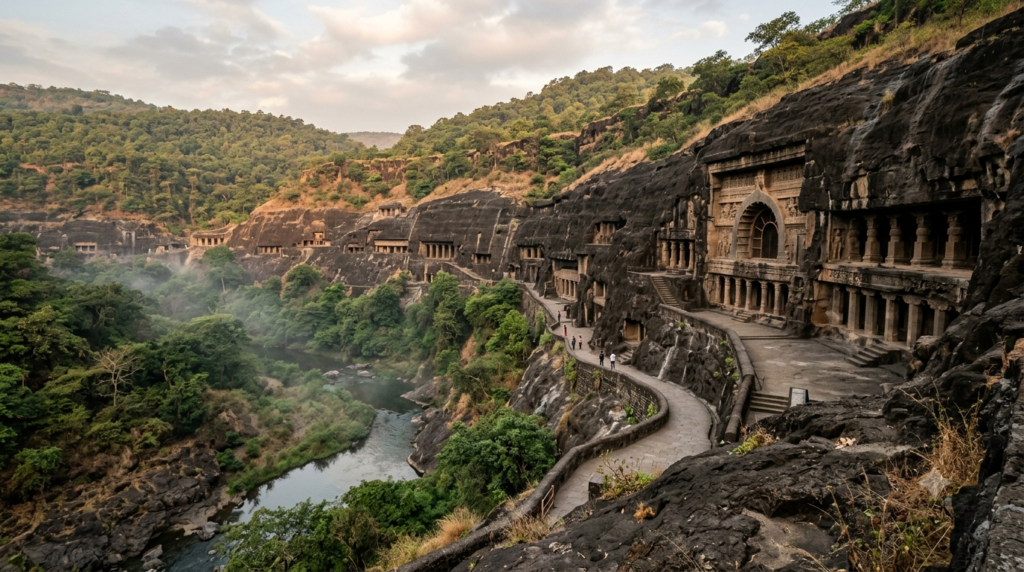
This Ajanta Caves visiting guide answers the question every first-time traveller asks: how do you explore 30 ancient rock-cut caves in one visit without missing the masterpieces? The short answer is simple. Arrive early, focus on Caves 1, 2, 16, 17 and 26, and set aside three to four hours for the walk along the cliff.
Go Kshetra is an independent travel guide. We are not affiliated with the Archaeological Survey of India, and we do not sell tickets or take bookings. For entry, always use the official ASI counter or portal linked below.
The caves sit in a horseshoe-shaped basalt gorge above the Waghora River in Maharashtra. Buddhist monks carved them between the 2nd century BCE and the 6th century CE. Inside, you find prayer halls, monasteries, Buddha sculptures, and some of the oldest surviving paintings in India. This Ajanta Caves visiting guide covers tickets, timings, the best caves, travel routes, and the practical details that competing pages often get wrong.
Ajanta Caves Visiting Guide: Key Facts at a Glance
Here are the essentials before you plan the trip. Each figure below is explained in detail further down.
- Location: Ajanta village, roughly 100–105 km from Chhatrapati Sambhajinagar (formerly Aurangabad).
- Entry ticket: ₹40 for Indian and SAARC visitors; ₹600 for foreign tourists; children under 15 free.
- Eco-shuttle fee: a small extra charge (around ₹16–₹26 per person) for the mandatory bus from the parking area.
- Timings: 9:00 AM to 5:00 PM, Tuesday to Sunday.
- Closed: every Monday.
- Time needed: three to four hours for the highlight caves.
- UNESCO status: World Heritage Site since 1983.
Because the site is remote, a quick plan saves you a rushed, disappointing visit. So treat this Ajanta Caves visiting guide as your starting checklist before you leave home.
What Makes the Ajanta Caves So Special?
Ajanta is one of the earliest surviving centres of Buddhist art, architecture and monastic life in the world. The paintings here are not just religious scenes. They capture daily life, jewellery, emotion and storytelling from more than 1,500 years ago.
The complex holds two kinds of caves. Chaitya halls served as prayer halls, while viharas were the residential monasteries where monks lived and studied. Detailed carvings of the Buddha and narrative murals of the Jataka Tales cover many of the walls.
Archaeologists group the construction into two clear phases. The difference explains why some caves feel plain while others overflow with art.
| Phase | Period | Dynasty | What They Built |
|---|---|---|---|
| First | 2nd–1st century BCE | Satavahana | Early prayer halls and simple monasteries (Caves 9, 10, 12, 13, 15A) |
| Second | c. 460–480 CE | Vakataka | Elaborate murals and sculptures under Emperor Harishena |
Many art historians rank the second-phase murals among the greatest achievements of classical Indian painting. That single fact is why the site draws visitors from across the globe.
Where Are the Ajanta Caves Located?
The caves lie in the Sahyadri hills of Maharashtra, overlooking a steep valley cut by the Waghora River. One naming change trips up many travellers, so note it now. Aurangabad, the main gateway city, was officially renamed Chhatrapati Sambhajinagar in 2023.
Because older articles and even some booking sites still say “Aurangabad”, search under both names when you book hotels or flights. The airport keeps its familiar code, IXU, so that is the safest thing to search for.
| From | Approximate Distance |
|---|---|
| Chhatrapati Sambhajinagar (Aurangabad) | ~100–105 km |
| Jalgaon | ~60 km |
| Pune | ~235 km |
| Mumbai | ~430 km |
Chhatrapati Sambhajinagar works as the main base because it also opens the door to Ellora Caves, Daulatabad Fort and Bibi Ka Maqbara. Most visitors stay there for two nights and cover both cave sites.
Ajanta Caves Visiting Guide: Tickets and Shuttle Fee
The Archaeological Survey of India (ASI) manages entry, and there are two separate charges to budget for. Many guides mention only the entry ticket and forget the mandatory shuttle, so first-timers get caught out at the gate. This Ajanta Caves visiting guide flags both, so your budget holds no surprises.
| Charge | Cost |
|---|---|
| Entry — Indian & SAARC citizens | ₹40 |
| Entry — foreign tourists | ₹600 |
| Children under 15 | Free |
| Eco-shuttle bus (parking to caves) | ~₹16–₹26 per person |
Private vehicles stop at a parking area about 4 km from the caves. From there, a green MTDC eco-shuttle carries you to the entrance, which cuts pollution around the fragile murals. The bus fee is separate from your ticket, so keep small cash ready.
A handheld camera is usually allowed for a small extra fee, while flash and tripods are banned to protect the pigments. Fees change from time to time, so confirm the current entry and camera charges on the official ASI website before you travel. Card machines often fail on the weak hill network, which is another reason to carry cash.
Ajanta Caves Visiting Guide: Timings and Best Season
The caves open from 9:00 AM to 5:00 PM, Tuesday through Sunday. Since Ajanta stays closed every Monday, plan your itinerary around that gap. Arriving before 10:00 AM usually means thinner crowds and cooler air on the exposed paths.
| Day | Opening Hours |
|---|---|
| Tuesday – Sunday | 9:00 AM – 5:00 PM |
| Monday | Closed |
Weather shapes the experience because the cliffside pathways sit fully in the open. So the season you pick matters as much as the time of day, and this is where an Ajanta Caves visiting guide earns its keep.
| Season | What to Expect |
|---|---|
| October – March | Pleasant temperatures and the best light for photos |
| April – June | Extreme heat, often above 40°C |
| July – September | Green gorge and monsoon waterfalls, but slippery paths |
Most travellers prefer winter mornings, when soft light fills the gorge. During a strong monsoon, though, the Waghora waterfalls become a memorable bonus if you accept the wet, slippery steps.
Best Caves to See: Ajanta Caves Visiting Guide Picks
Although the site holds 30 caves, a handful contain the finest art. If your time is short, these five reward you the most. Five caves — 9, 10, 19, 26 and 29 — are prayer halls, while the rest are monasteries.
Cave 1 — The Iconic Bodhisattvas
This vihara houses the famous Padmapani and Vajrapani bodhisattva paintings. The lotus-bearing Padmapani, with his gentle downcast gaze, is often called the single most celebrated image at Ajanta.
Cave 2 — Painted Ceilings
Cave 2 is loved for its intricate painted ceilings, full of geometric patterns and celestial figures. The colours still read clearly after roughly 1,500 years.
Cave 16 — Life of the Buddha
Cave 16 contains detailed murals narrating events from the Buddha’s life, including the moving “Dying Princess” scene. A carved elephant once guarded its entrance, greeting arrivals to the second-phase caves.
Cave 17 — The Painting Gallery
Art historians often call Cave 17 the finest mural gallery at the site. Its walls carry the widest range of surviving paintings, from Jataka tales to scenes of courtly life.
Cave 26 — The Reclining Buddha
This grand chaitya hall holds a dramatic sculpture of the Buddha in Mahaparinirvana, shown reclining at the moment of his passing. The scale and emotion of the carving make it a fitting finish to any visit.
Ajanta Caves Visiting Guide: How to Reach the Site
The site sits in rural Maharashtra, yet it connects well by air, rail and road. This part of the Ajanta Caves visiting guide breaks down each option, because your best route depends on where you start.
By Air
The nearest airport is Chhatrapati Sambhajinagar Airport (code IXU), formerly Aurangabad Airport. It links to Mumbai, Delhi, Hyderabad and Bengaluru, and the drive to Ajanta takes about 2.5 to 3 hours.
By Train
Jalgaon (about 60 km) and Chhatrapati Sambhajinagar (about 100 km) are the two useful railheads. Both stations offer taxis and buses onward to the caves. Travellers from Gujarat or Madhya Pradesh often find Jalgaon the easier choice.
By Road
State transport and private buses run from Chhatrapati Sambhajinagar and Jalgaon, and they are the budget-friendly option. Many visitors instead hire a taxi for the day, since it allows an early start and a flexible return.
Ajanta vs Ellora: How to Plan Both Sites
Travellers constantly compare these two UNESCO sites, and the honest answer is that they are different rather than rival. Ajanta is about painting; Ellora is about monumental sculpture.
| Feature | Ajanta | Ellora |
|---|---|---|
| Religious focus | Buddhist | Hindu, Buddhist, Jain |
| Main draw | Ancient murals | Kailasa Temple |
| Weekly closure | Monday | Tuesday |
| Distance from the city | ~100 km | ~30 km |
Here is the trap most people miss. Ajanta closes on Monday, but Ellora closes on Tuesday, so you cannot see both on those back-to-back days. Because each site deserves a full day, the smart plan is Ellora on one day and Ajanta on the next.
Ajanta Caves Visiting Guide: The 1819 Rediscovery
After the caves were abandoned, dense jungle swallowed them for centuries. Then, on 28 April 1819, a British officer named John Smith stumbled upon them during a tiger hunt in the Waghora gorge.
A local shepherd boy pointed him toward the arched façade of Cave 10 high on the cliff. Smith gathered villagers to clear the growth, and he then did something no visitor should copy. He scratched his name and the date across a painted pillar inside Cave 10, and that graffiti survives to this day.
News spread quickly, and scholars soon began recording the murals. This story of loss and rediscovery is part of what makes standing inside these caves feel so remarkable.
Ajanta Caves Visiting Guide: Smart Visitor Tips
Most people underestimate how much walking Ajanta involves. The caves stretch across roughly 600 metres of cliffside path, so a little planning goes a long way.
- Start at Cave 1 and move along the cliff path in sequence.
- Give your eyes a minute to adjust, because many caves are kept dim to protect the pigments.
- Never use flash photography, since it damages the ancient murals.
- Visit the free ASI museum near the entrance to add context.
- Consider an ASI-authorised guide, as the paintings mean far more once explained.
Health and safety note: the paths and cave steps are steep and exposed, so carry water, wear grippy footwear, and pace yourself in the heat. Travellers who are elderly, pregnant, or managing a health condition should rest often and skip the climb on very hot days.
Final Word on This Ajanta Caves Visiting Guide
Ajanta rewards the traveller who arrives with a plan, and that is the whole point of this Ajanta Caves visiting guide. Come early, budget for both the ticket and the shuttle, and give the highlight caves the time they deserve. Above all, remember that these fragile 2,000-year-old paintings survive only because visitors treat them with care.
For the latest entry rules and fees, check the Archaeological Survey of India and the site’s UNESCO World Heritage listing. If you are pairing Ajanta with more of the state, our Gajanan Maharaj Temple guide and other Maharashtra temple guides help you plan the wider trip. Then enjoy one of the oldest art galleries on earth, carved straight into a cliff.
Ajanta Caves Visiting Guide: FAQ
How many caves are there at Ajanta?
Ajanta has 30 rock-cut caves in total, including prayer halls and monasteries. They are numbered 1 to 29, with a later-found cave labelled 15A.
How long should I spend at the Ajanta Caves?
Most visitors need three to four hours to see the key caves comfortably. Art and history enthusiasts can easily spend a full day at the site.
Are the Ajanta Caves worth visiting?
Yes. Ajanta preserves some of the oldest surviving Buddhist paintings and sculptures anywhere in the world, and no photograph does the murals justice.
Can Ajanta and Ellora be visited in one day?
It is technically possible but not advised. Each site deserves a full day, and their closure days differ — Ajanta shuts on Monday and Ellora on Tuesday.
Is photography allowed inside the Ajanta Caves?
Handheld photography is allowed in many areas, often for a small fee. Flash and tripods are banned because bright light and vibration harm the ancient pigments.
What is the entry fee for the Ajanta Caves?
Entry costs ₹40 for Indian and SAARC visitors and ₹600 for foreign tourists, with children under 15 free. A small mandatory shuttle-bus fee applies on top of the ticket.
Which city is the base for visiting Ajanta?
Chhatrapati Sambhajinagar, formerly called Aurangabad, is the main base city. It sits about 100–105 km away and also serves Ellora, Daulatabad Fort and Bibi Ka Maqbara.