
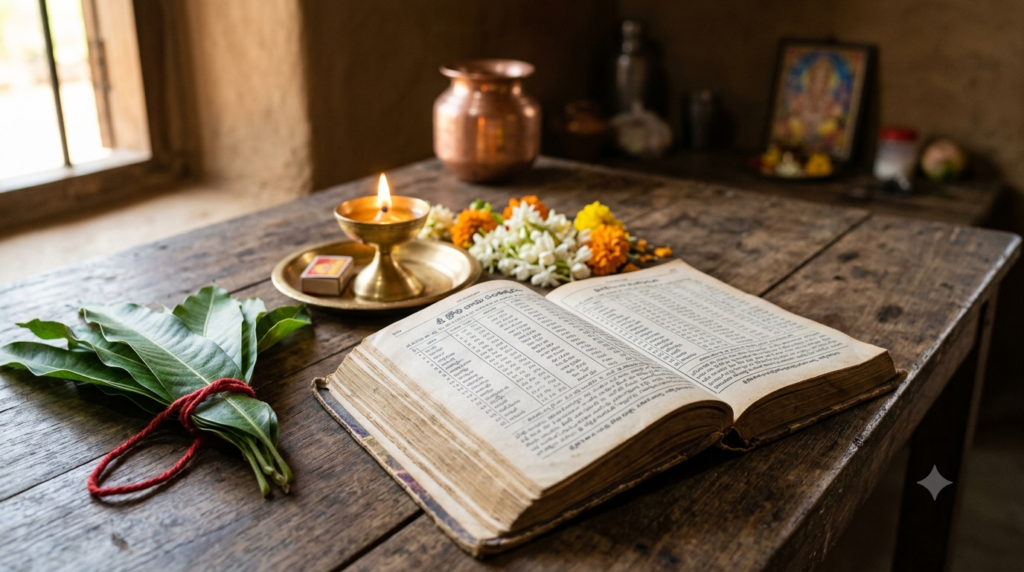
The Ugadi Panchangam Sobhakritu is the Telugu almanac for the Sri Sobhakritu Nama Samvatsara, the year that opened at Ugadi on 22 March 2023 and closed on 8 April 2024. If you have arrived here in a later year, you are probably looking up that specific samvatsara, so this guide keeps it accurate and clearly dated. It explains what the almanac covers, what its Rasi Phalalu predicted, where the genuine PDF lives, and how to reach the current year’s edition in a click.
Sobhakritu was the 37th name in the 60-year Telugu cycle, and the word itself points to beauty, joy, and bounty. Because each samvatsara has its own Panchangam, the Sobhakritu volume belongs to 2023-24 alone. A quick heads-up before you read on: we are no longer in that year.
Go Kshetra is an independent temple and pilgrimage guide. We are not a Panchangam publisher, not affiliated with any temple trust or almanac house, and we do not sell, host, or issue the Panchangam PDF. We take no bookings or payments. Download only from the publisher or official portals linked below.
Ugadi Panchangam Sobhakritu at a Glance
- Samvatsara name: Sri Sobhakritu Nama Samvatsara (37th of 60).
- Telugu year: 2023-24.
- Started: Ugadi, 22 March 2023.
- Ended: 8 April 2024 (Krodhi began the next day).
- Meaning: beauty, happiness, prosperity, abundance.
- Current year now: Sri Parabhava Nama Samvatsaram (2026-27), begun at Ugadi on 19 March 2026.
What Is the Ugadi Panchangam Sobhakritu?
The Ugadi Panchangam Sobhakritu is the yearly Telugu almanac read at the start of the Sobhakritu year. Panchangam means “five limbs,” so it tracks five daily elements: Tithi (lunar day), Varam (weekday), Nakshatram (star), Yogam, and Karanam. Together these decide the auspicious hours a family uses all year.
Priests recite parts of it during Panchanga Sravanam on Ugadi morning. Because the reading covers the whole samvatsara, one volume guides weddings, housewarmings, and new ventures until the next Ugadi arrives. It is a calendar, a ritual guide, and a book of yearly forecasts rolled into one.
The Five Angas of the Ugadi Panchangam Sobhakritu
Every Telugu almanac, the Sobhakritu edition included, is built on five daily elements. Once you know them, the columns in any Panchangam stop looking like a puzzle.
- Tithi is the lunar day, and it sets fasting days and festival timing.
- Varam is the weekday, since each day carries its own planetary ruler.
- Nakshatram is the star of the day, which drives most Muhurtham choices.
- Yogam blends the Sun and Moon positions into a daily quality.
- Karanam is half a Tithi, used for finer timing of tasks.
Because these five shift every day, no two days share the same profile. That is why families check the almanac before fixing anything important, rather than trusting a rule of thumb.
Which Telugu Year Are We In Now?
Sobhakritu has passed. The current Telugu year is Sri Parabhava Nama Samvatsaram, which started at Ugadi on 19 March 2026 and runs until Ugadi in 2027. A few almanacs mark the tithi spanning 19-20 March, so confirm the exact hour with your local panchangam.
Since Sobhakritu ended in April 2024, two full years have turned over: Krodhi in 2026-25, then Vishwavasu in 2026-26. If you want this year’s forecasts and muhurthams, read our Parabhava 2026-27 Panchangam guide instead. This page stays focused on the Sobhakritu almanac for readers researching that year.
Ugadi Panchangam Sobhakritu: Key Dates for 2023-24
The Sobhakritu year ran a little over twelve lunar months. Ugadi 2023 opened it, and the day before Krodhi’s Ugadi closed it. These are the anchor dates people still search for.
| Event | Date |
|---|---|
| Ugadi 2023 (Sobhakritu begins) | 22 March 2023 |
| Panchanga Sravanam (customary reading) | 22 March 2023 |
| Sobhakritu year ends | 8 April 2024 |
| Krodhi begins (next Ugadi) | 9 April 2024 |
Sobhakritu opened on 22 March 2023 and closed on 8 April 2024. If a PDF you find shows different bookends, it is likely mislabelled, so check the samvatsara name before you trust it.
What the Ugadi Panchangam Sobhakritu PDF Contains
A Telugu Gantala Panchangam packs in far more than a wall calendar. The Sobhakritu edition carried daily and yearly detail that families used for planning and prayer alike.
- Tithi, Nakshatram, Yogam, and Karanam for every day.
- Sunrise, sunset, and Rahukalam timings.
- Festival and vratam dates through the year.
- Auspicious Muhurtham windows for major events.
- Rasi Phalalu, the twelve-sign yearly forecasts.
- Graha positions for key occasions.
The Rasi Phalalu are the most-read pages, because each of the twelve signs gets its own outlook. Treat them as tradition and belief, though, not as guaranteed results. For real decisions about money, health, or law, consult a qualified professional as well.
What Sobhakritu Predicted for the Year
Astrologers framed Sobhakritu as a bright, building year, since the name signals bounty and growth. Popular readings tied it to good phases for buying homes, strengthening health, and starting fresh ventures. The chart placed Jupiter, the Sun, the Moon, and Mercury in Pisces at Ugadi, while Saturn sat in Aquarius.
These are traditional interpretations, so they carry cultural weight rather than proof. Still, they explain why the Sobhakritu volume drew steady interest through 2023 and 2024. Readers wanted the sign-by-sign detail that only a full Panchangam provides.
How the 60-Year Telugu Cycle Works
Telugu tradition names each year rather than only numbering it. The cycle runs through sixty names, then repeats, so Sobhakritu returns roughly every sixty years. Its last turn before 2023 came in 1963-64.
Each name carries a mood, from prosperity to hardship, drawn from old texts. Sobhakritu, the 37th name, sits among the brighter ones. Knowing where a year falls in the cycle explains why families greet some samvatsaras with more optimism than others.
Where to Download the Ugadi Panchangam Sobhakritu Safely
The genuine PDF comes from established Telugu almanac publishers, not from random download pages. Because scam portals copy these titles, knowing the real sources protects both your money and your data.
Trusted sources for the PDF
- Mulugu Gantala Panchangam publishes the Sobhakritu almanac and free Rasi Phalalu pages.
- Drik Panchang offers accurate day-by-day tithi and nakshatram data.
- Tirumala Tirupati Devasthanams (TTD) releases an official temple panchangam each year.
How to spot a fake download page
Real publishers do not ask for your Aadhaar, phone number, or payment before a “free” PDF loads. If a page demands personal details or an upfront processing fee, close it. A genuine Telugu Panchangam either downloads directly or is sold openly by a named publishing house.
Watch the web address too, because copycat sites lean on look-alike domains and stolen logos. A publisher’s own site, an app store listing, or a known bookshop is safer than a link buried in a forwarded message. When a deal looks too generous, it usually hides a data-harvesting form, so trust the established names above.
Which Publishers Released the Ugadi Panchangam Sobhakritu
Several respected houses printed the Sobhakritu almanac, and each has its own style. Knowing them helps you pick a version you can trust.
- Mulugu Siddhanti: a widely used Gantala Panchangam, known for detailed Muhurthams and free online Rasi Phalalu.
- Relangi Tangirala: a traditional Gantala edition popular in coastal Andhra households.
- TTD: the temple almanac from Tirumala, valued for its official standing.
All three cover the same five angas, so the core data lines up. Where they differ is in layout, regional Muhurtham emphasis, and the depth of the yearly predictions. Pick the one your family already follows, since switching mid-year can muddle date comparisons.
Panchanga Sravanam on Ugadi Day
Panchanga Sravanam is the public reading of the new almanac on Ugadi morning. A priest or scholar recites the year’s Rasi Phalalu, rainfall outlook, and key Muhurthams before the gathered community. For the Sobhakritu year, this reading fell on 22 March 2023.
Tradition treats the first listening as auspicious, so many families attend at a temple or watch a televised session. Because it sets the tone for the year, listeners note the dates that matter to them as the priest reads. It stays one of the most-followed Ugadi customs across the two Telugu states.
How to Read and Use the Almanac
Reading a Panchangam is simpler than it looks once you know the pattern. Most Telugu families use it in a handful of practical ways through the year.
- Pick Muhurtham windows for weddings, engagements, and housewarmings.
- Track festival and vratam dates so nothing is missed.
- Follow Tithi and Nakshatram for personal horoscope planning.
- Time farm work, since sowing and harvest often follow the almanac.
At many village temples on Ugadi morning, a priest leads the Panchanga Sravanam aloud. What strikes most first-time listeners is how closely the almanac ties to farming cycles, family events, and even land decisions later in the year. Hearing it chanted turns abstract dates into a shared plan for the months ahead.
Common Mistakes With the Ugadi Panchangam Sobhakritu
A few errors trip up people every year, and most are easy to avoid. Check these before you rely on any downloaded almanac.
- Grabbing the wrong year: confirm the file says Sobhakritu (2023-24), not a neighbouring samvatsara.
- Assuming fixed festival dates: Ugadi and linked festivals shift across March and April each cycle.
- Ignoring location: sunrise and Rahukalam differ between Andhra Pradesh, Telangana, and Karnataka.
- Skipping Nakshatram timings: these decide the real Muhurtham, so read them before fixing an event.
Because the Panchangam is location-sensitive, always match it to your town before planning. When in doubt, cross-check a date on an astrology reference or with a local priest.
Sobhakritu Versus the Current Panchangam
People often confuse a stored Sobhakritu PDF with the year now in force. The distinction matters, since Muhurthams and Rasi Phalalu change with every samvatsara.
The Sobhakritu almanac stays valid only as a record of 2023-24. For any event you are planning today, you need the running year’s edition. Our Gantala Panchangam guide walks through how the popular Telugu editions are laid out, whichever year you are reading.
Before You Download
The Ugadi Panchangam Sobhakritu remains a useful reference for anyone studying the 2023-24 Telugu year, its Rasi Phalalu, or its festival calendar. Keep the samvatsara name in view, pull the file only from a named publisher, and treat the forecasts as tradition rather than certainty. If you are planning something now, switch to the current Parabhava almanac and use this page for historical detail alone.
Ugadi Panchangam Sobhakritu FAQs
What year is the Sobhakritu Panchangam for?
The Sobhakritu Panchangam is for the Telugu year 2023-24. It began at Ugadi on 22 March 2023 and ended on 8 April 2024, after which the Krodhi year started.
When did the Sri Sobhakritu Nama Samvatsara end?
It ended on 8 April 2024, the day before Krodhi’s Ugadi. Every samvatsara closes on the eve of the next Ugadi, so the Sobhakritu volume covers only that window.
What Telugu year is it now?
The current year is Sri Parabhava Nama Samvatsaram (2026-27). It began at Ugadi on 19 March 2026 and runs until Ugadi in 2027, so the Sobhakritu almanac is no longer the active one.
Is the Ugadi Panchangam Sobhakritu only about astrology?
No. Alongside Rasi Phalalu, it lists calendar dates, festivals, sunrise and sunset times, and Muhurthams. Many families keep it as a full yearly planning reference, not just a forecast book.
Can I use the Sobhakritu Panchangam for daily Muhurthams today?
Only for reference to 2023-24. For a real event now, use the current Parabhava almanac, and confirm important Muhurthams with an astrologer using your birth details.
Is Ugadi celebrated only by Telugu people?
Ugadi is marked mainly by Telugu and Kannada communities as the new year. It parallels Gudi Padwa in Maharashtra, celebrated on the same lunar day.
Who releases the official Ugadi Panchangam?
There is no single official issuer. Established publishers like Mulugu and Relangi Tangirala print trusted Gantala editions, while TTD releases a temple almanac. Choose a named publisher rather than an anonymous download page.
Does the Sobhakritu Panchangam predict rainfall?
Yes. Traditional almanacs include a monsoon and agricultural outlook alongside the Rasi Phalalu. Farmers once planned sowing around it, though it reflects traditional forecasting rather than modern meteorology.