
The nine Navratri rituals in this guide shape almost every home puja, and most articles get at least two of them wrong. Sharad Navratri 2026 runs from Sunday, 11 October to Monday, 19 October, while Vijayadashami falls on Tuesday, 20 October.
If you have wondered whether the kalash can go up in the evening, or which day Kanya Puja lands on this year, both questions have a precise panchang answer. Getting those two wrong is the commonest mistake devotees make at home.
Go Kshetra is an independent guide to Hindu temples and festivals. We are not affiliated with any temple, trust or religious authority, and we do not accept bookings, donations or payments. For temple-specific Navratri programmes, please use that temple’s own official website.
Navratri Rituals at a Glance
Here is the short version of the Navratri rituals and dates, so you can plan before reading the detail below.
- Sharad Navratri 2026: Sunday, 11 October to Monday, 19 October. Vijayadashami follows on Tuesday, 20 October.
- Ghatasthapana muhurat: roughly 6:19 AM to 10:12 AM on 11 October by the New Delhi panchang. The Abhijit window runs 11:44 AM to 12:31 PM.
- Timing rule: tradition places Ghatasthapana before Hindu midday, so an evening kalash setup is not scripturally valid.
- Nine forms worshipped: Shailaputri, Brahmacharini, Chandraghanta, Kushmanda, Skandamata, Katyayani, Kalaratri, Mahagauri and Siddhidatri.
- Kanya Puja: Ashtami or Navami. Because the two tithis overlap in 2026, confirm the day on your local panchangam.
- Fasting: a personal vow, never an obligation, so adjust it to suit your health.
Navratri Rituals Day by Day: The 2026 Calendar
Navratri follows lunar tithis rather than calendar dates, so the civil dates shift every year. The 2026 sequence below follows the Shardiya Navratri calendar published by Drik Panchang. Use it to map the Navratri rituals to the right day.
| Day | Date (2026) | Form of Durga | Ritual focus |
|---|---|---|---|
| 1 | Sun, 11 Oct | Shailaputri | Ghatasthapana and barley sowing |
| 2 | Mon, 12 Oct | Brahmacharini | Mantra japa and simple offerings |
| 3 | Tue, 13 Oct | Chandraghanta | Evening aarti with bell and conch |
| 4 | Wed, 14 Oct | Kushmanda | Fresh naivedyam offering |
| 5 | Thu, 15 Oct | Skandamata | Lamp and floral alankaram |
| 6 | Fri, 16 Oct | Katyayani | Durga Saptashati recitation |
| 7 | Sat, 17 Oct | Kalaratri | Night puja; Saraswati Puja in many southern homes |
| 8 | Sun, 18 Oct | Mahagauri | Durga Ashtami, Kanya Puja, Sandhi Puja |
| 9 | Mon, 19 Oct | Siddhidatri | Maha Navami, havan and Ayudha Puja |
| 10 | Tue, 20 Oct | — | Vijayadashami, visarjan and Vidyarambham |
One caveat matters this year. Ashtami and Navami tithis overlap across 18 and 19 October. Some panchangams therefore place Durga Ashtami and Maha Navami on the same civil day. Since Kanya Puja hangs on that decision, check the panchangam your family follows.
Regional practice varies too. Saraswati Avahanam in Tamil Nadu, Kerala and Andhra Pradesh follows nakshatra rather than tithi, while Bengali Durga Puja counts Shashthi to Dashami. If you follow a day-wise Devi list from another tradition, treat that as an extra layer rather than a contradiction.
The 9 Navratri Rituals Every Devotee Should Follow
These nine Navratri rituals cover the full arc of a home observance, from the first kalash to the final immersion. None of them needs a priest, although many families invite one for the havan.
1. Ghatasthapana or Kalash Sthapana
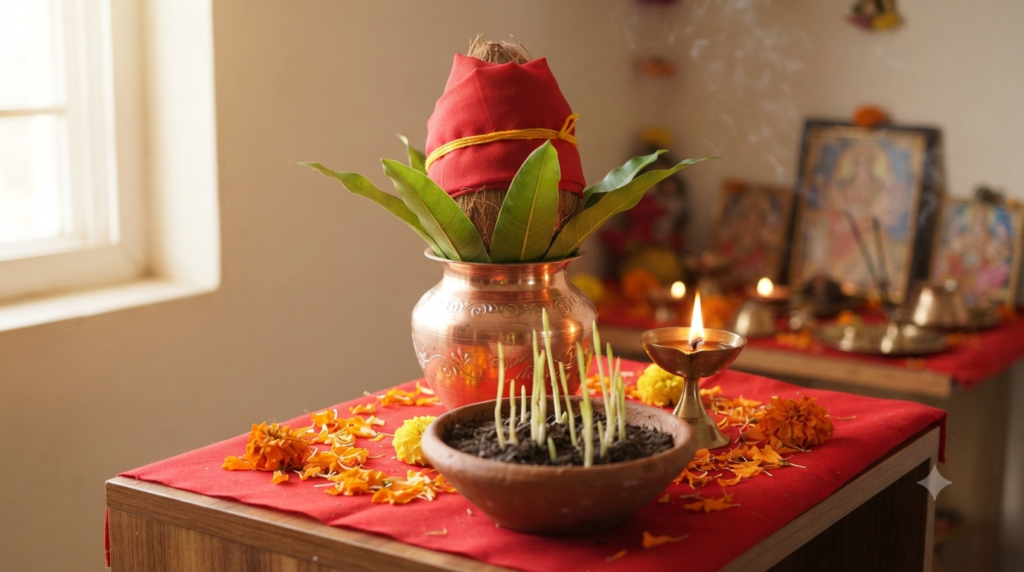
Ghatasthapana invokes Goddess Shakti into a copper or clay pot. It formally opens the nine nights, so every other ritual follows from it. Fill the kalash with clean water, then add a coin, whole rice, a betel nut and durva grass. Cover the mouth with five mango leaves and set a coconut wrapped in red cloth on top.
Place the kalash in the northeast corner of your puja space while you face east. Most families also sow seven grains, called saptadhanya, in a shallow clay bowl of soil below the pot. Barley is the usual choice, because sprouts appearing by Navami signal abundance.
The timing is stricter than most guides admit. Drik Panchang rules out Ghatasthapana during Amavasya and at night. It favours the first third of the day, while Pratipada still prevails. If you miss that window, use the Abhijit muhurat instead of waiting until evening.
2. Lighting the Akhand Jyot
The Akhand Jyot is a lamp that burns through all nine nights. Use pure ghee or sesame oil, and place the lamp to the right of the kalash. Shelter it from fans and open windows. A thick, loosely twisted cotton wick lasts noticeably longer.
Many families panic if the flame dies, because a widely repeated online claim links an extinguished jyot to misfortune. Traditional practice is far gentler. Relight it calmly, offer a short prayer, and carry on. Among all the Navratri rituals, this one rests on sustained intention rather than an unbroken physical flame.
3. Daily Invocation of the Goddess
Each morning begins with avahan, the formal invitation of the Devi into the kalash. Bathe first, clean the space, and light the diya before you chant. A simple sequence works well: three rounds of “Om Dum Durgaye Namah”, then a flower offered at the kalash.
Consistency matters more than elaboration in all the daily Navratri rituals. A five-minute invocation done every morning carries more weight than one grand ceremony followed by six skipped days.
4. Daily Bhog and Naivedyam
Offer freshly cooked sattvic food each day, prepared without onion, garlic or leftovers. Many households follow a nine-day naivedyam sequence, giving each form of the Devi her own preferred offering. Ghee, sugar, malpua, kheer, banana, honey, jaggery, coconut and sesame form one common pattern.
Our Navaratri prasadam guide sets out each day’s naivedyam with recipes. Serve the bhog on a clean plate, offer it before anyone eats, and share it as prasadam afterwards.
5. Durga Saptashati Path or Mantra Japa
Recitation of the Durga Saptashati, the 700-verse hymn from the Markandeya Purana, sits at the scriptural heart of the Navratri rituals. Reading all thirteen chapters daily is demanding. Many devotees therefore read one chapter a day across the nine nights.
Beginners should not feel excluded. Chanting “Ya Devi Sarva Bhuteshu” or a simple beeja mantra with a rudraksha mala serves the same devotional purpose. A family priest can help with pronunciation if accuracy matters to you.
6. Worship of the Nine Forms of Durga
Each day belongs to one Navadurga form, so the puja shifts slightly to match her character. Shailaputri opens the festival with steadiness. Devotees invoke Kalaratri on the seventh night for protection and the removal of fear.
Colour-coded dress lists circulate every year, yet each colour follows the weekday and therefore changes annually. Take the sequence from a current-year panchangam, because a recycled list will simply be wrong.
7. Vrat and Food Discipline
The vrat traditionally excludes grains, pulses, onion, garlic, alcohol and non-vegetarian food. Permitted foods include fruit, milk, curd, sabudana, kuttu and singhara flour. Rock salt replaces table salt. Some devotees keep a strict nirjala fast on Ashtami alone, while others eat one sattvic meal daily.
Unlike the other Navratri rituals here, the vrat is a personal sankalpa rather than a household rule. Choose a level you can sustain for nine days, because breaking a severe fast halfway helps nobody.
8. Kanya Puja on Ashtami or Navami
Kanya Puja, also called Kumari Puja, honours young girls as living forms of the Devi. Families traditionally invite nine girls aged roughly two to ten. They wash their feet, apply tilak, and serve puri, kala chana and halwa before giving small gifts.
Two practical points get missed. In North Indian practice, families also invite a young boy, often called the langoor or Batuk Bhairav. And if nine girls are genuinely unavailable, tradition permits fewer, so no family should feel the ritual has failed.
9. Aarti, Havan and Visarjan
Close each evening with aarti, using a camphor flame, incense and a bell. On Navami many families perform a havan, offering ahutis into a small fire. Feeding the kanyas usually follows as the concluding act.
Visarjan completes the Navratri rituals on Vijayadashami. Immerse the kalash water and offerings respectfully, ideally in a garden or a designated tank rather than a polluted waterway. Family members then share the sprouted barley as a blessing.
Common Mistakes People Make With Navratri Rituals
Most home-puja errors are small, repeated, and easy to avoid once you know them.
- Evening Ghatasthapana. Setting up the kalash after sunset because it suits work hours, although scripture places it before midday.
- Recycled date lists. Copying last year’s colour or tithi chart, which shifts every year with the lunar calendar.
- Offering stale bhog. Using packaged sweets or yesterday’s food, when freshness is the whole point of naivedyam.
- Treating fasting as compulsory. Forcing a strict fast on children, elders or unwell family members.
- Moving the kalash. Shifting the pot mid-festival to clean around it, when it should stay undisturbed until visarjan.
- Skipping the sankalpa. Starting without stating the intention, which traditionally frames all nine days.
One more error deserves its own line. Several sites present Navratri rituals as a guaranteed remedy for illness, debt or legal trouble. Faith practices belong to tradition and belief, so they should never replace medical treatment or professional advice.
Navratri Rituals for Working People and Small Homes
Most guides assume a spare puja room and a free morning. Reality is usually a one-bedroom flat and an office login at nine. These Navratri rituals still work if you scale them sensibly.
Anchor the day on two fixed points. Do a short morning avahan before you leave, then the evening aarti when the household is together. Everything else, including the Saptashati reading, can move to whichever slot is realistic. A shelf in the northeast corner of any clean room serves perfectly well as the sthapana space.
If you travel during the nine days, the kalash cannot travel with you. Either keep the vrat without the sthapana, or ask someone at home to maintain the lamp and offerings until you return.
Navratri Rituals Samagri: What You Actually Need
Shops sell elaborate kits every autumn, yet the essential list for the Navratri rituals is short. Buying the long version is a convenience, never a requirement.
- Essential: kalash, clean water, whole rice, a coin, betel nut, durva grass, five mango leaves, a coconut, red cloth, soil and barley seed.
- Also essential: a ghee lamp, cotton wicks, camphor, incense sticks and fresh flowers for daily offering.
- Useful but optional: a Devi photo or idol, a red chunri, a copper plate, a bell, a rudraksha mala and a Saptashati book.
- Not required: imported dry-fruit hampers, silver kalash, branded “muhurat kits” and paid online sankalpa services.
That last line is worth repeating, because paid portals offering to perform your sankalpa remotely have multiplied. Home Navratri rituals need no intermediary, so keep your money and perform them yourself.
Health and Safety During Navratri Fasting
Nine consecutive days of restricted eating is a real physical demand. Late-night garba and long temple queues add to it. Dehydration and low blood sugar are the two problems reported most often during the festival.
Drink water regularly unless your vrat specifically excludes it. Break the fast with something light rather than a heavy meal.
Anyone with diabetes, kidney conditions or low blood pressure should speak to a doctor first. The same applies to pregnant women, elderly relatives and young children. Every tradition accepts a vrat adjusted for health, so the Navratri rituals lose nothing when you scale the fast down.
Before You Begin
Fix three things before 11 October and the rest falls into place. Confirm the Ghatasthapana muhurat for your own city, buy the samagri, and settle the Kanya Puja day with your family panchangam. Because Navratri rituals reward consistency over scale, a modest daily puja beats an ambitious one abandoned by Day 4.
UNESCO inscribed Durga Puja on its Representative List of Intangible Cultural Heritage in 2021, a useful reminder that this is a living tradition. There is room in it for how your own household keeps the nine nights. When they end, the Vijayadashami puja procedure carries the observance to its close.
Frequently Asked Questions About Navratri Rituals
When does Navratri 2026 start and end?
Sharad Navratri 2026 begins on Sunday, 11 October with Ghatasthapana, and ends on Monday, 19 October. Vijayadashami, or Dussehra, follows on Tuesday, 20 October. These dates come from the Drik Panchang Shardiya Navratri calendar, and they shift slightly by city.
Can Ghatasthapana be done in the evening?
No. You must complete Ghatasthapana before Hindu midday, while Pratipada tithi prevails. Scripture specifically rules it out at night and during Amavasya. If you miss the morning window, the Abhijit muhurat around midday is the accepted alternative.
Is fasting mandatory during Navratri?
Fasting is a voluntary vow rather than an obligation. Many devotees keep partial fasts, some observe only Ashtami, and others skip the fast entirely while still performing the daily Navratri rituals. Let your health decide the level.
Which day is Kanya Puja in 2026?
Kanya Puja falls on Durga Ashtami or Maha Navami, which are 18 and 19 October in 2026. Because the two tithis overlap this year, panchangams differ on the exact day. Confirm with the panchangam your family follows before inviting the girls.
Can Navratri rituals be performed at home without a priest?
Yes. Families perform every one of these Navratri rituals at home, including Ghatasthapana, daily naivedyam and Kanya Puja. Only the Navami havan commonly involves a priest, and even that remains optional.
What happens if the Akhand Jyot goes out?
Relight it and carry on. Despite alarming claims circulating online, mainstream practice does not treat an accidentally extinguished lamp as a spiritual failure. Sheltering the lamp from draughts and topping up the ghee twice a day prevents most incidents.
Do the nine Navratri colours change every year?
Yes, because each colour follows the weekday that a Navratri day falls on, and the weekdays shift annually. A colour list copied from last year will be inaccurate, so take the sequence from a current-year panchangam.
What should be done with the kalash after Navratri?
Perform visarjan on Vijayadashami. Share the sprouted barley with family members, then immerse the water and offerings in a garden, a clean tank or a designated immersion point. Wash the kalash afterwards and store it for reuse.