
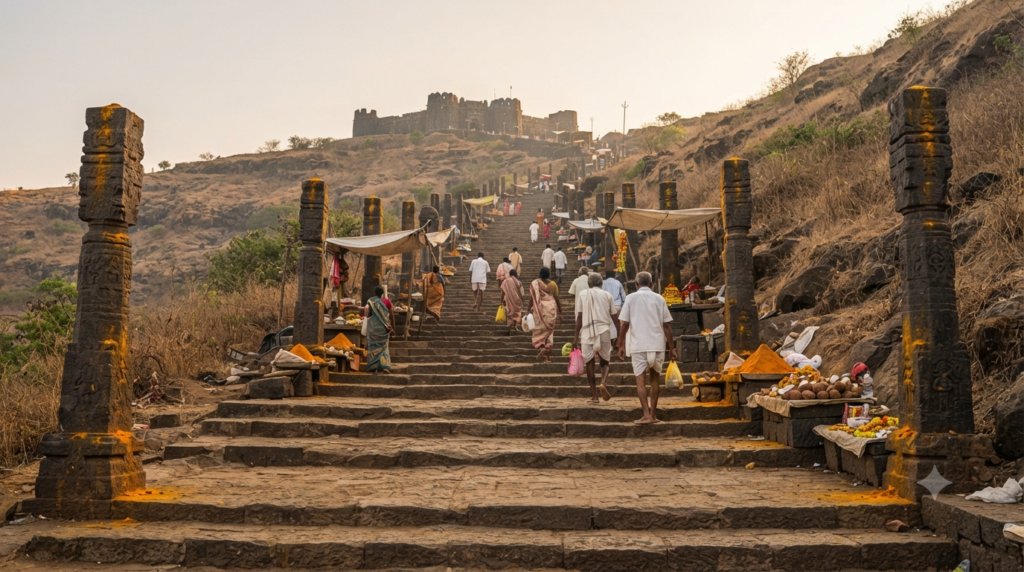
Khandoba Temple Darshan at Jejuri is free for every pilgrim, and the temple charges no entry ticket at all. Yet most first-time visitors still turn up confused about passes, fees and the number of steps. Shree Martand Dev Sansthan, the trust that runs the hill temple, publishes its rules plainly on its own portal. Almost no travel page repeats them correctly, so pilgrims lose hours at the gate over avoidable mistakes.
Go Kshetra is an independent pilgrimage guide. We are not affiliated with, endorsed by, or the official website of Shree Martand Dev Sansthan, Jejuri. We take no bookings, donations or payments. Use the official portal linked below for passes, rooms and official information.
Khandoba Temple Darshan at a Glance
- Temple: Shree Martand Dev Sansthan, Jejuri Gad, Purandar taluka, Pune district, Maharashtra 412303
- Deity: Khandoba, also called Martanda Bhairava and Malhari Martand, a Deccan form of Shiva
- Khandoba Temple Darshan timings: 5:00 AM to 9:00 PM daily
- General entry: free, and the trust sells no ticket for it
- Online darshan pass: a donation of ₹100 or ₹200 per person
- Pass darshan window: 7:00 AM to 12 noon, then 1:00 PM to 7:00 PM
- The climb: roughly 200 to 450 steps, depending on your route up
- Official portal: khandoba.com
Khandoba Temple Darshan Timings and the Daily Aarti Schedule
The temple opens at 5:00 AM and closes after Shej Aarti at 9:00 PM, every day of the year. Bhupali and the morning abhishek run from 5:00 AM until 6:30 AM. Dupar Aarti with abhishek follows between 12:30 PM and 1:30 PM. Mahaprasad distribution then continues until roughly 2:30 PM.
| Time | What happens on the gad |
|---|---|
| 5:00 AM | Temple doors open |
| 5:00 – 6:30 AM | Bhupali, aarti and abhishek |
| 12:30 – 1:30 PM | Dupar aarti and abhishek |
| 1:30 – 2:30 PM | Naivedya, then mahaprasad distribution |
| 9:00 PM | Shej aarti, after which the temple closes |
This schedule comes straight from the Sansthan’s published daily programme. Aggregator pages still quote a 6:00 AM opening, which sends early risers to a gate that has already been open an hour.
Is There an Entry Fee for Khandoba Temple Darshan?
No. Khandoba Temple Darshan in the general queue costs nothing, and the trust sells no entry ticket. The only official charge is the online darshan pass, taken as a donation of ₹100 or ₹200 per person. That pass buys you a separate, quicker queue rather than entry itself.
You will also see a “₹50 special darshan” figure repeated across travel sites. The Sansthan’s own portal lists no such fee, so treat that number as unverified. Confirm any counter charge at the temple office before you pay.
How to Book the Online Khandoba Temple Darshan Pass
The trust runs its pass system through its own website, and the process takes a few minutes. Since Aadhaar is mandatory, keep the card handy before you start.
- Open the official online darshan pass page on the Shree Martand Dev Sansthan website.
- Register with a working mobile number, an email address and your Aadhaar details.
- Choose your date and a slot inside the 7 AM to 12 noon or 1 PM to 7 PM windows.
- Pay the donation of ₹100 or ₹200 per person through the portal’s payment options.
- Save the e-pass, then carry it with the same Aadhaar card on your visit.
- Collect the physical pass at the Sansthan office or the tatkal pass distribution centre inside the Gadkot premises.
Khandoba Temple Darshan Pass Rules Most Guides Never Mention
Three official conditions catch pilgrims out, because hardly any Khandoba Temple Darshan guide prints them. First, the pass is strictly non-transferable, so you cannot pass it to a relative who came instead. Second, once booked it cannot be cancelled, and it cannot be shifted to another day.
Third, every person named on a pass must carry Aadhaar on the day. Families booking for elderly parents often forget this, and the distribution centre will ask for it. Check each name and each document the night before you travel.
What Can Go Wrong With Your Khandoba Temple Darshan Pass
A booked pass is not an absolute guarantee of a quick darshan. The Sansthan states plainly that during yatras, jatras, festivals, Saturdays, Sundays, government holidays and emergencies, the pass system runs as per its own arrangements on the day. Crowd management overrides the normal queue when lakhs of devotees arrive.
So plan for that possibility instead of assuming it away. If your Khandoba Temple Darshan slot collapses on a festival day, these are the realistic fallbacks:
- Join the free general queue. It is always open and needs no booking, although it moves slowly on peak days.
- Ask at the tatkal pass distribution centre inside the Gadkot premises, since same-day arrangements are handled there.
- Shift to a weekday visit if your dates are flexible, because Tuesday to Friday mornings are calm.
- Use the trust’s live darshan stream when travel itself fails, though it is no substitute for the climb.
Remember that the money is a donation and will not come back. Booking a festival-day pass is therefore a small risk you accept knowingly.
The Jejuri Trust Has No Booking Agents
Shree Martand Dev Sansthan states on its darshan pass page that it has no authorised agents for online darshan booking. That single line matters more than any tip in this guide. Any site offering to “arrange” Khandoba Temple Darshan for a service charge acts without the trust’s authority.
The risk is not only money, because a pass booking asks for Aadhaar details. Handing that data to an unofficial middleman is a far bigger loss than a booking fee. Enter your Aadhaar only on khandoba.com, and check the address bar before you type anything.
The trust also publishes a notice that it does not support forced donations of any kind. If anyone on the premises pressures you for money, the Sansthan directs complaints to the Joint Charity Commissioner, Pune.
How Many Steps Is the Climb for Khandoba Temple Darshan?
Counts genuinely differ, so treat any single number with caution. Maharashtra Tourism’s official page puts the climb at nearly 200 steps to the main sanctum. Other established accounts give 350 to 450 steps, because the gad has three gateways and the count changes with your starting point.
What matters more is the effort. Most reasonably fit pilgrims reach the top in 15 to 25 minutes with a short pause. The hill stands at roughly 718 metres, and the steps are stone, uneven and lined with stalls selling bhandara and coconuts.
Kadepathar: the Older and Much Harder Shrine
Jejuri actually holds two Khandoba shrines, and most visitors never learn this. Kadepathar is the ancient one, set higher on the ridge, and accounts put its climb anywhere between 400 and 750 steps. Allow 45 minutes to an hour each way, plus real stamina.
Gad-Kot, the fort-like temple everyone photographs, is the newer and far easier climb. A ridge path links the two, so experienced walkers do Kadepathar first and then cross to Gad-Kot. Families with small children should simply skip Kadepathar.
Health and Safety Notes for Khandoba Temple Darshan
The ascent is genuinely strenuous in Maharashtra’s summer heat, when the exposed stone throws warmth back at you. Carry water, start before 8:00 AM, and rest at the deepmalas if your breath shortens. Turmeric powder fills the air during Bhandara, which can irritate asthma and sensitive eyes.
Anyone with a heart condition, knee trouble or a difficult pregnancy should consult a doctor before attempting Khandoba Temple Darshan. Devotees observing a fast should be especially careful about dehydration. Faith practices at Jejuri are matters of tradition and belief, and they are not a substitute for medical treatment.
Getting to Jejuri for Khandoba Temple Darshan
By train
Jejuri has its own station, code JJR, on the Pune–Miraj line of Central Railway. It sits about 4 to 5 km from the temple, and autos wait outside. Passenger and express services connect it with Pune and beyond, though timings are sparse.
By road
Jejuri lies roughly 48 to 50 km from Pune, and the usual drive runs through Hadapsar, Dive Ghat and Saswad. The ghat section is scenic but slow, so allow 90 minutes to two hours. MSRTC buses run frequently from Pune’s Swargate stand.
Some guides claim the route follows NH48, which is wrong. NH48 is the Mumbai–Pune–Bengaluru corridor and does not pass through Jejuri at all.
By air
Pune International Airport is the nearest option, about 55 to 60 km away by road. Cabs take between one and a half and two hours depending on city traffic. Book the return leg in advance, because evening cabs from Jejuri are scarce.
Staying at Malhar Bhaktaniwas: the Rules That Surprise People
The Sansthan runs Malhar Bhaktaniwas in Jejuri town, and its published rules are stricter than most pilgrims expect. Rooms go to families only, and the trust states that a single or unmarried individual will not be given a room. Every occupant must carry photo identification.
A single room takes two people and a double room takes three. Check-in starts after 12 noon, and check-out is 12 noon, after which a separate charge applies. Cooking inside rooms is banned outright.
Two more rules catch people out. During the Somvati Amavasya and Magh Purnima yatras, a continuous three-night booking is compulsory. Also, the office collects a refundable deposit of ₹400 when you take the room, and the trust does not refund the facility fee once you book.
Hot water runs at a common point from 4:00 AM to 7:00 AM through a solar system, so monsoon mornings can be lukewarm. Since the building sits in the town centre, there is no four-wheeler parking; drivers use private lots nearby. Our separate guide to Jejuri Bhakta Niwas facilities covers the room types in more detail.
Best Time for Khandoba Temple Darshan and the Festival Calendar
October to February is the comfortable window, because the weather stays mild and the climb feels manageable. March to May turns harsh on the exposed steps. Monsoon months bring green hills, yet wet stone makes the descent slippery.
Jejuri’s festival calendar is busier than most guides suggest. The Sansthan’s own list runs well beyond Champa Shashti, and each occasion changes the crowd completely.
- Somvati Amavasya: a new moon falling on a Monday, and the single biggest bhandara day, when turmeric turns the whole hill gold.
- Champa Shashti: a six-day Margashirsha festival ending on Shukla Shashti, also called Dev Diwali, with Tel Handa near its close.
- Chaitra Purnima: the first large yatra of the Hindu year, drawing many communities together.
- Magh Purnima: a two to three day fair, when Koli community palkhis arrive every third year.
- Paush Purnima: notable for its old donkey fair, a trading tradition few visitors expect.
- Jejuri Mardani Dasara: Vijayadashami celebrations that include a khanda-lifting contest.
These fall on lunar tithis, so the calendar dates shift every year. Confirm the exact day on the official portal or an established panchang before you book travel.
What First-Time Pilgrims Get Wrong
- Buy your bhandara and coconut at the base, since stalls higher up charge more.
- Wear old clothes on festival days, because turmeric stains almost never wash out completely.
- Keep the phone pouched during Bhandara, as fine powder gets into charging ports.
- Reach before 8:00 AM on weekends, when the general queue is still short and the stone is cool.
- Carry small change, because the deepmala area and stalls rarely handle large notes well.
- Dress modestly. The Sansthan explicitly asks devotees to avoid revealing or short clothing inside the temple.
- Do not carry cameras, bottles or tobacco inside, since the trust lists these among prohibited items.
Nearby Places Worth Adding to Your Trip
- Shri Kshetra Veer (Mhaskoba temple) – about 22 km, an old stone shrine named on the Sansthan’s own site.
- Morgaon Mayureshwar – roughly 15 km, the first of the Ashtavinayak temples. See our Morgaon Ganpati darshan guide.
- Purandar Fort – around 20 km, a Maratha hill fort in the same taluka.
- Saswad – about 20 km, a heritage town on the Dive Ghat route.
- Pune – roughly 48 km, easily combined as a base for the whole trip.
Before You Go
Treat Khandoba Temple Darshan as a half-day plan rather than a quick stop. Arrive by 7:00 AM, finish darshan before the mid-morning rush, and give yourself time for the ridge views. If you want the faster queue, book the pass on khandoba.com well ahead, and remember it cannot be cancelled or moved.
For daily ritual schedules and seva charges, our guide to Khandoba Temple pooja timings and seva costs goes deeper than this page does. Verify any fee on the official Sansthan portal before travelling, since trusts revise charges without notice.
Frequently Asked Questions
Do I need a ticket for Khandoba Temple Darshan?
No. Khandoba Temple Darshan needs no ticket, and general entry to Jejuri Gad stays free for everyone. The optional online darshan pass, a ₹100 or ₹200 donation per person, only buys access to a faster queue.
What are the Khandoba Temple Darshan timings at Jejuri?
The temple stays open from 5:00 AM to 9:00 PM daily. Pass holders get windows of 7:00 AM to 12 noon and 1:00 PM to 7:00 PM. Morning aarti runs from 5:00 AM to 6:30 AM.
How much does the online darshan pass cost?
The trust takes ₹100 or ₹200 per person as a donation. Both options appear on the official booking page. The Sansthan levies no other online charge.
Can I cancel my darshan pass or change the date?
No. The Sansthan states that once booked, a pass cannot be cancelled and cannot be transferred to another day. You also cannot hand it to a different person, so book only when your date is certain.
How many steps are there at Jejuri Gad?
Maharashtra Tourism cites nearly 200 steps to the main sanctum, while other accounts give 350 to 450. The gad has three gateways, which explains the spread. Most visitors climb it in 15 to 25 minutes.
Is Kadepathar worth climbing?
Kadepathar is the older shrine and a much harder climb, reported at 400 to 750 steps. It rewards fit walkers with quiet and views. Families with young children or elderly members should stay with Gad-Kot instead.
Can one person book a room at Malhar Bhaktaniwas?
No. The trust’s rules give rooms to families only, and not to a single or unmarried individual. Every occupant must also carry identification at check-in.
Does the temple trust have online booking agents?
No. The Sansthan states clearly that it has no authorised agents for online darshan booking. Book only on khandoba.com, because unofficial sites asking for Aadhaar details put your data at risk.
Which month is best for a Jejuri visit?
October to February offers the most comfortable weather for the climb. Somvati Amavasya and Champa Shashti bring extraordinary atmosphere, although crowds swell enormously. Weekday mornings in winter are the calmest choice.