
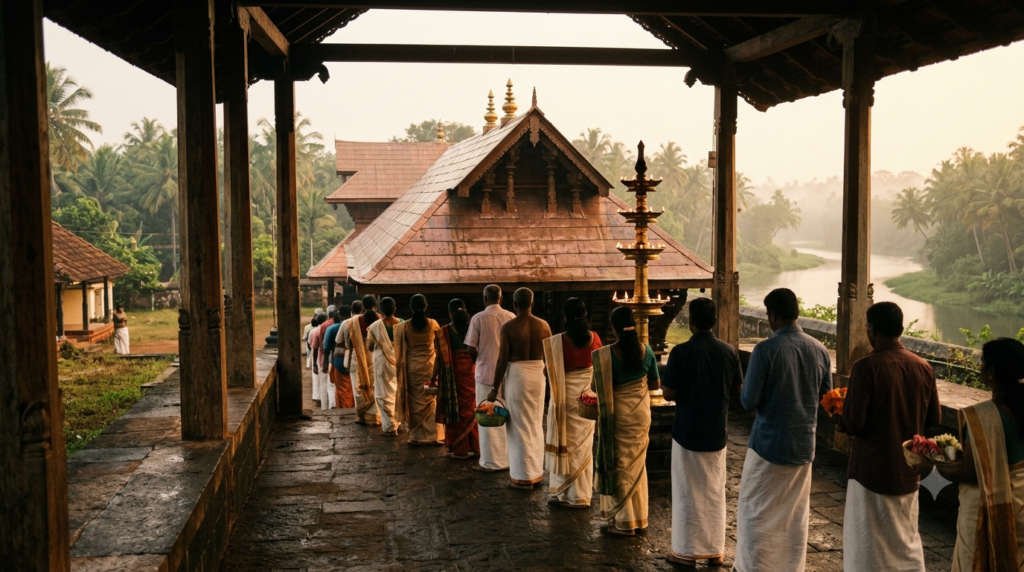
Chengannur Mahadeva Temple Darshan gives you something no other Shiva shrine in Kerala offers, because here the Goddess is believed to menstruate. This ancient temple sits in the heart of Chengannur town in Alappuzha district, right beside the Pamba River. It honours Lord Shiva as Mahadeva and his consort Bhagavathy together, so it is both a Shiva temple and a Bhagavathy temple in one.
Devotees arrive daily for quiet morning worship, and thousands more come for the rare Triputharattu festival. This guide covers the verified timings and the honest booking facts. It also maps the travel routes and the one ritual that makes this temple unlike any other.
Go Kshetra is an independent pilgrimage guide. We are not affiliated with, endorsed by, or the official website of the Chengannur Mahadeva Temple or the Travancore Devaswom Board. We take no bookings, donations, or payments. Please use the official channels linked below for confirmed timings and offerings.
Chengannur Mahadeva Temple Darshan at a Glance
The temple is managed by the Travancore Devaswom Board (TDB), the statutory body that runs around 1,250 temples across southern Kerala. Daily Chengannur Mahadeva Temple Darshan is free, and no ticket is needed to see the deity. Because the shrine follows the traditional Kerala pattern, it closes through the hot midday hours and reopens in the evening.
| Detail | Information |
|---|---|
| Location | Chengannur town, Alappuzha district, Kerala – 689121 |
| Deities | Mahadeva (Shiva) facing east; Bhagavathy (Parvati) facing west |
| Morning darshan | Around 4:00 AM to 11:30 AM (opens ~3:50 AM) |
| Evening darshan | Around 5:00 PM to 8:00 PM |
| Entry fee | Free; no darshan ticket required |
| Managed by | Travancore Devaswom Board |
| Nearest station | Chengannur Railway Station (code CNGR), about 1 km |
| Annual festival | 28-day utsavam in Dhanu–Makaram (December–January) |
Timings can shift on festival days, so always confirm the current schedule with the temple or the Travancore Devaswom Board before you travel. The figures above match what multiple pilgrimage sources report, yet a quick check saves a wasted early start.
What Makes Chengannur Mahadeva Temple Darshan Special
Most Shiva temples enshrine the lord alone. Here, though, Shiva and Bhagavathy share the sanctum as Shiva-Shakti. Devotees worship the main lingam as Ardhanareeswara, the half-male half-female form.
The presiding Mahadeva faces east as a lingam. Directly behind, the image of Bhagavathy faces west.
The temple’s most famous feature is deeply human. Devotees believe the Goddess undergoes her monthly cycle, just as women do. When priests find the traditional sign on her vesture, the temple observes Triputharattu and closes for about three days. This belief celebrates fertility and feminine power, and no other major temple observes it the same way.
The panchaloha image of Bhagavathy, cast from five metals, is attributed to the legendary master craftsman Perumthachan. A serious fire once damaged the shrine, and Vanjipuzha Thampuran rebuilt the present structure in the 18th century. So while the woodwork you see today is centuries old, the temple’s roots run far deeper. Locals also call Chengannur the “Gateway to Sabarimala,” since most Ayyappa pilgrims pass through this town.
Chengannur Mahadeva Temple Darshan Timings and Poojas
Plan your Chengannur Mahadeva Temple Darshan around the temple’s two clear windows. The morning session opens very early, roughly at 3:50 AM, with darshan running until about 11:30 AM. After that the temple shuts for the afternoon. It reopens around 5:00 PM and continues until about 8:00 PM.
Several poojas fill the daily calendar. These include Abhishekam, Usha Pooja, Pantheeradi Pooja, Ucha Pooja, Deeparadhana, and Athazha Pooja. Because the earliest rituals carry the most serene atmosphere, arriving before the Usha Pooja rewards you with fewer crowds. The evening Deeparadhana, when oil lamps light the sanctum, is especially moving.
| Session | Approximate hours | Best for |
|---|---|---|
| Early morning | 4:00 AM – 8:00 AM | Quiet darshan, key poojas |
| Late morning | 8:00 AM – 11:30 AM | Regular visits, more footfall |
| Evening | 5:00 PM – 8:00 PM | Deeparadhana, lamp-lit sanctum |
Chengannur Mahadeva Temple Darshan: Fee and Online Booking
No. Chengannur Mahadeva Temple Darshan is free and walk-in, so you do not buy a darshan ticket or book a slot. This is where many websites mislead pilgrims. Some aggregator pages claim you can book Chengannur darshan through a private “online pooja booking” portal, but that is not how this temple works.
You pay only if you sponsor a specific vazhipadu, meaning an offering or pooja. You arrange those at the counter inside the temple, in cash. The Travancore Devaswom Board runs official online vazhipadu services for some major temples. Always reach those through the board’s own website, never a third-party site.
The Travancore Devaswom Board states plainly that it has not entrusted any agency or individual to collect funds on its behalf. If a site demands an upfront “booking fee” for Chengannur darshan, treat it as a scam.
So the safe rule is simple. For darshan, just walk in. For an offering, use the temple counter or the official TDB portal, and never share card details on an unofficial “booking” page.
How to Reach for Chengannur Mahadeva Temple Darshan
Getting here for Chengannur Mahadeva Temple Darshan is easy, because the town sits on a major rail and road corridor. The railway station is the real advantage for pilgrims, since it lies barely a kilometre from the shrine.
By Train
Chengannur Railway Station (station code CNGR) is about 1 km from the temple, so many devotees simply walk across town in under fifteen minutes. The station sits on the Ernakulam–Kottayam–Kollam line, and long-distance trains such as the Malabar Express stop here. Because it is also the nearest railhead for Sabarimala, trains fill up fast in the Ayyappa season.
By Air
Two airports serve the town almost equally. Cochin International Airport (COK) is roughly 117 km away, while Trivandrum International Airport (TRV) is about 119 km away. From either airport you can hire a taxi or catch a bus, and the drive usually takes three to four hours depending on traffic.
By Road
Chengannur is well connected by KSRTC and private buses. The bus stand is about 1 km from the temple, with services to Thiruvalla, Kottayam, Alappuzha, Pandalam, and Thiruvananthapuram. If you drive, the temple is signposted near the railway bridge, and parking is available near the station.
Festivals at Chengannur Mahadeva Temple
The temple’s festival calendar is rich, yet three occasions stand out. Each draws large crowds, so plan accommodation early if you visit during any of them.
Triputharattu (Thripputhu): This is the temple’s signature ritual. When the Goddess is believed to menstruate, the temple closes for about three days. At the reopening, priests carry the festival images of Mahadeva and Bhagavathy in procession on decorated elephants. They travel to the Pamba River for a holy dip, the Aarattu, as women devotees carry traditional Thalappoli lamps to panchavadyam music.
28-day Utsavam: The grand annual festival runs for 28 days across the months of Dhanu and Makaram, usually December and January. Flag hoisting begins on the Thiruvathira star of Dhanu, and the Aarattu falls on the Thiruvathira of Makaram. Because dates follow the Malayalam lunar calendar, they shift each year, so confirm them before booking travel.
Maha Shivaratri: As a major Shiva temple, Chengannur observes Shivaratri with night-long worship, usually in February or March. Devotees stay awake and offer special prayers through the night.
Dress Code and Temple Etiquette
Kerala temples follow a traditional dress code, and Chengannur is no exception. Men usually remove their shirt and wear a mundu or dhoti before entering the inner shrine. Women wear a saree, set-mundu, or salwar kameez.
Leave leather items, footwear, and modern casual wear outside. The temple generally bars photography inside the sanctum, so keep your phone away near the shrine. Because the temple honours strict Kerala customs, dressing modestly is both respectful and expected.
What If Your Darshan Plans Go Wrong
Chengannur Mahadeva Temple Darshan itself is rarely a problem, since it is free and needs no booking. Still, a few situations can catch pilgrims out, so it helps to know the fallbacks in advance.
- You arrive during midday closure: The temple shuts roughly from 11:30 AM to 5:00 PM. If you reach at noon, rest by the Pamba River or visit a nearby temple, then return for the evening session.
- Your visit lands on a Triputharattu closure: The temple can close for about three days when the ritual is observed. Since these days are not fixed far ahead, ask locally or check with the temple before you travel.
- Festival crowds are heavy: During the 28-day utsavam, queues grow long. Arrive before the Usha Pooja, or choose a weekday darshan outside the festival window for a calmer visit.
- Trains are full in Sabarimala season: Chengannur is the gateway railhead for Ayyappa pilgrims. Book rail tickets early, or plan a road approach from Kochi or Thiruvananthapuram.
Nearby Attractions and Temples
Chengannur pairs well with a wider temple circuit, because several revered sites sit within a short drive. You can easily build a day around them.
- Aranmula Parthasarathy Temple — a famous Krishna temple and heritage village, about 10 km away.
- Thrichittatt Maha Vishnu Temple — one of the ancient Pandava-linked temples, roughly 5 km away.
- Pamba River Ghats — peaceful riverside spots barely 1 km from the shrine, ideal for a quiet pause.
- Chakkulathukavu Devi Temple — a popular Bhagavathy temple within easy reach for devotees continuing their pilgrimage.
- Sabarimala base — Chengannur is the main railhead for the Ayyappa pilgrimage, so many pilgrims start here.
For another great Kerala Shiva temple with a similar dual character, our Vaikom Mahadeva Temple darshan guide is worth a read. Devotees drawn to Kerala’s Bhagavathy shrines may also enjoy our Attukal Bhagavathy Temple guide and the Chottanikkara Temple darshan guide.
Best Time for Chengannur Mahadeva Temple Darshan
The best time for Chengannur Mahadeva Temple Darshan is the cool, dry stretch from October to March. Kerala’s climate turns hot and humid outside these months, so an early morning visit is always the most comfortable. The December–January utsavam is spectacular, though you should expect big crowds.
If you prefer calm over spectacle, choose a weekday outside festival season. Because the earliest poojas draw the fewest people, a pre-dawn arrival gives you the most peaceful darshan. Avoid the peak monsoon from June to September, when heavy rain can disrupt travel across the region. For seasonal weather and regional travel updates, Kerala Tourism is a reliable official reference.
Insider Tips Most Guides Miss
A little local knowledge goes a long way at this temple. These practical notes come from how pilgrims actually experience Chengannur.
- Reach before 8 AM on a weekday for the quietest darshan and the best chance to witness several poojas.
- The stone floor heats up by midday, so wear socks or plan an evening visit if you travel with elderly family.
- Carry enough cash, since offerings are paid at the counter and ATMs in temple towns can run dry during festivals.
- Pair your morning darshan with a Kerala breakfast nearby, because fresh dosa and filter coffee taste even better after a serene visit.
- Sit by the Pamba River after darshan for a calm end to the trip, especially during the midday closure.
Before You Go
Chengannur Mahadeva Temple Darshan rewards pilgrims who plan around its rhythm. Entry is free and walk-in, with fixed morning and evening windows around a long midday break. Best of all, the railway station puts you within walking distance of the shrine.
Above all, this is the one temple that honours the Goddess as a living presence through the Triputharattu ritual. Confirm your dates against the official Travancore Devaswom Board, avoid any site charging a “booking fee,” and arrive early for the calmest experience.
Frequently Asked Questions
Is there an entry fee for Chengannur Mahadeva Temple Darshan?
No. Daily darshan is free and walk-in, with no ticket required. You pay only if you choose to sponsor a specific vazhipadu (offering), which you arrange at the temple counter in cash.
Can I book Chengannur darshan tickets online?
There is no online darshan ticket for this temple. Darshan is walk-in, so any site claiming to sell Chengannur darshan slots for a fee is not official. For online offerings at TDB temples, use only the Travancore Devaswom Board’s own website.
What are the Chengannur Mahadeva Temple Darshan timings?
The temple is generally open around 4:00 AM to 11:30 AM and again from 5:00 PM to 8:00 PM, with a midday closure. Timings can change on festival days, so confirm before you travel.
Why is Chengannur temple famous?
It is famous for the Triputharattu festival, the belief that the Goddess menstruates. When the sign appears, the temple closes for about three days, then celebrates a river Aarattu. No other major temple observes this ritual in the same way.
What is the dress code?
Traditional Kerala attire is expected. Men typically wear a mundu or dhoti and remove their shirt inside the shrine, while women wear a saree, set-mundu, or salwar kameez.
How do I reach Chengannur Mahadeva Temple?
Chengannur Railway Station (code CNGR) is about 1 km away and is the easiest option. The nearest airports are Cochin (about 117 km) and Trivandrum (about 119 km), and frequent buses connect the town to major Kerala cities.
Can I visit with children or elderly family members?
Yes. Plan around the early morning or evening sessions, since the stone floor gets hot at midday. Arriving early also means shorter queues and a calmer atmosphere for older visitors.
Which is the nearest railway station to the temple?
Chengannur Railway Station (CNGR) is the nearest, roughly 1 km from the temple. It is also the main railhead for Sabarimala pilgrims, so it stays busy during the Ayyappa season.