
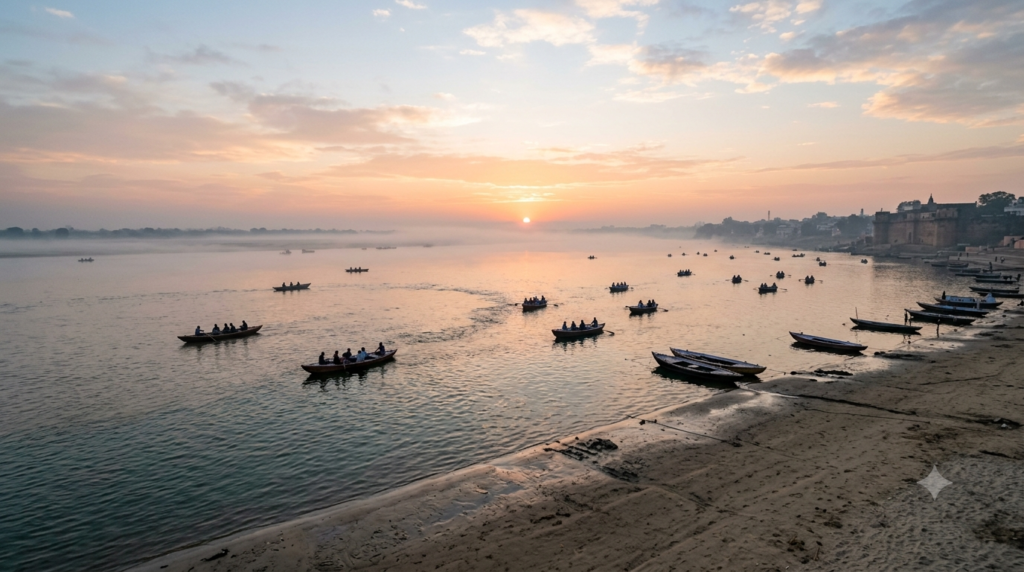
Triveni Sangam Allahabad Travel takes you to the sacred meeting point of the Ganga, the Yamuna, and the mythical Saraswati in Prayagraj, the city once called Allahabad. Entry to the Sangam is completely free. So the only real cost is an optional boat ride out to the exact confluence.
Every year millions arrive to take a holy dip and watch the line where two river colours meet. Most guides gloss over the honest boat prices and the safety basics. This page fixes that, because a calm, well-planned trip always beats a rushed one.
Go Kshetra is an independent pilgrimage guide. We are not affiliated with the Prayagraj district administration, the tourism department, or any boat operator. We take no bookings, donations, or payments, so always confirm current fees and timings on the official portals linked below.
Triveni Sangam Allahabad Travel: Quick Facts
Before the detail, here is the snapshot every visitor asks for. The confluence is an open riverbank, not a ticketed temple, so the rules stay refreshingly simple.
- Location: Sangam, near Allahabad Fort, Prayagraj, Uttar Pradesh
- Entry fee: Free for the ghat and the holy dip
- Boat ride: Optional and paid, from roughly ₹100 per person to ₹2,000 for a private boat
- Best months: October to March, when the weather stays cool
- Ideal time of day: Sunrise, because the water is calm and crowds are thin
- Official info: The Prayagraj district portal and Uttar Pradesh Tourism
| Detail | What to expect |
|---|---|
| Access hours | The ghat stays open through the day; dawn to dusk is the practical window |
| Holy dip | Free from the banks and built platforms; a small platform or locker charge may apply |
| Shared boat | Commonly ₹100–₹200 per person, though rates shift with season and demand |
| Private boat | Around ₹500–₹2,000 for the whole boat, depending on size and time |
| Nearest airport | Prayagraj Airport (IXD), about 12–17 km away |
| Nearest major station | Prayagraj Junction, roughly 7–10 km from the ghat |
Why the Confluence Is So Sacred
Triveni Sangam is where three rivers are believed to unite as one. The Ganga arrives pale and silt-heavy. The Yamuna runs a deeper greenish-blue, so the meeting line is often visible from a boat. The third river, the Saraswati, is described in tradition as invisible, flowing underground to join the other two from below.
Belief holds that a dip here washes away sins and can free a devotee from the cycle of rebirth. That is why the site is called Tirtharaj, the king of all pilgrimage places. The confluence has also received the ashes of national figures. Mahatma Gandhi’s ashes came here in 1949, and Atal Bihari Vajpayee’s in 2018, which shows how deeply it sits in the country’s memory.
Is There an Entry Fee for Triveni Sangam Allahabad Travel?
No, there is no entry fee to reach the Sangam ghat or to take a holy dip from the banks. The riverbank is open public land, so walking down to bathe near the platforms costs nothing. You may pay only small, optional charges. A token fee for a built bathing platform or a locker for valuables is the usual example.
The one experience that genuinely costs money is the boat ride to the mid-river confluence point. The actual meeting of the rivers sits offshore, so most visitors hire a boat to reach it. That is where planning matters most on any Triveni Sangam Allahabad Travel trip.
Boat Rides on Your Triveni Sangam Allahabad Travel
A boat ride is the only way to stand at the exact point where the rivers merge. There is no single fixed, year-round rate card, so prices move with the season, the boat size, and the crowd.
As a fair guide, a shared rowing boat usually runs about ₹100–₹200 per person. A private family boat often costs ₹500–₹2,000 for the whole boat. This is the biggest variable cost in any Triveni Sangam Allahabad Travel budget.
During Magh Mela and Kumbh, demand spikes and rates climb, since lakhs of pilgrims want the same ride. Overcharging is the most common complaint here. Ghat-side boatmen frequently quote inflated prices to first-time and unaccompanied visitors. So ask about the government fare board displayed at the ghat, agree the price before you step in, and never pay the opening quote blindly.
How to Avoid Boat-Ride Scams
Treat any website claiming to be the “official Triveni Sangam boat booking portal” with caution. No single official online booking system runs the ghat boats. Several private tour sites pose as official channels and charge steep markups. The safest approach is simple: book on the spot at the ghat, confirm the rate first, and refuse pressure to add unwanted pooja packages mid-river.
How to Reach: Triveni Sangam Allahabad Travel Routes
Prayagraj is well linked by air, rail, and road, so reaching the Sangam is straightforward from most of North India. From any arrival point, an auto-rickshaw, app cab, or e-rickshaw can drop you close to the ghat.
By Air
The nearest airport is Prayagraj Airport (IXD) at Bamrauli, about 12–17 km from the Sangam. A taxi or app-based cab covers the distance in roughly 45 minutes. Flights connect Prayagraj with Delhi and a few other cities, though schedules are limited, so book early.
By Train
Prayagraj Junction (PRYJ) is the main station and sits about 7–10 km from the ghat. The small Prayagraj Sangam halt lies closer, near 2–3 km, but it often shuts during large mela crowds. From the station, autos, cycle rickshaws, and cabs reach the Sangam easily outside peak days.
By Road
Prayagraj connects by highway to Lucknow, Varanasi, Kanpur, and Ayodhya, so buses run frequently. Varanasi lies roughly 120–130 km away, which makes a day trip possible. Ayodhya is about a four to five hour drive.
Once in the city, local transport takes you the last stretch to the Sangam ghat. Many pilgrims combine this with a Varanasi pilgrimage on the same route.
Best Time for Triveni Sangam Allahabad Travel
The best window for Triveni Sangam Allahabad Travel is October to March. Cool, dry weather then makes the ghats and boat rides comfortable. Winter mornings are especially rewarding, because a soft mist lifts off the water as the sun rises. Summer, from April to June, turns harsh, so avoid midday outings during those months.
The monsoon brings a different picture. Rivers swell and run fast. Boat services may pause or shorten routes for safety. If you want the great festivals, plan around the Magh Mela dates below, but expect very heavy crowds.
Magh Mela and Kumbh at the Sangam
The Sangam hosts the largest religious gatherings on earth. The Maha Kumbh here concluded in early 2025 after drawing hundreds of millions of pilgrims. The great Kumbh returns to Prayagraj only about once every 12 years, so the next full Kumbh is still years away. An Ardh Kumbh falls roughly midway between them.
In the years between, the annual Magh Mela keeps the tradition alive across January and February. Mauni Amavasya is usually the single biggest bathing day. The expected Magh Mela 2027 snan window runs from Paush Purnima around 22 January to Maha Shivratri in early March. These tithis shift each year, so confirm them on the Prayagraj district portal or Drik Panchang before you plan.
Health and Safety for Triveni Sangam Allahabad Travel
A holy dip is deeply meaningful, yet the river demands respect. The Yamuna runs deep at the confluence, and currents can be strong. So bathe only in the marked shallow areas or from the built platforms. Non-swimmers, elderly pilgrims, and children should stay close to the banks.
On the boat, insist on life jackets. Refuse any craft that looks overloaded, because overcrowded boats are a real risk on busy days. Carry drinking water, a change of clothes, and any personal medication. This is general safety advice, not medical direction, so anyone with a health condition should consult a doctor before a strenuous festival visit.
Nearby Attractions to Pair With Triveni Sangam Allahabad Travel
The Sangam pairs well with several landmarks within a short ride, so you can build a half-day circuit around it. Each stop adds a different layer of history to the pilgrimage.
- Allahabad Fort – about 3 km. Akbar’s riverside fort, which shelters the sacred Akshayavat and Patalpuri temple inside.
- Bade Hanuman Mandir – about 3.5 km. Known for its large reclining Hanuman idol near the fort.
- Anand Bhavan – about 5 km. The Nehru family’s ancestral home, now a museum.
- Khusro Bagh – about 7 km. A walled Mughal garden with striking sandstone tombs.
- Allahabad Museum – near Chandra Shekhar Azad Park, holding art, sculpture, and freedom-movement history.
With an extra day, you can extend the journey to Ayodhya. See our guide to the Ram Janmabhoomi Mandir in Ayodhya for that leg. You can also cross-check facts on the Incredible India tourism page.
Insider Tips for Triveni Sangam Allahabad Travel
These are the small lessons that make a Triveni Sangam Allahabad Travel day smoother, drawn from how the ghat actually works. A little preparation removes most of the stress.
- Arrive before 7 am, since the early light is beautiful and boats are easier to get before the rush.
- Agree the boat fare first, and where possible split a shared boat with other travellers to cut the cost.
- Carry small cash in change, because vendors and boatmen rarely handle large notes smoothly.
- Bring a dry bag for phones and a spare set of clothes if you plan to bathe.
- Watch your footing near the boats, as the steps down to the water can be uneven and slippery.
- Book a hotel in the Civil Lines area for easy access, since it stays calmer than the crowded ghat side.
Before You Go
Triveni Sangam rewards a slow, mindful visit far more than a hurried one. Keep it simple, because entry is free, the holy dip is free, and a fair boat ride is the only true expense.
Reach the ghat at dawn, confirm your boat price up front, and respect the water. Route every payment through the vendor rather than any unofficial online “portal.” Plan a Triveni Sangam Allahabad Travel visit around the cool season or the mela dates, and this confluence will stay with you for a lifetime.
Frequently Asked Questions
Is there an entry fee to visit Triveni Sangam?
No, general access to the Sangam ghat is free, and so is a holy dip from the banks or platforms. You pay only for optional extras, such as a boat ride, a locker, or a token platform charge. There is no ticket to enter the confluence area itself.
How much does a boat ride at Triveni Sangam cost?
A shared boat typically costs around ₹100–₹200 per person. A private boat runs roughly ₹500–₹2,000 for the whole craft. Prices are not fixed year-round and rise sharply during Magh Mela and Kumbh. Always agree the fare before boarding and check the government rate board at the ghat.
Can I take a holy dip at the Sangam?
Yes, taking a dip is the main reason most pilgrims come. Bathe only in the marked shallow zones or from the built platforms, because the river is deep and fast at the confluence. Non-swimmers and children should stay near the banks under supervision.
What are the boat ride timings?
Boats generally run from around 6 am until late afternoon. The exact window depends on the season, the water level, and daylight. Early morning is the calmest and safest time. Services may pause during high monsoon flows or heavy mela congestion.
Which is the official website for Triveni Sangam?
There is no single “official Sangam” booking website. For verified information, rely on the Prayagraj district administration portal and Uttar Pradesh Tourism. Treat private sites that claim official status, especially those charging upfront boat fees online, with caution.
When is the next Magh Mela and Kumbh?
The Magh Mela is held every January and February, apart from the years when the Kumbh or Ardh Kumbh takes its place. The Maha Kumbh here ended in early 2025, so the next full Kumbh is over a decade away. Confirm the exact Magh Mela snan dates on the official portal before planning.
Are cameras allowed at Triveni Sangam?
Yes, photography is allowed, and the meeting of the two river colours makes for striking images. Be respectful of pilgrims mid-ritual, and keep your equipment secure on the boat. A waterproof pouch protects your phone or camera from splashes.
Is Triveni Sangam very crowded?
On ordinary days the ghat is busy but manageable, especially at sunrise. During Magh Mela, Kumbh, and major bathing dates, the crowds swell into the millions and movement slows greatly. Visit outside these peaks for a calmer, more reflective experience.