
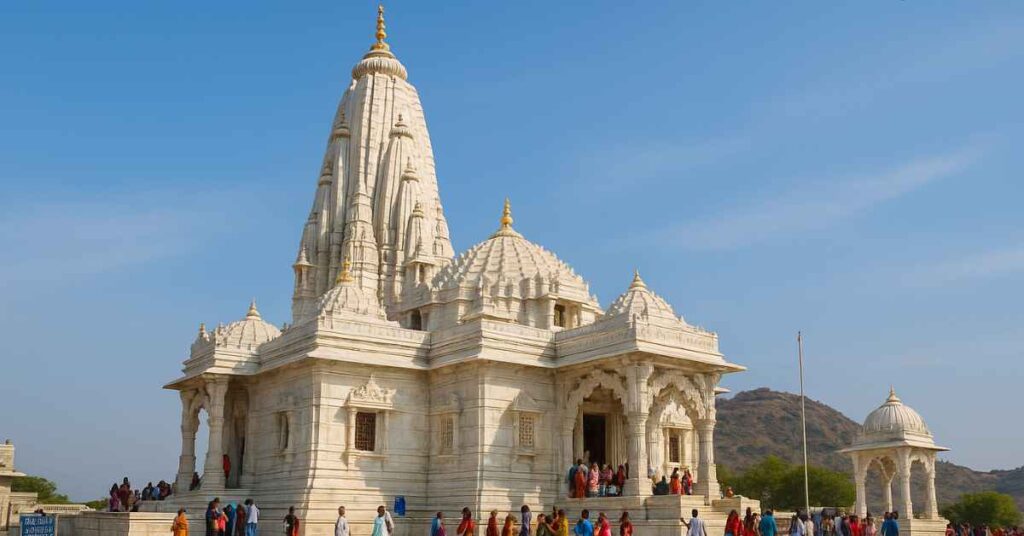
Explore Ambaji Mata Temple in Gujarat — its legend, architecture, festivals, and pilgrimage tips to this revered Shakti-Peetha.
Nestled on the Arasur Hill of the Aravalli range near the Gujarat–Rajasthan border lies the venerable Ambaji Mata Temple in Banaskantha district. Recognised as one of the 51 traditional Shakti Peethas, this sacred shrine draws millions of devotees each year who come to worship the Mother Goddess in her form as Amba. In this guide, you will discover the legend, architecture, festivals, pilgrimage tips, and spiritual significance of this revered temple.
Quick Facts
- Location: Ambaji village, Banaskantha district, Gujarat, India.
- Elevation: Approx. 480 m above sea level (Arasur Hill).
- Deity: Goddess Amba (Shakti), revered here via the sacred Shree Visa Yantra rather than an idol.
- Mythological Significance: Considered one of the major Shakti Peethas — the heart of Goddess Sati is believed to have fallen here following the cosmic Daksha Yajna event.
- Major Festivals: The Bhadarvi Purnima fair (September), Navratri Garba celebrations.
- Recent Development: A ₹1,632 crore “Shakti Corridor” master plan launched to enhance pilgrimage infrastructure.
1. Spiritual & Mythological Significance
The Ambaji Mata Temple holds deep roots in Hindu spiritual tradition:
- According to legend, when the goddess Sati immolated herself at her father Daksha’s yajna, her body parts fell in various locations — the site at Ambaji is believed to be where her heart or right arm landed, thus conferring the site with potent Shakti energy.
- The worship at Ambaji is distinct because instead of a traditional deity image, devotees revere the Shree Visa Yantra, a sacred geometric diagram, housed in the sanctum.
- The entire site forms part of the broader Shakti tradition (Shaktism) and attracts practitioners seeking empowerment, protection and fulfillment of vows.
2. Architecture & Temple Layout
While the temple retains spiritual gravitas, its physical complex is also noteworthy:
The shrine is built from white marble, with a gold-plated spire and silver-plated doors — emphasizing its sanctity and royal patronage.
No conventional idol is present; instead, the yantra is concealed behind the sanctum walls and strictly no photography is allowed in the inner chamber.
The setting on Arasur Hill provides panoramic views; nearby Gabbar Hill is closely linked via the ongoing development plan known as the Shakti Corridor.
- 3. Festivals & Pilgrimage Experience
- Being a major pilgrimage site, Ambaji hosts vibrant festivals and offers specific experiences to devotees:
- Bhadarvi Purnima Fair: Held annually in the month of Bhadrapada (Sept), this 3-day mela (Terās–Chaudās–Purnimā) sees more than 300,000 devotees.
- Navratri: The temple resonates with Garba and folk traditions during the nine nights of Navratri — pilgrims often combine Ambaji with Garba pilgrimage circuits.
- Pilgrims often walk up to the temple from base points, and the surrounding market you’ll find prasad stalls, chundadi shops, and folk performance zones.
- Recent years have seen major investments into amenities: a data-centre for online prasad & registration, better parking and connectivity.
- 4. How to Reach & Best Time to Visit
- Getting There:
- The nearest major railway station is Abu Road (approx. 20 km) from Ambaji.
- From Ahmedabad (approx. 185 km) the road connectivity is good.
- For those traveling by air, Sardar Vallabhbhai Patel International Airport (Ahmedabad) is the closest major airport.
- Best Time to Visit:
- Major festivals (Bhadarvi Purnima in Sept, Navratri in Oct) are peak times — expect crowds, vibrant rituals, and strong devotional energy.
- For more tranquil darshan, early morning or off-peak weekday visits are preferable.
- Weather-wise: October–March offers comfortable climate for hill-temple pilgrimage in north Gujarat.
- 5. Tips for Pilgrims
- Dress modestly and respectfully; temple follows traditional sanctity norms.
- Photography may be restricted inside the inner sanctum — please comply.
- Footwear removal mandatory.
- During major fairs, plan for accommodation in nearby towns (Palampur, Abu Road) or book in advance.
- If visiting with family or elderly, choose early darshan slots to avoid peak queueing.
- Combine visit with a walk/hike to Gabbar Hill, believed to be the original seat of the goddess — the forthcoming Shakti Corridor will ease the connections.
- FAQs
- Q1. Why is Ambaji called a Shakti Peetha?
A1. Because, per myth, the goddess Sati’s heart or right arm fell at this site when Lord Shiva carried her corpse after her immolation — hence this location became sacred as a seat of divine feminine energy. - Q2. Is there an idol of the goddess in the Ambaji temple?
A2. No, worship is conducted via the Shree Visa Yantra — a sacred geometric symbol — and not a conventional anthropomorphic idol. - Q3. What are the busiest times to visit?
A3. The Bhadarvi Purnima fair (Sept) and Navratri (Oct) bring massive pilgrim numbers. Off-peak months are preferable for quieter darshan. - Q4. Can one visit both Ambaji Temple and Gabbar Hill in one trip?
A4. Yes — the planned Shakti Corridor connects the two. Currently you can drive or walk the path to Gabbar Hill to experience the full sacred circuit.
- Conclusion
- The Ambaji Mata Temple offers a profound combination of myth, devotion, architecture and pilgrimage experience. Whether you’re drawn by the magnetism of the goddess, the heritage of the Shakti tradition, or the serene hill-setting in Gujarat, a visit here can be both spiritually rewarding and culturally enriching. Plan your journey during quieter times or join the vibrant festival crowds — either way, the energy of this sacred site stays with you.
Usefull Links
- Hindu temples of Gujarat
- Shakti Peetha Temples in India
- Daksha Yajna Legend
- Official Ambaji Temple Website
- Gujarat Tourism – Ambaji Temple
- Shree Visa Yantra Details (Hindu Blog)
Author Box
- Author: Gokshetra Blog — Content Editor, specialising in Hindu temples and pilgrimage destinations across India.