
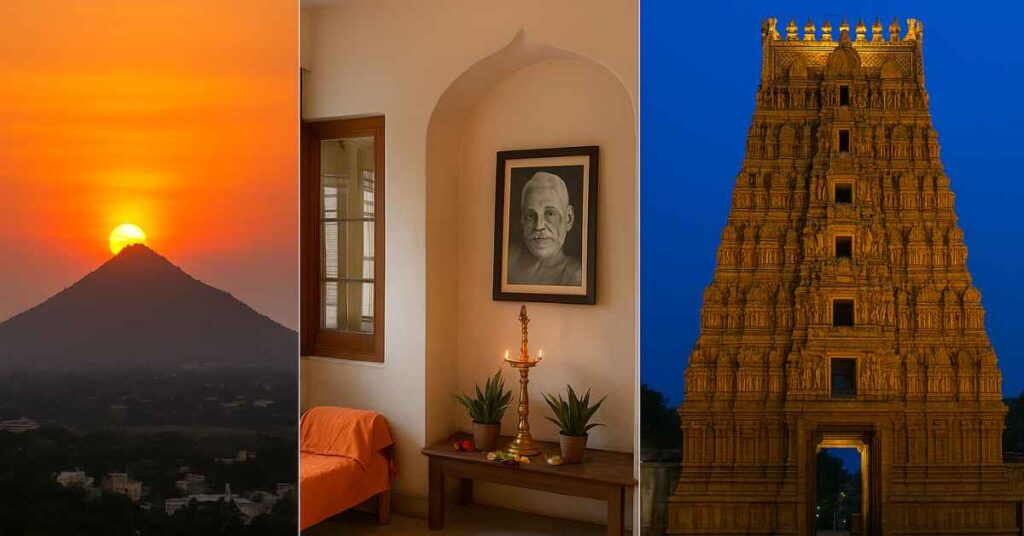
Tiruvannamalai Arunachala Explore Tiruvannamalai and Arunachala Hill’s sacred flame-legend, history, & complete pilgrimage guide to this cosmic Shiva abode.
Key Information at a Glance
- Timings: to VisitYear-round (check festivals)
Nestled in Tamil Nadu, the town of Tir
- Entry/Ticket: Cost Timings Booking
DetailInformation
LocationTiruvannamalai
TimingsSee detai - Location: Tiruvannamalai town & Arunachala Hill, Tamil Nadu, India
Primary Shrine:
Quick Information
| Detail | Information |
|---|---|
| Location | Tiruvannamalai |
| Timings | See detailed timings below |
| Online Booking | Available (see guide) |
| Entry Fee | See pricing section |
| Best Time to Visit | Year-round (check festivals) |
Nestled in Tamil Nadu, the town of Tiruvannamalai and the sacred Arunachala Hill stand as powerful centres of Shaivite devotion and spiritual purification. Known as the place where Lord Shiva manifested as a roaring flame and became the eternal “Arunachala” (Fire-Hill), this pilgrimage destination draws seekers of mantra, silence, and transformation. In this comprehensive guide we will explore the legend, temple architecture, contemplative ashrams, the famous Karthigai Deepam festival, how to visit, and the deeper spiritual essence of Tiruvannamalai & Arunachala.
Quick Facts
- Location: Tiruvannamalai town & Arunachala Hill, Tamil Nadu, India
- Primary Shrine: Arunachalesvara Temple – dedicated to Lord Shiva as Arunachalesvara (the Hill-Flame)
- Sacred Hill: Arunachala Hill (also called ‘Red Mountain’ or ‘Hill of Light’) — every step and foot-path is considered sacred.
- Legendary Event: Lord Shiva appeared here as a “flame of fire” to manifest the cosmic form, establishing this hill as his body and the temple as his abode.
- Major Festival: Karthigai Deepam – the hilltop fire-light on full moon night in the Tamil month of Karthigai draws hundreds of thousands of devotees.
- Ashram: Sri Ramana Maharshi Ashram – the famed modern-time contemplative centre where the sage Ramana Maharshi taught self-enquiry.
- Pilgrimage Practice: Walking the full circumambulation of Arunachala Hill (~14 km) is considered extremely meritorious.
History & Legend
The Flame-Mountain Legend
According to tradition, when Lord Shiva and Lord Brahma quarreled over who was more supreme, Shiva appeared as an infinite column of fire and challenged both. Brahma went upward as a swan and Brahma lied about the end, while Vishnu went downward. Shiva’s flame manifested as Arunachala; Brahma’s false claim led to his curse. The hill became the embodiment of Shiva’s light.
This legend establishes the hill and temple as a physical-symbolic locus of pure consciousness, beyond form and time.
Temple & Heritage
Arunachalesvara Temple traces its earliest iterations to the 7th century, with major additions under the Cholas, Pandyas and Vijayanagara kings. The sacred gopurams, the vast courtyard, the thousand-pillar halls and hundreds of subsidiary shrines reflect classical Dravidian temple architecture.
Today the temple stands as one of South India’s major Shiva centres, not just mythically but as a living pilgrim hub.
Modern Spirituality: Ramana Maharshi
In the early 20th century, the sage Ramana Maharshi arrived at Arunachala at the age of 16, spontaneously entered deep silence and later taught the path of self-enquiry (Who am I?). His ashram near the temple remains a beacon for seekers worldwide. This modern link adds fresh spiritual relevance to the site — it is not only mythic, but also practical.
Spiritual Significance
- Flame of Consciousness: The hill is symbolically Shiva’s light, beyond dualities. Standing at its base evokes awareness of the unmanifest.
- Walking the Hill (Girivalam): The 14 km path around the hill (especially on full-moon nights) is sacred. It purifies and awakens the inner flame.
- Ashram & Silence: The teachings of Ramana Maharshi emphasise turning inward, stilling the mind — aligning with the hill’s symbolism.
- Karthigai Deepam & Fire Ceremony: On the festival night, a giant fire-lamp is lit atop Arunachala Hill — symbolic of the cosmic flame. The event draws massive pilgrim gatherings and is deeply devotional.
- Integration of Dharma & Meditation: Unlike some pilgrimage sites that focus only on ritual, Tiruvannamalai invites both ritual devotion and inner practice side-by-side.
Visitor’s Guide: How to Reach, Best Time & What to See
Access & Connectivity
- By Road: Tiruvannamalai is about 188 km from Chennai by road. Regular buses and taxis connect.
- By Rail: Tiruvannamalai has a railway station; from there taxis/auto-rickshaws to temple/ashram.
- By Air: Nearest major airport is Chennai International Airport; then road onward to Tiruvannamalai (~3-4 hours).
Temple Timings & Dress Code
- The Arunachalesvara Temple is generally open early morning until late evening (temple specific hours vary).
- Dress code: Modest/traditional attire recommended — men often wear dhoti or shirt-trouser; women saree or salwar-kameez preferred.
- Remove footwear before entering temple premises and respect sanctity.
Key Attractions Inside the Town
- Arunachalesvara Temple Complex: Explore the gopurams, halls, shrine of Shiva as Arunachalesvara, and many sub-shrines.
- Girivalam Path: Walk the full circumference of Arunachala Hill (especially on Pournami/full-moon nights) — take a flashlight for night-walk during special occasions.
- Sri Ramana Maharshi Ashram: Visit the silent hall, browse the library, sit in meditation under trees where the sage spent time.
- Hilltop Viewpoints: From certain vantage points you get panoramic view of hill and temple lit at dusk or dawn.
- Evening Aarti & Bhajans: Attend the temple evening aarti and the ashram bhajan session for immersive devotion.
Best Time to Visit
- October to March: Pleasant weather, especially good for walking the hill path.
- Karthigai Deepam (November/December depending on Tamil calendar): Major festival — expect large crowds but deeply vibrant experience.
- Full-moon nights (Pournami): The Girivalam path around the hill glows with lamps and candles.
- Avoid heavy monsoon months or very hot summer mids as the hill-walk can be strenuous.
Tips for Pilgrims
- Wear comfortable footwear for hill-walk though you’ll remove shoes in temple areas.
- Carry water, a light torch (if walking at night), and modest clothing for the hill circumambulation.
- Respect local customs: Quiet meditation zones, remove hats/caps in sacred zones, avoid loud chatter in ashram.
- If participating in festival nights, arrive early, check for accommodation, and plan for heavy foot-traffic.
- For spiritual seekers: allocate time at the ashram for silent sitting or guided satsang.
Frequently Asked Questions (FAQs)
Q1: Why is Arunachala Hill considered sacred?
A: According to legend, Lord Shiva appeared here as a column of fire and manifested as the hill itself — making the hill sacred as the body of Shiva and symbol of eternal light.
Q2: What is Girivalam and why should I do it?
A: Girivalam is the full circumambulation of the Arunachala Hill (~14 km). On full-moon nights or on Tuesdays in Karthigai month, devotees walk the path and it is believed to attain high spiritual merit.
Q3: Can I visit the Sri Ramana Maharshi Ashram without doing any ritual?
A: Yes. The ashram welcomes all — you can simply sit in silence, attend the daily bhajans, or join guided meditations. No formal ritual is needed.
Q4: Is the Karthigai Deepam festival only for locals?
A: Not at all. The festival draws national/international devotees. While large crowds are expected, it’s a unique spiritual event and open to all pilgrims.
Q5: How much time should I allocate for visit?
A: Ideally 2-3 days: one day for temple & ashram, one for Girivalam either day or night, and optionally a third for deeper practice or relaxation.
Q6: Is the hill-walk physically challenging?
A: The path is relatively flat but long (~14 km). At night it may be cooler and require torch. For seniors or those with health issues, plan accordingly (e.g., walk part-way or use stop-points).Tiruvannamalai Arunachala
If your spiritual journey calls for a sacred abode of fire, silence and timeless devotion, Tiruvannamalai & Arunachala stand as a profound destination. Whether you are drawn by the mythic flame of Shiva, the contemplative presence of Ramana Maharshi, the ritual walk of the hill, or the festival burst of Karthigai Deepam — this is pilgrimage in rich, multi-layered form. As you tread this path, may the flame of inner awareness kindle and the silence of the hill reflect back your highest self.
Usefull Links
- Connects fire element (Agni – Arunachala) with air element (Vayu – Srikalahasti) in Pancha Bhoota context.
- For readers exploring all five elemental temples of Shiva.
- Completes the Pancha Bhoota link series with Akasha element.
- Another elemental shrine reference – complements Tiruvannamalai’s fire aspect.
- Verified government portal with temple overview, visitor information, and festival calendar.
- National tourism page highlighting temple architecture and history.
Author Box
Author: Gokshetra Blog Team – Alpha v4 “Gokshetra Auto Mode”
Dedicated to producing accurate, immersive, spiritually aligned articles on Hindu temples and sacred pilgrim sites across India.
Important Tips for Visitors
- Carry a valid ID proof — some temples require it for special darshan or accommodation booking.
- Arrive early morning for a peaceful darshan experience — most temples are less crowded before 8 AM.
- Remove footwear before entering the temple premises. Shoe storage is usually available near the entrance.
- Visit during weekdays for shorter queues. Weekends and festival days see significantly higher footfall.