
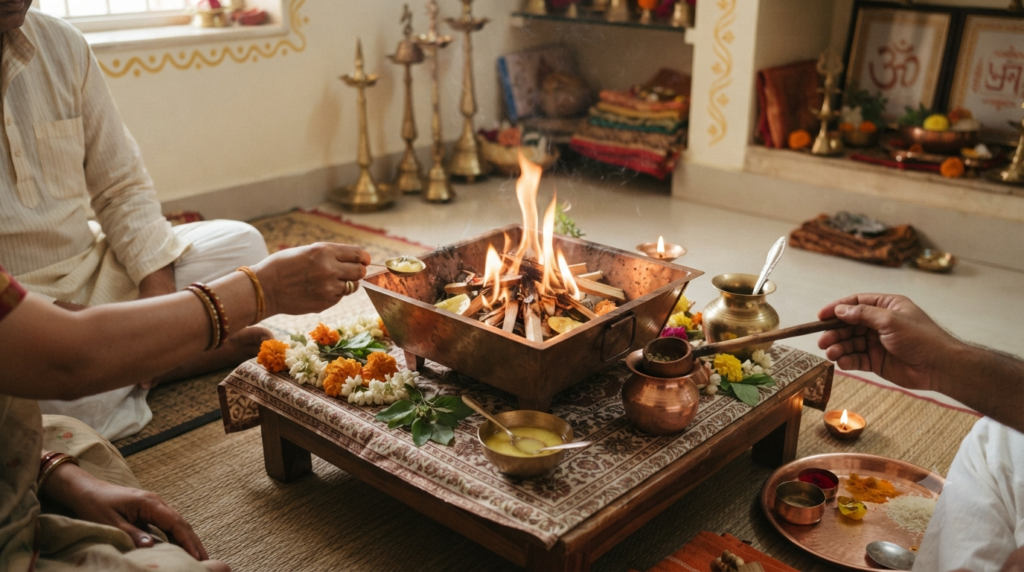
Gayatri Mantra Homam is a fire-based devotional practice centred on the Gayatri Mantra. However, Hindu traditions do not all follow one short ritual in exactly the same way. A beginner can perform a simple home havan with a small fire and mantra offerings.
A full Vedic homa can include purification, nyasa, deity invocation and fire-establishment. Learn those additional rites from a qualified priest or teacher.
Go Kshetra is an independent devotional guide. We are not an official temple, ashram or ritual-booking service, and we do not accept puja bookings, donations or payments.
Important: The simple method below is a household devotional format, not a claim to reproduce every sampradaya’s full Vedic homa. If your family follows a specific Vedic shakha, guru-parampara or priestly tradition, follow that tradition first.
Gayatri Mantra Homam at a Glance
- Core mantra: the famous Gayatri verse is Rigveda 3.62.10, addressed to Savitr.
- Home format: a small havan can use a safe fire, ghee or prescribed havan material, and repeated mantra offerings.
- Documented simple count: All World Gayatri Pariwar (AWGP) describes a simplified practice with 24 Gayatri-mantra offerings. This format belongs to that tradition and is not a universal rule.
- Full ritual: formal Gayatri Yagya can include purification, achamana, pranayama, nyasa, agni-sthapana, samidha offerings, purnahuti, arati and shanti prayers.
- Main devotional aim: the mantra asks for illumination and guidance of the intellect. It does not promise a specific material result.
- Safety: treat the havan kund as an open flame. Keep children, loose clothing and flammable items well away from it.
What Is Gayatri Mantra Homam?
Gayatri Mantra Homam is a yajna or havan centred on sacred-fire offerings. Devotees make those offerings while reciting the Gayatri Mantra. The core verse comes from Rigveda 3.62.10 and invokes Savitr, a Vedic deity linked with luminous, impelling power. Later devotional traditions also worship Gayatri as the personified divine mother of the mantra.
The term homam or homa refers to a fire offering, while yajna can have a wider ritual meaning. In everyday use, people often use havan, homam and yajna loosely for similar fire ceremonies. However, the detailed vidhi can differ by region, lineage and ritual school.
This distinction matters because many online pages copy a single checklist and present it as the only correct method. A more accurate approach is to separate the essential devotional idea from the fuller Vedic procedure.
The Gayatri Mantra, Source and Meaning
The core Gayatri verse is found in Rigveda 3.62.10. Therefore, its scriptural source is clear. The Government of India’s Vedic Heritage Portal preserves Vedic textual resources. Traditional recitation often places Om and the three vyahritis before the Rigvedic verse.
Common recitation form:
ॐ भूर्भुवः स्वः ।
तत्सवितुर्वरेण्यं भर्गो देवस्य धीमहि ।
धियो यो नः प्रचोदयात् ॥
Om bhur bhuvah svah, tat savitur varenyam, bhargo devasya dhimahi, dhiyo yo nah prachodayat.
A careful plain-language meaning is: “We meditate on the worthy radiance of Savitr; may that divine light inspire and guide our understanding.” Translations vary. Words such as bharga, dhi and prachodayat carry several shades of meaning.
The familiar opening “Om bhur bhuvah svah” belongs to the later liturgical recitation around the verse. It should not be confused with the exact wording of Rigveda 3.62.10 in isolation.
Is a Home Havan the Same as a Full Vedic Gayatri Homam?
No. A short household havan and a formal Vedic Gayatri Homam are not identical. A full ritual may include preliminary rites, specific Vedic mantras and prescribed vessels. Fire-establishment and closing offerings can also depend on the tradition being followed.
All World Gayatri Pariwar publishes both a fuller Procedure of Gayatri Yagya and a simplified Gayatri havan method. Its shorter household guidance includes fire establishment and Gayatri offerings. Its extended manuals contain many more ritual steps.
If you want a simple home practice, use a modest format. Do not present it as a replacement for formal instruction. For a samskara, major family sankalpa or group yajna, arrange guidance from a competent acharya or purohit. Do the same for a priest-led Vedic rite.
Items Needed for a Simple Gayatri Mantra Homam
Keep the setup small, clean and manageable. More ingredients do not make the ritual more authentic, while excess ghee can create unsafe flames or smoke.
| Item | Purpose | Beginner note |
|---|---|---|
| Small havan kund. | Contains the sacred fire. | Use a stable, heat-safe base. |
| Dry samidha or suitable wood. | Maintains a small fire. | Use small pieces; avoid treated wood. |
| Ghee. | Traditional offering. | Offer tiny amounts, not spoonfuls that flare. |
| Havan samagri. | Offering mixture. | Use a clean prepared mix from a trusted source. |
| Water vessel and spoon. | Purification and closing use. | Keep separate drinking water nearby. |
| Flowers or akshata. | Optional devotional offering. | Keep them away from open flame. |
| Gayatri Mantra text. | Accurate recitation aid. | Learn slowly before starting the fire. |
AWGP’s published havan material lists several traditional woods, grains and herbs. You do not need a long ingredient list for a small home practice. Use extra items only when your teacher or tradition requires them.
Gayatri Mantra Homam Procedure for Beginners
This Gayatri Mantra Homam procedure is a simplified household devotional sequence. It keeps the focus on prayer, discipline and safe mantra offerings. Specialised Vedic details remain with a trained teacher.
- Prepare the space. Bathe or wash, wear clean clothes and choose a quiet, ventilated place. Put the havan kund on a firm, non-flammable surface before arranging any offerings.
- Begin with a simple sankalpa. Sit calmly and state your intention in plain words. You may dedicate the practice to clarity, gratitude, family welfare or spiritual discipline without making a promise of guaranteed results.
- Offer an opening prayer. Many household traditions begin by remembering Ganesha and the guru before the main rite. Keep this short if you do not know a formal mantra sequence.
- Light a small controlled fire. Use a little camphor or another safe ignition method, then add only enough dry wood to maintain a steady flame. Never use petrol, kerosene or other accelerants.
Making the Gayatri Offerings
- Recite the Gayatri Mantra. Chant at a steady pace. When giving an offering, use a small pinch of havan material or a tiny amount of ghee. Add it at the closing “svaha” used in the ritual form you learned.
- Complete the chosen number of offerings. AWGP’s simplified household tradition describes 24 Gayatri offerings, while other traditions may use different counts. Beginners should not treat 24, 108 or any other number as a universal command.
- Close with gratitude and peace prayers. Formal procedures may include purnahuti, arati and shanti patha. In a simple home practice, conclude respectfully and sit quietly for a few minutes.
- Make the fire fully safe. Stay present until the embers are out. Do not carry hot ash through the house or throw warm ash into a bin.
If you are new to mantra pronunciation, learn the recitation before coordinating chanting and fire offerings. That reduces distraction, so the practice stays calmer.
Why 24 Offerings Are Often Suggested
Some modern Gayatri traditions use 24 offerings in a simplified havan. The count is linked to the mantra’s conventional 24-syllable metrical form. AWGP specifically teaches a short household practice with 24 Gayatri-mantra offerings. It also mentions larger counts such as 108 or 240 in some devotional contexts.
That does not mean every Vedic school requires exactly 24 offerings. Formal homa counts can depend on sankalpa, ritual text, priestly instruction and the larger ceremony. Therefore, say “24 in this documented simplified tradition.” Do not say that 24 is the only correct number.
When Can You Perform Gayatri Mantra Homam?
Gayatri Mantra Homam can be part of regular devotional practice. It can also be done on a sacred day chosen by family custom. AWGP literature discusses regular or periodic Gayatri havan. Its own practice framework also mentions Sunday, Amavasya and Purnima.
There is no need to invent a universal “best muhurta” for everyone. Instead, match the timing to the ritual you are actually performing. If a formal homa is tied to a samskara or family sankalpa, ask the officiating priest about timing. The same applies to a birthday, nakshatra or vrata rite.
For a small home practice, a quiet morning is often easier because the room is cooler and distractions are fewer. Fire safety and local housing rules matter more than chasing an internet muhurta.
Gayatri Mantra Homam Benefits: Faith, Practice and Evidence
Traditional Gayatri Mantra Homam benefits are described in devotional language. They include purification, discernment, spiritual discipline, inner steadiness and prayer for family or community welfare. These are matters of Hindu faith and practice. Therefore, do not present them as guaranteed medical, financial or astrological outcomes.
The mantra is especially relevant to clarity. Its closing line asks that divine radiance guide or impel our intellect. That scriptural meaning is stronger than exaggerated claims. Avoid promises such as “this homam will cure disease” or “guarantee success.”
Scientific research on mantra-based meditation is broader than Gayatri Homam itself. A 2022 systematic review found small-to-moderate improvements in several mental-health measures.
However, the authors noted study bias and limited long-term evidence. The U.S. National Center for Complementary and Integrative Health also cautions that meditation evidence varies by method and study quality.
So, use the homam as a religious and contemplative practice. Do not use it as a replacement for medical or mental-health care.
Fire and Smoke Safety During Gayatri Mantra Homam
A homam uses real fire, so safety is part of responsible worship. The National Institute of Disaster Management warns against leaving burning candles or incense unattended. It also recommends keeping children away from open flames and flammable objects.
- Use a stable metal or heat-safe havan kund on a non-combustible base.
- Keep curtains, paper, synthetic cloth, hair and loose sleeves away from the flame.
- Keep children and pets outside the immediate fire area.
- Maintain ventilation, especially if anyone is sensitive to smoke or has a respiratory condition.
- Keep water, sand or an appropriate fire extinguisher close enough to use immediately.
- Never use petrol, kerosene, spirit or other accelerants to start or revive the fire.
- Do not perform an indoor fire ritual where open flames are prohibited.
For general household fire guidance, see the National Institute of Disaster Management fire-safety material. If your building does not permit open flames, do mantra japa and meditation instead of improvising an unsafe indoor homam.
Common Gayatri Homam Mistakes to Avoid
The first mistake is assuming every website gives the same canonical ritual. Since Gayatri homa procedures differ, a commercial checklist should not be treated as universal. Copy-pasting a priest-service checklist can create a false sense of certainty.
The second mistake is using too much ghee or too much samagri. A small, steady fire is easier to control, while excess fuel can cause sudden flames and heavy smoke.
Third, do not treat pronunciation like a speed contest. If the mantra is unfamiliar, practise slowly from a reliable recording or teacher before combining it with offerings.
Finally, avoid exaggerated benefit claims. Homam is a sacred practice, but faith language should remain faith language. For comparison, read Go Kshetra’s guide to Sudarshana Homam at Yadagirigutta. It shows how a temple-specific homam can have a different procedure and purpose.
What If You Cannot Perform a Fire Ritual at Home?
You do not need to force an indoor homam. If the setting is unsuitable, choose a non-fire practice instead. For example, perform Gayatri Mantra japa or silent meditation when fire is unsafe or prohibited. A simple lamp-based prayer may also suit your tradition.
This is especially sensible in apartments or air-conditioned rooms. It also helps around children, pets, medical oxygen or people sensitive to smoke. The spiritual centre of Gayatri practice is sincere recitation and contemplation, not proving that you can maintain a fire indoors.
If you prefer a structured non-fire puja, see the Shodashopachara puja guide. For a home vrata without a homa requirement, see the Pradosham pooja at home guide. It uses offerings and prayer in a different format.
Do You Need a Priest for Gayatri Mantra Homam?
You may not need a priest for a small household Gayatri havan. However, that depends on your tradition and whether you know the basic practice. A full Vedic Gayatri Homam is more technical. It can involve mantra sequences, eligibility rules and procedures that a short web article cannot teach safely.
Use a priest or trained teacher for a major samskara or large group yajna. Do the same for a complex sankalpa or lineage-specific Vedic observance. Ask what text or paddhati they follow, since that explains why their sequence may differ from an online checklist.
Gayatri Mantra Homam: Key Takeaway
Gayatri Mantra Homam is a family of fire-offering practices centred on the Gayatri Mantra. It is not one universally fixed internet recipe. The core verse is Rigveda 3.62.10, while the surrounding homa procedure depends on tradition.
For beginners, a small and safe devotional havan with learned recitation is enough. Use 24 offerings when following the documented simplified tradition that teaches that count. Seek a qualified teacher for a full Vedic ceremony.
Most importantly, keep the claims proportionate. Pray for clarity, wisdom and wellbeing. However, do not turn a sacred ritual into a guarantee of health, wealth, exam results or dosha removal.
Frequently Asked Questions
Can beginners perform Gayatri Mantra Homam at home?
Yes, beginners can perform a simple household Gayatri havan if their tradition permits it. They must also be able to manage the fire safely. Learn the mantra first, keep the offering sequence modest, and avoid copying advanced Vedic steps that you do not understand.
How many ahutis should I offer in Gayatri Mantra Homam?
There is no single number used by every tradition. AWGP documents a simplified home practice with 24 Gayatri offerings, while other contexts may use 108, 240 or different counts. Follow the paddhati or teacher for your specific ritual.
What should I say while giving each offering?
In many havan traditions, the offering is coordinated with the Gayatri Mantra and a closing “svaha.” However, the exact ritual wording can vary. If you have not learned an offering formula, use a documented tradition. Do not invent one from fragments found online.
Can I perform Gayatri Homam without a havan kund?
Do not improvise with an unsafe household container. A proper heat-safe havan kund or fire vessel is the safer choice. If you cannot arrange one, perform mantra japa or a non-fire prayer instead.
Can women perform Gayatri Mantra Homam?
Practice differs across Hindu communities and lineages, so a universal yes-or-no answer would be misleading. Many modern devotional movements include women in Gayatri practice, while some Vedic ritual traditions apply specific initiation or eligibility rules. Follow your family tradition, guru or officiating priest for formal rites.
Is Gayatri Mantra Homam a cure for illness or anxiety?
No medical cure should be claimed for Gayatri Homam. Devotees may find prayer or mantra repetition calming. Research suggests possible benefits from mantra meditation, but it does not prove Gayatri Homam treats disease. Use professional medical care when needed.
What is the best time for Gayatri Homam?
There is no single universal time for every Gayatri Homam. Some traditions favour regular morning practice or selected sacred days, while formal ceremonies may use a priest-chosen muhurta. For a simple home havan, choose a safe, quiet time when you can complete the ritual without rushing.
What if smoke is a problem in my home?
Skip the fire ritual if smoke or open flame creates a health or safety problem. You can do Gayatri japa, meditation or a simple prayer instead. Devotion does not require violating building rules or exposing someone to avoidable smoke.