
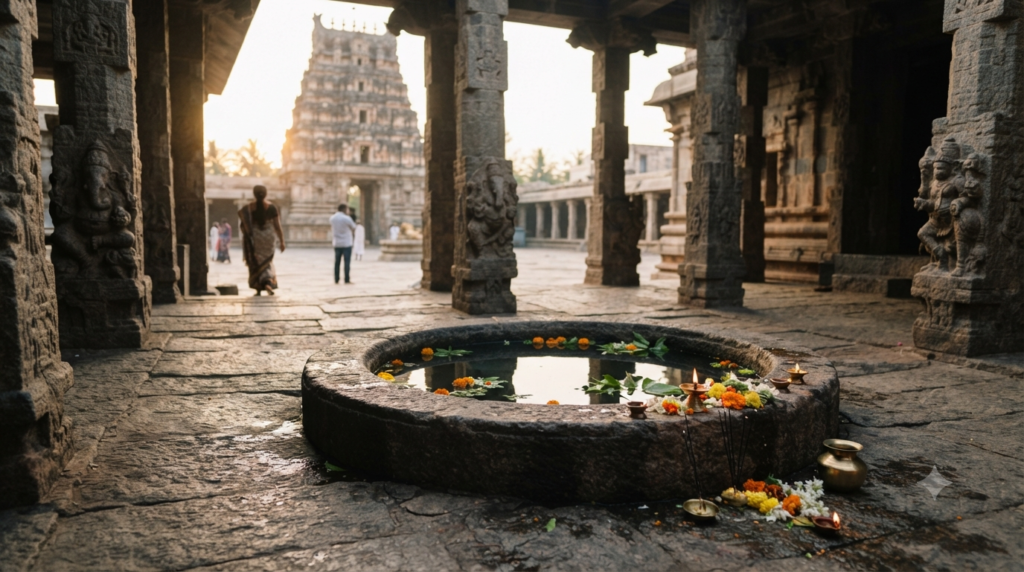
Kanipakam Temple history begins with a local origin legend and continues through nearly a millennium of recorded royal patronage. The shrine is famous for a swayambhu, or self-manifested, form of Lord Ganesha that remains in a water-filled well. Devotees also connect Kanipakam with the growing-idol belief and the long-standing Pramanam oath tradition.
Go Kshetra is an independent pilgrimage guide. We are not affiliated with Sri Kanipaka Devasthanam, and we do not accept darshan, seva, accommodation, donation, or other payments. Use the official Sri Kanipaka Devasthanam website for current temple services.
Kanipakam Temple history at a glance
The temple story has two layers that readers should keep separate. The first layer comes from sacred tradition, which explains how the deity appeared in a farm well. The second is datable history, which records Chola construction and later Vijayanagara expansion.
- Presiding deity: Sri Varasiddhi Vinayaka Swamy, worshipped as a swayambhu form of Ganesha.
- Origin tradition: three brothers discovered the deity while deepening a well used for irrigation.
- Historic temple phase: government tourism sources place early construction in the 11th century under Kulottunga Chola I.
- Later expansion: the shrine received major Vijayanagara patronage, with a commonly cited expansion in 1336 CE.
- Living belief: devotees believe the murti has gradually increased in visible size.
- Distinctive custom: Kanipakam remains strongly associated with Pramanam, a solemn oath made before the deity.
This distinction matters because faith claims and historical claims answer different questions. One explains why devotees regard the shrine as sacred, while the other shows how the temple developed over time. Kanipakam Temple history becomes clearer when those two layers stay separate.
Kanipakam Temple history: the three-brothers origin story
The best-known Kanipakam origin story centres on three brothers who were mute, deaf, and blind. They depended on a small agricultural holding, so water from their well was essential. When the water level fell, one brother entered the well to deepen it.
According to the legend recorded by the Chittoor District administration, his tool struck a hard object. Blood then appeared in the well, and the legend says the event restored the brothers’ lost abilities. Villagers gathered at the site and found the form of Ganesha within the well.
The villagers tried to excavate further, yet tradition says they could not find the base of the deity. Kanipakam Temple history therefore starts in an agricultural landscape rather than a royal court. The murti therefore remained where it had appeared. That water-filled setting still defines the temple’s identity today.
What does swayambhu mean at Kanipakam?
Swayambhu means “self-manifested.” In temple tradition, the term describes a sacred form believed to have appeared naturally rather than one carved and installed by people. At Kanipakam, devotees apply the term to Sri Varasiddhi Vinayaka because tradition says the murti emerged in the well.
The current temple website also describes the deity as swayambhu and says the original well still exists. It notes that the temple gives devotees water from the well as theertham, or sacred water.
Recorded Kanipakam Temple history after the legend
Datable history begins later than the sacred origin story. Kanipakam Temple history becomes easier to date once royal patronage enters the record. The Government of India tourism portal states that Kulottunga Chola I built the temple in the early 11th century CE. It also records a major Vijayanagara expansion in 1336 CE.
That sequence is more useful than saying one ruler “built the whole temple.” South Indian temples often developed in stages, so later dynasties could enlarge an older sacred site. Kanipakam should therefore be understood as a shrine whose religious origin tradition predates the surviving historical construction narrative.
The temple has also seen modern reconstruction and renewal. The present Devasthanam website reports a major reconstruction project and Kumbhabhishekam-related reopening activity. Those works belong to the temple’s continuing institutional history rather than its ancient origin.
Who built Kanipakam Temple?
Government tourism material credits Kulottunga Chola I with the early 11th-century temple construction. Vijayanagara rulers later expanded the shrine, with 1336 CE commonly given for that phase. So the most accurate short answer is that Kanipakam developed under more than one period of patronage.
This wording avoids a common online mistake. Readers should not combine the sacred site, first structural temple, later additions, and modern reconstruction into one building event.
Why is the Ganesha idol still in a well?
The well is not a later decorative feature. Tradition places it at the centre of the shrine before the later structural temple took shape. It is central to the Kanipakam origin legend because devotees believe the swayambhu murti appeared there. Government and temple sources still describe the deity as seated in the water-filled well.
That continuity gives Kanipakam an unusual ritual geography. The sanctum does not simply preserve an image of the story; it preserves the place where the story says the manifestation occurred. For many pilgrims, that connection makes darshan feel inseparable from the origin narrative.
Theertham from the sacred water has devotional importance. However, no guide should present sacred water as a medical treatment. There is no sound basis for replacing medical care with temple water, ritual, or any other faith practice.
Why do devotees believe the Kanipakam idol is growing?
The growing-idol tradition is one of Kanipakam’s best-known beliefs. This part of Kanipakam Temple history belongs to living devotion rather than measurable chronology. The official temple website says devotees believe Sri Vinayaka’s form increases in size. India’s tourism portal also notes the belief and mentions an older silver armour that is said to no longer fit.
It is better to describe this as a living religious belief, not as a scientifically proven physical measurement. That distinction protects both accuracy and the integrity of the tradition. Devotees may regard the change as miraculous, while a factual guide should not claim scientific confirmation that does not exist.
The belief also explains why descriptions often mention which parts of the murti are visible above the water. Those observations belong to devotional tradition and temple narration, so readers should treat them in that context.
Kanipakam Temple history and the Pramanam tradition
Kanipakam is also associated with truth-taking oaths known as Pramanam. The current official daily schedule still lists a Pramanam period, which shows that the custom remains part of temple life. Devotees traditionally regard Sri Varasiddhi Vinayaka as a witness to solemn statements and disputes.
A Tirumala Tirupati Devasthanams publication describes the deity as “Satya Pramaanaala Devudu,” meaning a deity associated with truthful oaths. It explains that people have historically come to swear before the Lord when disputes arise. This is a religious and social custom, not a substitute for a court process.
If you plan to participate, use the temple’s current instructions rather than old blog claims. Our dedicated Kanipakam Pramanam guide explains the visitor-facing procedure and points readers back to official channels.
What does the name Kanipakam mean?
A Government of India tourism event page gives a traditional explanation of the place-name. It says “Kani” refers to one-and-a-quarter measure of land, while “Pakam” refers to the flow of water used for irrigation. The explanation fits the agricultural setting of the origin story.
This is best treated as the official tourism explanation rather than a settled linguistic proof. Place-name meanings can acquire folk interpretations over centuries. Still, the water-and-field theme closely matches the local memory of the shrine’s discovery.
Powers and benefits linked with Kanipakam Vinayaka
Devotees approach Sri Varasiddhi Vinayaka with the same broad hopes often associated with Lord Ganesha: removal of obstacles, a clear beginning, wisdom, and success in sincere efforts. At Kanipakam, the truth-oath tradition adds a special emphasis on honesty, accountability, and resolving disputes.
| Devotional association | How devotees understand it | Important caution |
|---|---|---|
| Obstacle removal | Prayer before a new venture, journey, study, or family event | A matter of faith, not a guaranteed outcome |
| Truth and justice | Linked with Pramanam and solemn vows before Vinayaka | Not a replacement for legal advice or court procedure |
| Learning and new beginnings | Families seek blessings before education or important milestones | Spiritual support does not replace practical preparation |
| Health-related prayers | Some devotees pray for wellbeing because of the origin legend | Rituals and theertham are not medical cures |
Faith becomes misleading only when a guide presents belief as certainty. A careful guide can respect the temple’s traditions while making clear that no one can promise, measure, or medically guarantee spiritual benefits.
What common Kanipakam Temple claims need correction?
Older pages often blend temple tradition, travel advice, and miracle claims into one block. A careful reading of Kanipakam Temple history avoids that problem. This blending makes it hard to see what comes from government records, what comes from temple tradition, and what is simply repeated online. Four corrections are especially useful.
- “The idol is proven to grow.” The temple and tourism sources describe a strong belief in growth, but that is not the same as independent scientific proof.
- “The sacred water cures illness.” The origin legend includes miraculous healing, yet modern readers should not treat theertham as medical treatment.
- “One king built the entire temple.” Sources point to Chola construction, later Vijayanagara expansion, and modern reconstruction.
- “Any booking link or WhatsApp number is official.” Use only the current Devasthanam website for transactions because old third-party instructions can become unsafe or outdated.
These corrections do not weaken the devotional story. Instead, they separate belief from verifiable history, which makes the article more trustworthy for pilgrims and researchers alike.
How the temple story shapes a visit today
The origin legend still changes how many devotees understand the shrine. Darshan focuses attention on the swayambhu form within the well, while theertham recalls the water at the heart of the discovery story. Pramanam connects that sacred narrative with a living practice centred on truth.
For practical planning, keep history and logistics separate. Use our Kanipakam Temple complete guide for current darshan and seva planning. If transport is your main concern, the Kanipakam route guide covers the road, rail, and airport approach.
Before paying for any temple service, verify the live details on the official Devasthanam website. Timings, quotas, seva availability, and fees can change, while the historical material in this article is largely evergreen.
Why Kanipakam Temple history still matters
Kanipakam endures because its history is not only a date-and-dynasty timeline. The temple links an agricultural origin legend, a living water-filled sanctum, medieval patronage, a growing-idol belief, and a truth-oath custom in one place. Few Ganesha temples combine those threads so clearly.
The strongest way to understand the shrine is to hold two ideas together. Seen this way, Kanipakam Temple history respects both devotion and verifiable chronology. Its legends explain devotion and meaning, while government and institutional sources help establish the historical framework. Neither needs to erase the other.
For visitors, that makes the temple more than a stop on a Chittoor itinerary. The story explains why the well matters, why truth is central to local devotion, and why Sri Varasiddhi Vinayaka has such a distinct identity in Andhra Pradesh.
Frequently asked questions
What is the Kanipakam Temple origin story?
The traditional story says three brothers discovered a Ganesha form while deepening their irrigation well. Their tool struck a hard object, blood appeared, and the legend says the event restored their lost abilities. Villagers then found the swayambhu form in the well and could not locate its base.
How old is Kanipakam Temple?
Government tourism sources place the structural temple’s early construction in the 11th century under Kulottunga Chola I. Temple tradition places the sacred origin legend earlier than that construction phase. The shrine therefore combines a traditional origin account with a datable medieval temple history.
Who built Kanipakam Temple?
Government tourism material credits Kulottunga Chola I with early 11th-century construction. Vijayanagara rulers later expanded the temple, with 1336 CE commonly cited for that phase. Modern reconstruction has also changed parts of the complex, so no single building episode explains the temple seen today.
Is the Kanipakam Ganesha idol really growing?
Devotees strongly believe the swayambhu murti has increased in size, and official tourism material repeats the silver-armour tradition. However, a factual guide should describe this as a religious belief rather than a scientifically established measurement. The distinction is important when discussing miracle claims.
Why is the Kanipakam Vinayaka idol inside a well?
The well is the place where the origin legend says the swayambhu deity appeared. Temple and government sources still describe the murti as remaining in the water-filled well. That makes the well part of the shrine’s core identity, not a later decorative addition.
What is Pramanam at Kanipakam?
Pramanam is a solemn oath tradition associated with Sri Varasiddhi Vinayaka as a witness to truth. The official temple schedule still includes a Pramanam period. The practice has religious and social meaning, but readers should not treat it as a replacement for legal procedure.
What benefits do devotees seek at Kanipakam?
Devotees commonly pray for obstacle removal, wisdom, success in new beginnings, family wellbeing, and clarity in difficult situations. Kanipakam’s Pramanam tradition also gives the shrine a special association with truth. These are matters of faith, so no one can guarantee a particular outcome.
Does Kanipakam theertham cure diseases?
No medical evidence supports a claim that temple theertham cures disease. Devotees treat the water as sacred within temple tradition, and the origin legend includes miraculous healing. Still, anyone with a health problem should use appropriate medical care and treat theertham as a devotional practice only.
What is the meaning of Kanipakam?
A Government of India tourism page explains “Kani” as one-and-a-quarter measure of land and “Pakam” as the flow of irrigation water. That interpretation fits the agricultural setting of the temple legend. It is best understood as a traditional place-name explanation rather than definitive linguistic proof.