
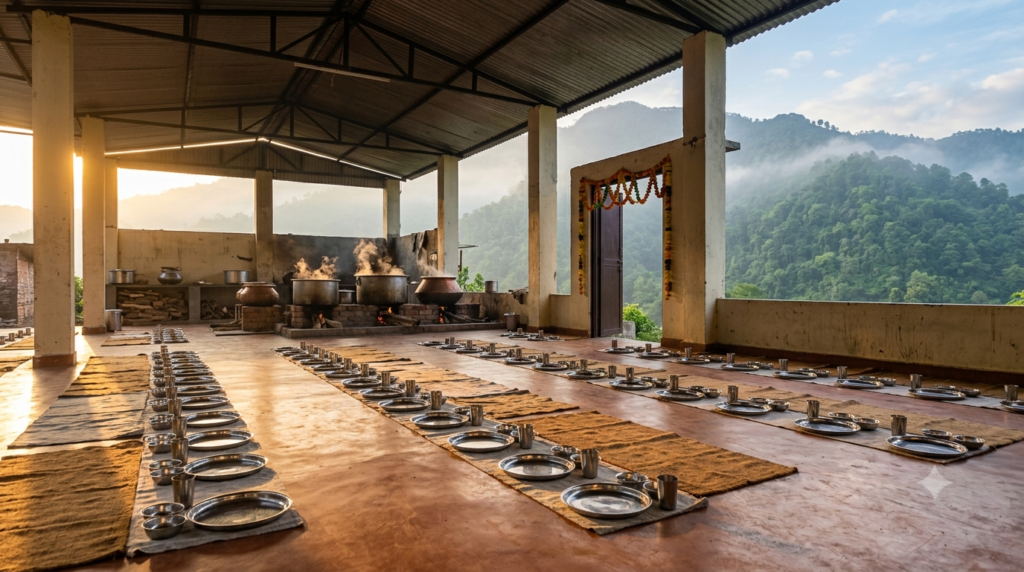
The Gulshan Kumar Langar is a free community kitchen at Banganga in Katra, right where the 13 km trek to the Vaishno Devi shrine begins. Every pilgrim can eat here at no cost, because the T-Series family runs it as pure seva, or selfless service. If you want the exact timings, the precise location, and the rules to follow inside, this guide covers all of it. It also corrects a location error that many websites still repeat.
Quick Facts About the Langar
- What: Free vegetarian meals for all Vaishno Devi pilgrims, started by T-Series founder Gulshan Kumar.
- Where: Banganga, Katra — at the start of the trek route, just after the yatra check post.
- Timings: Daily, from about 6:00 AM to late evening; hours stretch longer during Navratri rush.
- Cost: Completely free. Donations are optional, never demanded.
- Run by: The family of late Gulshan Kumar through the T-Series charitable setup, since the 1990s.
What Is the Gulshan Kumar Langar?
The Gulshan Kumar Langar is a free bhojanalaya, or community food hall, that serves simple vegetarian meals to Vaishno Devi pilgrims at Banganga in Katra. Gulshan Kumar, the founder of the T-Series music label, started it in the early 1990s. His family has kept it running every single day since his death, so no yatri begins the climb hungry.
The word langar comes from the Sikh tradition of free community kitchens, where everyone eats together as equals. This langar follows the same spirit, because food here is served without any question of caste, class, or religion. Thousands of pilgrims eat here daily, while the number swells into tens of thousands during Navratri.
Gulshan Kumar Langar Timings at Vaishno Devi
The Gulshan Kumar Langar opens daily at around 6:00 AM and serves food until late evening, usually up to about 10:00 PM. During heavy-rush periods such as Chaitra and Sharad Navratri, the kitchen often runs almost round the clock. There is no fixed closing bell, since service depends on the crowd that day.
A practical point matters here. The langar serves continuously through the day, so you do not need to arrive at a fixed lunch or dinner slot. However, the queue is shortest between 11:00 AM and 12:30 PM, before the big afternoon batches of pilgrims start the trek. Timings can shift without notice on rare days, so treat the hall as a reliable but not guaranteed stop.
Best Time to Eat Before the Trek
Eat a moderate meal here 20–30 minutes before you start climbing, because a heavy stomach makes the first steep stretch to Charan Paduka harder. Many experienced yatris eat half a plate at the langar and carry dry snacks for the route. Night trekkers should eat by 9:00 PM, since options thin out after that.
Where Is the Gulshan Kumar Langar Located?
The Gulshan Kumar Langar stands at Banganga, the official starting point of the Vaishno Devi trek in Katra, Jammu and Kashmir. You reach it within the first kilometre of the route — walk from the Darshani Deodi gate, cross the yatra access check post, and the langar building appears on the track near the Banganga bridge. The new Tarakote Marg route also branches off right next to this langar point.
Several websites wrongly state that this langar sits at Manokamna Bhawan or up at the main Bhawan. That is incorrect. The Gulshan Kumar Langar is at Banganga at the base of the trek, while the Shri Mata Vaishno Devi Shrine Board (SMVDSB) runs its own separate free langar facility on the Tarakote Marg. Knowing the difference saves you from skipping a meal stop you cannot get back, because the next free food point comes much later on the climb.
How to Reach the Langar from Katra
From Katra bus stand or railway station, the Banganga entry point is about 1.5–2 km away. Auto-rickshaws drop you near Darshani Deodi for roughly ₹50–₹100, or you can walk it in 20–25 minutes. Carry your RFID yatra card, since the check post before the langar will not let anyone through without it. You can get this free card at the Katra registration counters or through the official SMVDSB website.
What Food Does the Langar Serve?
The langar serves a simple, fresh, sattvik vegetarian meal — typically dal, rice, roti, and a seasonal vegetable curry, with halwa or kheer added on festive days. The menu changes slightly by season and supplies, so no two days are identical. Everything is cooked in bulk on-site, and volunteers serve it hot in pangat style, where pilgrims sit in rows and eat together.
Do not expect restaurant variety, because that is not the point. The food is designed to be light, hygienic, and energy-giving for a 13 km uphill walk. Tea and drinking water are also available at most times.
Gulshan Kumar Langar Rules Every Pilgrim Must Follow
The Gulshan Kumar Langar runs on discipline and respect, so a few simple rules apply to everyone. None of them are harsh, yet following them keeps the hall running smoothly for thousands of people a day.
- Queue discipline: Join the line and wait your turn. Volunteers manage entry in batches when the rush is heavy.
- Sit and eat: Meals are eaten seated inside the hall, in rows. Taking plates outside is discouraged.
- No wastage: Take only what you can finish. You can always ask for a second serving, so never pile the plate.
- Footwear off: Remove shoes before entering the dining area, as in any religious kitchen.
- Cleanliness: Deposit your used plate at the counter and keep the area clean.
- No payment, no pressure: The meal is free. If you wish to donate, use the official donation counter only — never hand cash to individuals.
- No alcohol, tobacco, or non-veg items anywhere on the premises or the yatra track.
Can You Volunteer or Donate?
Yes, pilgrims can offer seva at the langar, such as serving food, rolling rotis, or cleaning. Speak to the supervisor at the hall, because volunteer slots depend on the day’s need. Donations are accepted at the counter with a proper receipt. Treat any person collecting money on the track in the langar’s name as a scam, since the langar never sends collectors out.
How to Eat at the Langar: Step-by-Step
- Complete yatra registration in Katra and collect your RFID card.
- Enter the trek route through Darshani Deodi and clear the Banganga check post.
- Spot the langar hall on the track near the Banganga bridge — large boards mark it clearly.
- Remove footwear and join the queue at the entry.
- Take a plate, sit in the row, and volunteers will serve you.
- Finish your food, return the plate at the counter, and continue the climb.
The whole stop takes 20–40 minutes depending on the crowd. During Navratri, budget up to an hour, because queues stretch long in the evenings.
The Story Behind the Langar
Gulshan Kumar rose from running a fruit-juice shop in Delhi to building T-Series into India’s biggest music company. He was a devoted believer of Mata Vaishno Devi and credited his success to her, so he started this free kitchen at Banganga in the early 1990s. After his murder in Mumbai on 12 August 1997, his family — including his son Bhushan Kumar and daughter Tulsi Kumar — continued the seva without a break.
The langar has now fed pilgrims for over three decades. In fact, it ran for years as the only large free food point on the route, and pilgrims publicly cited it when demanding that the Shrine Board start its own langar — which SMVDSB eventually did on the Tarakote route.
Free and Paid Food Options on the Vaishno Devi Route
The langar at Banganga is your first food stop, but not the only one. Here is how it compares with what lies ahead on the route.
| Food Point | Location | Cost |
|---|---|---|
| Gulshan Kumar Langar | Banganga (trek start) | Free |
| SMVDSB Langar | Tarakote Marg | Free |
| Shrine Board Bhojanalayas | Adhkuwari, Sanjichhat, Bhawan | Paid, subsidised |
| Private stalls | All along the track | Paid |
In plain terms: you get free food at Banganga and on the Tarakote Marg, while every stop after that charges money. The Shrine Board bhojanalayas at Adhkuwari, Sanjichhat, and the Bhawan sell fixed-rate vegetarian meals, so they remain affordable. If you plan to stay overnight near the shrine, check our guide to Manokamna Bhawan room booking as well.
What Most Pilgrims Get Wrong
A few mistakes repeat every season, so learn from them before you go.
- Skipping the langar to “save time”: The next affordable hot meal is at Adhkuwari, about 6 km uphill. Many regret skipping Banganga by the halfway mark.
- Confusing the two langars: The Gulshan Kumar Langar is at Banganga on the classic route, while the Shrine Board langar sits on the Tarakote Marg. If you take one route, you pass only one of them.
- Overeating before the climb: A heavy meal plus a steep gradient is a bad mix. Eat light, then snack on the way.
- Carrying plates out: Volunteers will stop you, because the sit-and-eat rule is firm.
- Arriving after midnight expecting food: Outside peak season, service winds down by late evening. Night trekkers should eat early or carry food.
Elderly pilgrims or those with knee trouble can pair the langar stop with an easier ascent. After eating at Banganga, walk to Adhkuwari and use the Vaishno Devi battery car for the upper stretch.
Before You Begin the Climb
The Gulshan Kumar Langar gives every yatri a free, hot, simple meal exactly where the journey starts — at Banganga in Katra. Reach it between 6:00 AM and late evening, follow the queue and no-wastage rules, and eat light before the trek. Remember that it sits at the base, not at the Bhawan, so plan your route food stops around it. For the full yatra picture, read our complete Vaishno Devi temple guide and verify current yatra advisories on the Shrine Board website before travel.
Frequently Asked Questions
Is the Gulshan Kumar Langar free for everyone?
Yes, the meal is completely free for every pilgrim, with no ticket, coupon, or registration needed beyond your yatra RFID card for the track itself. Donations are voluntary and accepted only at the official counter.
What are the Gulshan Kumar Langar timings?
The langar serves food daily from about 6:00 AM until late evening, around 10:00 PM. During Navratri and other peak periods, service often continues almost round the clock, although exact hours can change with crowd and weather.
Where exactly is the langar on the Vaishno Devi route?
It stands at Banganga in Katra, within the first kilometre of the trek, just after the yatra check post near the Banganga bridge. It is not at Manokamna Bhawan or the main Bhawan, despite what some websites claim.
What food is served at the langar?
Expect a simple vegetarian meal of dal, rice, roti, and a vegetable curry, with halwa or kheer on festive days. Tea and drinking water are also available. The menu varies slightly by season.
Who runs the Gulshan Kumar Langar now?
The family of late T-Series founder Gulshan Kumar runs it, and they have done so continuously since his death in 1997. The Shrine Board does not operate this langar; SMVDSB runs its own separate langar on the Tarakote Marg.
Can I volunteer at the langar?
Yes, pilgrims can do seva such as serving food or cleaning, subject to the day’s requirement. Ask the supervisor at the hall when you arrive, because slots are informal and crowd-dependent.
Is there free food higher up on the trek?
Only on the Tarakote Marg, where the Shrine Board runs its langar. On the classic route beyond Banganga, food at Adhkuwari, Sanjichhat, and the Bhawan comes from paid but subsidised Shrine Board bhojanalayas and private stalls.
Do I need my RFID yatra card to reach the langar?
Yes. The langar sits past the Banganga check post, so you must carry the free RFID yatra card issued at Katra registration counters or online via the SMVDSB website.