
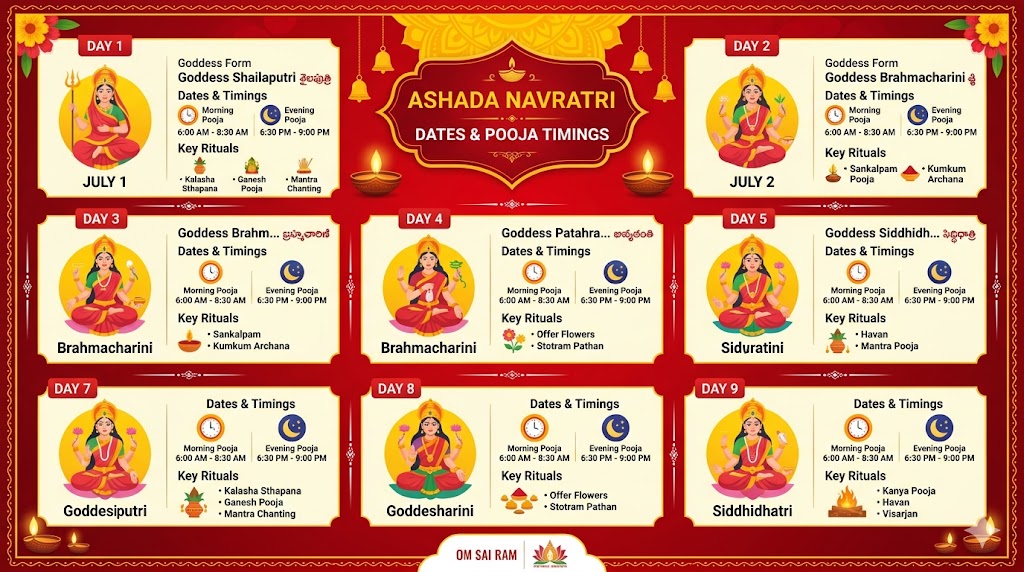
Ashada Navratri Dates & Pooja Timings are essential for devotees who wish to observe this spiritually powerful festival with proper rituals and discipline. Ashada Navratri is celebrated during the Ashada month (June–July) and is dedicated to Goddess Durga and her nine divine forms. Although less popular than Sharad Navratri, this Navratri holds immense significance for spiritual seekers, especially those interested in meditation, tantra sadhana, and inner transformation. Therefore, knowing the correct Ashada Navratri Dates & Pooja Timings helps devotees perform rituals at the most auspicious moments and receive maximum blessings. Moreover, each day of this nine-day festival is associated with a specific form of Goddess Durga, symbolising strength, wisdom, and protection. In addition, following the proper pooja vidhanam, fasting rules, and daily rituals enhances spiritual energy and mental clarity. This complete guide provides detailed dates, timings, rituals, significance, and practical tips so you can observe Ashada Navratri with devotion and accuracy.
Ashada Navratri Dates & Pooja Timings
📅 Ashada Navratri Dates & Pooja Timings – Complete Festival Schedule
Ashada Navratri occurs during the lunar month of Ashada and usually falls between June and July. Therefore, understanding the full schedule helps you plan your pooja properly.
🗓️ 9-Day Ashada Navratri Schedule
| Day | Tithi | Goddess Form | Spiritual Meaning |
|---|---|---|---|
| Day 1 | Pratipada | Shailaputri | Strength & Stability |
| Day 2 | Dwitiya | Brahmacharini | Devotion & Discipline |
| Day 3 | Tritiya | Chandraghanta | Courage |
| Day 4 | Chaturthi | Kushmanda | Energy & Creation |
| Day 5 | Panchami | Skandamata | Motherhood |
| Day 6 | Shashti | Katyayani | Power |
| Day 7 | Saptami | Kalaratri | Protection |
| Day 8 | Ashtami | Mahagauri | Purity |
| Day 9 | Navami | Siddhidatri | Blessings & Fulfilment |
👉 However, exact dates vary yearly based on the Hindu Panchang.
⏰ Ashada Navratri Pooja Timings (Detailed)
Following the right Ashada Navratri Dates & Pooja Timings is very important for spiritual benefits.
🔔 Daily Pooja Timings:
- Morning: 6:00 AM – 9:00 AM
- Evening: 6:00 PM – 8:00 PM
🪔 Ghatasthapana Muhurat:
- Performed on Day 1 (Pratipada)
- Best done during early morning
- Avoid Rahu Kalam and inauspicious periods
👉 Therefore, starting pooja at the correct time enhances positive energy.
🪔 Step-by-Step Ashada Navratri Pooja Procedure
Performing pooja correctly ensures divine blessings. Hence, follow this structured process.
🧹 Step 1: Clean and Prepare Home
Firstly, clean your house thoroughly. Moreover, decorate the pooja area with rangoli and flowers to invite positivity.
🪙 Step 2: Kalasha Sthapana
- Place a Kalash filled with water
- Add mango leaves and coconut
- Apply turmeric and kumkum
👉 This symbolises the presence of Goddess Durga.
🔥 Step 3: Sankalpam
Take a vow to perform pooja for nine days with devotion and discipline.
🌺 Step 4: Daily Pooja Rituals
- Light diya and incense sticks
- Offer flowers and kumkum
- Chant Durga mantras
- Perform aarti
🍎 Step 5: Naivedyam
Offer fruits, sweets, and sattvic food daily.
🧾 Ashada Navratri Pooja Samagri List
Having all items ready makes pooja smooth and organised.
Essential Items:
- Kalash and coconut
- Mango leaves
- Turmeric, kumkum, sandalwood
- Flowers and garlands
- Diya, oil/ghee, cotton wicks
- Incense sticks and camphor
- Fruits and sweets
- Rice (Akshata)
- Betel leaves and nuts
🌟 Spiritual Significance of Ashada Navratri
Ashada Navratri is considered highly powerful for spiritual growth. Therefore, many devotees use this time for deep meditation and sadhana.
Key Significance:
- Enhances inner strength and discipline
- Helps remove negative energies
- Improves focus and mental clarity
- Supports spiritual awakening
- Attracts divine protection
Moreover, this Navratri is particularly important for tantric practices and advanced spiritual rituals.
🧘 Fasting Rules During Ashada Navratri
Fasting plays a significant role in this festival. However, it is optional and depends on individual capacity.
Common Fasting Practices:
- Eat fruits, milk, and vrat-friendly food
- Avoid onion, garlic, and non-vegetarian food
- Drink plenty of water
- Maintain a sattvic diet
👉 Therefore, fasting helps purify the body and mind.
📿 Daily Worship Tips for Each Day
To maximise benefits, focus on each goddess daily:
- Day 1: Pray for strength
- Day 2: Focus on discipline
- Day 3: Seek courage
- Day 4: Ask for energy
- Day 5: Pray for family well-being
- Day 6: Seek power and success
- Day 7: Protection from negativity
- Day 8: Purity and peace
- Day 9: Fulfilment of desires
⚠️ Common Mistakes to Avoid
Avoid these mistakes to ensure effective pooja:
- Ignoring proper timings
- Skipping daily rituals
- Using stale flowers or food
- Breaking fasting discipline
- Lack of concentration
✅ Important Tips for Devotees
- Perform pooja at the same time daily
- Maintain cleanliness and discipline
- Use fresh pooja items
- Keep mind calm and focused
- In addition, involve family members
📊 Benefits of Observing Ashada Navratri
| Benefit | Result |
|---|---|
| Spiritual Growth | Inner peace |
| Protection | Removes negativity |
| Prosperity | Attracts blessings |
| Discipline | Improves focus |
| Mental Clarity | Better decision-making |
👉 Consequently, this festival helps in both spiritual and personal growth.
🧭 Who Should Observe Ashada Navratri?
This Navratri is ideal for:
- Spiritual seekers
- Students preparing for exams
- Business owners seeking growth
- Individuals facing life challenges
- Devotees of Goddess Durga
❓ FAQ – Ashada Navratri Dates & Pooja Timings
1. When is Ashada Navratri celebrated?
It falls in June–July based on the Hindu calendar.
2. Is fasting compulsory?
No, fasting is optional but beneficial.
3. Can I perform pooja at home?
Yes, it can be done easily at home.
4. What is Ghatasthapana?
It is the Kalash स्थापना ritual on Day 1.
5. What should be offered as prasadam?
Fruits, sweets, and sattvic food.
6. Is Ashada Navratri powerful?
Yes, it is considered highly powerful for spiritual practices.
7. Can working people follow this Navratri?
Yes, simple daily pooja can be performed.
🔗 External Official Links
Important Tips for Visitors
- Book accommodation well in advance — rooms fill up quickly during festival season.
- Check the exact festival dates on the official temple website as lunar calendar dates may shift.
- Be prepared for long queues and allocate extra time for darshan during festivals.
- Carry sufficient cash — ATMs near temple towns may run out during peak festival periods.