
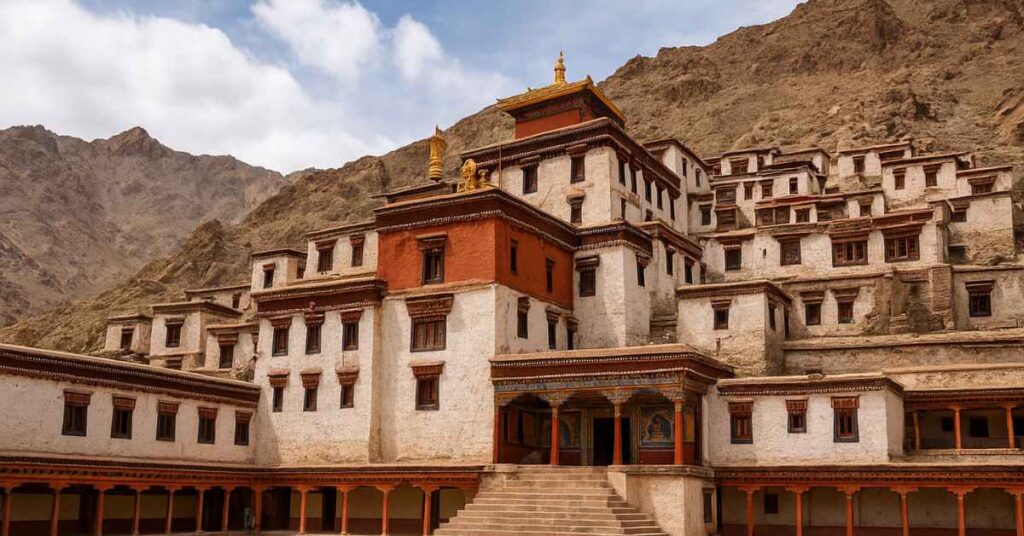
Discover Hemis Monastery in Ladakh — its ancient roots, Drukpa lineage, festival highlights, travel tips and spiritual essence in the Himalayas.
High in the stark but majestic mountains of the Indian Himalayas, the Hemis Monastery stands as an enduring beacon of Buddhist devotion, history and culture. Located in the remote region of Ladakh, this sacred seat of the Drukpa lineage offers an immersive pilgrimage beyond the ordinary. In this blog we explore 7 spiritual gems of Hemis Monastery — its ancient origins, significance, architecture, festival life, travel advice and deeper contemplative meaning.
Key Information at a Glance
- Timings: to VisitYear-round (check festivals)
Quick Facts
Location: Hem
- Entry/Ticket: for Hemis Monastery?A1
- Location: in the remote region of Ladakh, this sacred seat of the Drukpa lineage offers an
Quick Information
| Detail | Information |
|---|---|
| Location | Hemis |
| Timings | See detailed timings below |
| Online Booking | Available (see guide) |
| Entry Fee | See pricing section |
| Best Time to Visit | Year-round (check festivals) |
Quick Facts
- Location: Hemis village, Leh district, Ladakh, India — about 40-45 km from Leh town.
- Lineage: Belongs to the Drukpa (Drukpa Kagyupa) lineage of Tibetan Buddhism.
- Founded / Re-established: While the site is believed to have roots before the 11th century, the monastery was formally re-established in the 17th century under King Sengge Namgyal.
- Elevation: Roughly around 3,500 metres above sea level.
- Annual Festival: The famous Hemis Festival (Hemis Tsechu) with masked dances, ritual, and sacred thangka displays.
1. Ancient Origins & the Drukpa Seat
- Hemis Monastery’s history is wrapped in legends and enduring tradition. Although there was some monastic presence in the valley before the 11th century, the present institution owes much to the 17th-century revival under King Sengge Namgyal and the master Stagsan Raspa.
- The Drukpa lineage (also called the Dragon Line) established Hemis as one of its major seats, tying together spirituality and local Ladakhi royalty.
- Spiritual Tip: Reflect on how sacred centres often arise where geography, culture and devotion align — here in the remote Himalayas, the monastery becomes a bridge between earth and sky.
2. Architecture, Art & Sacred Space
- The monastery’s architecture adapts to its high-altitude Himalayan environment: thick walls, flat roofs, stone and mud-brick construction using local materials.
- Inside, there are assembly halls (dukhang), sanctuaries, murals, thangkas, ancient Buddhist artefacts and art spanning centuries. One of its distinguishing features is the collection of murals and thangkas.
- Travel Tip: Allow at least 1-2 hours to explore the art halls, savour the detailed murals and take in the courtyard views.
3. The Hemis Festival – A Living Tradition
- Each year the Hemis Festival draws devotees, monks and visitors into a spectacle of ritual dances (cham), music, costumes and spirituality. The core of the festival honours Guru Padmasambhava and features masked dance-dramas symbolising the victory of compassion over ignorance.
- On festival days, the multi-storey thangka — a massive scroll-painting — may be unfurled (once in 12 yrs in certain cycles) marking a special event.
- Visitor Tip: If you time your visit with the festival (usually in June/July), book accommodation early; expect higher crowds and an extraordinary spiritual-cultural experience.
4. Why Hemis Matters for Pilgrims
- The remote location offers a heightened sense of “coming away” from everyday life.
- The Drukpa lineage emphasises meditation, tantric ritual and mindfulness; the monastery retains these living practices.
- The setting in Ladakh — with stark mountains and the Indus valley below — invites reflection on impermanence and vastness.
- Contemplative Practice: Sit in the courtyard at dawn, feel the thin air, the silence of the mountains and evoke the mantra Om Ah Hum — letting the mind expand beyond the visible peaks.
5. Practical Travel & Pilgrimage Tips (Especially from South India)
- Since you are located in Andhra Pradesh (Tirupati region), a journey to Hemis may be longer, yet deeply rewarding.
How to Reach:
- Fly into Leh (via Delhi) and then drive ~45 km to Hemis.
- Best season: May to September (winter is harsh above 3,000 m).
- Acclimatise in Leh for 1-2 days before venturing to Hemis.
What to Bring:
- Warm layers, even in summer — mornings/evenings can be chilly.
- Good walking shoes.
- Respectful dress (modest, covering shoulders/legs).
- Water, sunscreen, sunglasses for high altitude glare.
Etiquette:
- Show respect in the prayer halls: walk clockwise around stupas, keep noise low.
- Photography may be restricted in sanctum areas — ask when unsure.
- Support local Ladakhi vendors (tea, yak butter-tea, souvenirs) and local stay.
- 6. Nearby Spiritual & Nature Highlights
- The valley around Hemis lies close to Hemis National Park — unique high-altitude ecology where snow-leopards roam.
- From Hemis you can explore other monasteries and villages, giving a fuller pilgrim circuit of Ladakh’s sacred geography.
7. FAQs
- Q1. Is there an entry fee for Hemis Monastery?
A1. Yes — as per reviews there is a nominal fee (e.g., around INR 50) for visitors.
Q2. Can non-Buddhists visit?
A2. Yes — the monastery welcomes visitors of all backgrounds, as long as they respect the sanctity.
Q3. When is the best time to visit?
A3. Summer months (May to September) are ideal. Winter travel is challenging above 3,000 m altitude.
Q4. How long should one stay?
A4. For a meaningful visit: stay in Hemis or nearby Leh for 1-2 nights; spend half a day at the monastery plus time absorbing the environment.
Q5. What is the height and altitude effect?
A5. Located above ~3,000 m; altitude acclimatisation is needed to avoid mountain sickness. - Hemis Monastery is more than a tourist stop — it is a living shrine where devotion, art, Himalayan geography and Buddhist wisdom converge. For the pilgrim or seeker, each step up the valley road is also a step inward. Whether you arrive for the masked dance spectacle of the Hemis Festival, or simply the silence of the high Himalayas, Hemis offers a sacred encounter. Prepare with respect, pace your journey, and let the mountain air open a doorway to inner stillness.
Usefull Links
- Ladakh Spiritual Pilgrimage Guide
- Top Monasteries of India
- Leh-Ladakh Travel Essentials for Pilgrims
- Hemis Monastery – Wikipedia
- Incredible India – Hemis Village
- Sahapedia – Hemis Monastery Article
Author Box
- Author: Gokshetra Blog Writer
Important Tips for Visitors
- Wear modest, traditional clothing — most temples require covered shoulders and knees.
- Arrive early morning for a peaceful darshan experience — most temples are less crowded before 8 AM.
- Photography may be restricted inside the main sanctum. Check with temple authorities before clicking pictures.
- Visit during weekdays for shorter queues. Weekends and festival days see significantly higher footfall.
Official Resources

Go Kshetra covers 1,600+ Hindu temples across 28 states. Content sourced from official temple websites and first-hand visits. About our editorial process